





When to Seek Shampoo Formulation Support for Foam, Mildness, or Stability Issues
Foam that collapses too quickly, cleansing that feels harsh, or formulas that separate over time are clear signals that shampoo formulation support may be needed. For technical evaluation teams, identifying the right intervention point is critical to balancing surfactant performance, sensory mildness, preservative compatibility, and long-term stability. This article outlines when external expertise can reduce development risk, improve efficiency, and help move a shampoo formula closer to market-ready performance.
In practice, most shampoo development problems do not begin as dramatic failures. They start as “almost acceptable” results: foam looks rich in the beaker but weak in consumer use, viscosity holds for two weeks then drifts, or a mildness claim is supported by ingredient selection but contradicted by scalp feedback. Technical teams often try to solve these issues internally by adjusting one variable at a time. That approach can work when the formula is simple and the performance target is modest. It becomes much less efficient when surfactant architecture, fragrance load, conditioning additives, preservatives, pH, electrolyte tolerance, packaging interaction, and regulatory constraints begin to influence one another at the same time.
That is the point where external formulation support is not a luxury but a risk-control measure.
Foam problems are often a sign of system imbalance, not just weak surfactants
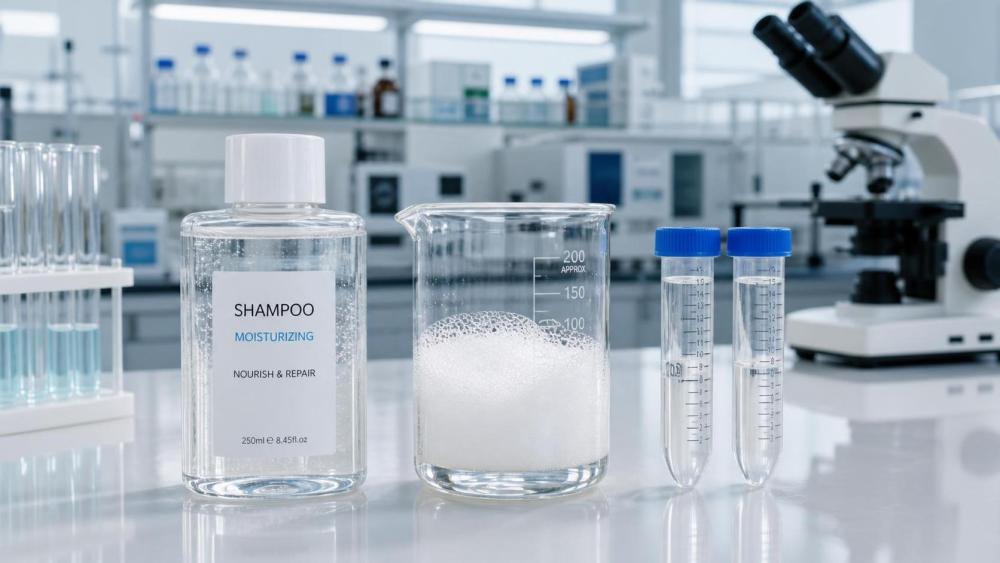
Foam is one of the most misunderstood shampoo performance markers. Technical teams know that consumer perception of cleansing is closely tied to lather volume, speed of foam generation, bubble texture, and how long foam survives during massage and rinse-off. Yet internal troubleshooting still often defaults to one assumption: if foam is weak, increase the primary surfactant or switch to a more aggressive one.
That can solve one problem while creating three others.
Low or unstable foam may come from several different sources:
- excessive oil, silicone, or botanical extract load suppressing foam generation;
- fragrance components interfering with surfactant packing;
- polyquaterniums or conditioning polymers reducing flash foam but improving wet combing;
- hard-water sensitivity in the intended market;
- electrolyte-driven viscosity adjustment pushing the surfactant system out of its optimal range;
- air incorporation during lab testing creating misleading bench results.
When these interactions are present, shampoo formulation support becomes valuable because the issue is no longer “which surfactant foams more,” but “which system can deliver acceptable foam under real-use conditions without undermining mildness, deposition, or stability.”
A technical evaluation team should consider bringing in outside expertise when foam complaints persist after two or three reformulation rounds, especially if each fix creates a new tradeoff. That pattern usually indicates the team is optimizing locally rather than at the system level.
It is also worth seeking support when the target market has specific usage realities. A shampoo intended for Southeast Asia, the Middle East, Latin America, or parts of Africa may face different rinsing habits, water hardness, climate exposure, and consumer expectations around foam richness. Bench success in one lab environment does not guarantee market success across regions.
Mildness issues usually appear after performance has already been over-optimized
Harshness in shampoo is rarely caused by a single “bad” ingredient. More often, it is the result of a formula that has been tuned too heavily toward cleansing power, degreasing speed, or dense foam aesthetics. A surfactant blend may look reasonable on paper and even include amphoteric or amino acid-based components, yet the finished formula still produces scalp tightness, eye sting, or cumulative dryness in repeated use.
Technical teams should be careful not to treat mildness as a claim-language issue. It is a formulation behavior issue.
External support is usually justified when any of the following happens:
- patch, salon, or informal user feedback repeatedly describes dryness or irritation;
- the formula passes basic stability work but fails sensory acceptance in extended use;
- the team is trying to move from mass-market sulfate systems toward sulfate-free or low-irritancy positioning without losing cleansing performance;
- conditioning agents are being increased simply to mask surfactant harshness;
- baby, sensitive scalp, anti-hair loss, or daily-use positioning raises the tolerance threshold for irritation.
These are not minor refinements. They involve core system redesign decisions.
For technical evaluators, the key question is whether mildness can still be improved through dosage adjustment, or whether the surfactant framework itself needs to be reconsidered. If the answer is unclear, outside formulation specialists can shorten the path by assessing irritation risk in relation to active surfactant matter, surfactant ratio, pH window, preservative choice, fragrance allergens, and polymer deposition behavior.
This is especially important when premium claims are involved. Many brands now want “mild,” “microbiome-friendly,” “sensitive scalp,” or “barrier-respecting” positioning. Some of these terms may carry marketing flexibility, but technical substantiation remains critical. Overpromising mildness while relying on a harsh cleansing backbone is a common formulation-commercial mismatch.
Stability problems are where hidden incompatibilities become expensive
Shampoo instability is often underestimated early in development because the product may look acceptable during short-term lab observation. Separation, haze shift, viscosity collapse, sedimentation, fragrance bloom, color drift, or preservative stress can emerge later under transport or climate stress. By the time this appears, packaging has often already been discussed, samples may have been sent, and launch timing may be under pressure.
That is when formulation support has the highest economic value.
Stability issues usually deserve external technical review when they involve one or more of the following:
- viscosity fluctuation across temperature cycles;
- loss of clarity in clear shampoos after adding fragrance or actives;
- pearlescent systems showing phase separation or settling;
- preservative efficacy concerns after introducing plant extracts, proteins, or fermentation-derived ingredients;
- incompatibility between cationic conditioning ingredients and anionic surfactants;
- pH drift over time;
- packaging interaction, including panel stress cracking or formula discoloration.
For technical evaluation teams, the real challenge is not identifying that instability exists. It is identifying which mechanism is driving it. A viscosity drop may be caused by salt curve mismanagement, but it may also result from fragrance solubilization limits, polymer collapse, microbial burden, or raw material variability. A separation issue may look like an emulsion problem even though the root cause is poor deposition aid compatibility.
External experts are particularly useful when instability appears only after the addition of “value-added” ingredients. Anti-dandruff actives, botanical extracts, proteins, silicones, exfoliating acids, and natural fragrances can all complicate systems that were originally robust in a simpler base. This is common in projects where marketing upgrades the concept faster than formulation architecture is updated.
Repeated bench rework is a signal that internal resources are being used inefficiently
Not every technical problem requires outside help. Skilled in-house chemists can solve many shampoo issues if the brief is stable, the ingredient toolbox is familiar, and the performance target is realistic. The decision to seek shampoo formulation support becomes more compelling when project economics start to deteriorate.
There are several practical indicators:
- the team has entered repeated reformulation cycles without a clear root-cause map;
- raw material screening is expanding, but decision quality is not improving;
- multiple departments are giving conflicting targets for foam, cost, clarity, mildness, and claims;
- scale-up risk is rising because the lab formula is not robust enough;
- launch timing is more expensive than the cost of external support.
From a technical evaluation perspective, this is not a question of pride or capability. It is a question of whether the current development path is still evidence-based. Once a team is changing three variables at once just to keep the project moving, learning quality falls sharply. At that stage, an outside formulator or application lab can provide structured troubleshooting, comparative system knowledge, and access to prior failure patterns that internal teams may not have seen recently.
This is particularly relevant for manufacturers expanding into sulfate-free, high-natural-origin, scalp-care, or prestige segments. These categories create formulation complexity beyond standard cleansing products. The gap is often not chemistry knowledge in general, but category-specific optimization experience.
Support is most valuable when the formula must satisfy multiple constraints at once
Technical teams should be especially alert when a shampoo brief combines conflicting requirements. Examples include:
- high foam with very mild cleansing;
- clear appearance with heavy fragrance or active load;
- silicone-free claims with premium conditioning feel;
- natural-positioned systems with strong preservative robustness;
- cost reduction without noticeable sensory downgrade;
- regional compliance alignment across multiple export destinations.
These are classic situations where support delivers more than troubleshooting. It supports decision prioritization.
For instance, if a brief requires sulfate-free cleansing, excellent flash foam, low irritation, high perfume impact, and crystal clarity, someone must define which compromises are acceptable and which are not. That work is not purely creative. It depends on understanding surfactant behavior, solubilization limits, rheology control, preservative tolerance, and the claim environment in the target market.
Without that discipline, teams often end up with formulas that are technically “balanced” but commercially unconvincing. They are not harsh enough to clean deeply, not mild enough for sensitive positioning, and not stable enough for scale confidence.
What technical evaluators should prepare before seeking outside formulation help
External support is most effective when the team can define the problem in performance terms rather than vague dissatisfaction. “Foam is not good” is much less useful than “foam collapses after 20 seconds during wet-hair massage compared with benchmark B.” Better inputs produce faster, lower-cost solutions.
Before engaging support, technical evaluators should assemble:
- current full formula and processing method;
- target pH, viscosity range, and appearance standard;
- benchmark products and the specific attributes they outperform;
- known constraints on cost, INCI positioning, sulfate-free status, silicone-free status, or natural-origin targets;
- packaging format and expected transport/storage conditions;
- available stability, compatibility, and microbiological data;
- user or salon feedback linked to observable performance issues.
This allows the support partner to determine whether the issue is formula design, raw material choice, processing sequence, preservation strategy, or claim overreach.
It also helps avoid a frequent mistake: asking for optimization after commercial constraints have already made optimization nearly impossible. If fragrance level, active load, cost cap, preservative exclusion list, and claim language are all fixed too early, technical room for improvement becomes very narrow.
Choosing the right kind of support matters as much as choosing support itself
Not all formulation assistance solves the same problem. Ingredient suppliers, independent consultants, contract manufacturers, and specialized test laboratories each approach shampoo issues differently.
Supplier-led support is often strongest when the problem is linked to a specific raw material family, such as surfactants, conditioning polymers, preservatives, or rheology modifiers. Independent formulators may be better suited to system-level redesign when no single ingredient category is clearly responsible. Contract manufacturers can be useful when scale-up behavior or processing limitations are the real bottleneck. Testing labs are essential when the dispute is not about chemistry direction but about confirmation, such as preservative efficacy, stability protocol, irritation screening, or packaging compatibility.
For technical evaluation teams, the decision should be based on the bottleneck. If the formula is conceptually strong but fails challenge testing, the right support may be microbiological rather than reformulatory. If viscosity shifts only in pilot scale, process engineering support may matter more than new ingredients. If foam, mildness, and stability all fail together, broader formulation expertise is usually needed.
That distinction prevents wasted effort and reduces the common tendency to ask one partner to solve problems outside their actual competence.
The right time to seek help is earlier than most teams think
Many companies wait until a shampoo formula is clearly failing before asking for support. By then, the project is already carrying hidden costs: lost time, duplicated testing, benchmark drift, and internal misalignment. In technical terms, the best point to seek help is usually when the pattern of failure becomes clear, not when the damage is already visible.
If foam tradeoffs are recurring, if mildness depends on masking rather than true optimization, or if stability becomes fragile as soon as claims-enhancing ingredients are added, those are strong signs that the formula has moved beyond routine adjustment. At that stage, outside expertise can protect timeline, reduce false reformulation paths, and improve confidence before scale-up or export.
For technical evaluators, that is the central judgment. Shampoo formulation support is not only for broken products. It is often most valuable for products that are close to viable but not yet robust enough to survive real-world manufacturing, transit, storage, and repeated consumer use.
In a market where surfactant systems must now satisfy performance, sensory, safety, and positioning at the same time, the ability to recognize that threshold early is itself a technical advantage.
Related News
- When does amino acid surfactant powder improve cleanser mildness?Oct 05, 2026Surfactant Chemistry Architect
- When to Seek Shampoo Formulation Support for Foam, Mildness, or Stability IssuesAug 07, 2026Surfactant Chemistry Architect
- FDA Tightens GRAS Data Requirements for Amino Acid SurfactantsJul 20, 2026Surfactant Chemistry Architect
- Amino Acid Surfactant Prices Rise on Coconut Oil TightnessJul 15, 2026Surfactant Chemistry Architect
Related News
- 00
0000-00
What drives fragrance ingredients price changes in bulk orders? - 00
0000-00
How to assess a food antioxidants distributor’s traceability practices - 00
0000-00
How minimum order quantities shape private label ingredient sourcing costs - 00
0000-00
What drives personal care ingredient price volatility in sourcing - 00
0000-00
What drives micelles price differences in cosmetic formulations?
Surfactant Chemistry Architect
Weekly Insights
Stay ahead with our curated technology reports delivered every Monday.