





Low-energy manufacturing is changing how formulations are designed, not just how plants are run. In that shift, cold-process bio-based thickeners have moved from a niche choice to a strategic formulation variable across food, personal care, and broader FMCG systems.
Their appeal is easy to understand. They can reduce heating steps, shorten batch cycles, support cleaner labels, and fit wider sustainability goals. The harder question is whether they can deliver the same viscosity profile, texture, suspension power, and stability expected from conventional processing routes.
That tension matters because rheology is rarely a secondary issue. It influences mouthfeel, spreadability, fragrance release, active delivery, visual appearance, and even packaging performance. For platforms followed closely by FFAI, thickener choices sit at the intersection of sensory design, compliance pressure, and production economics.
Why cold-process thickening is getting renewed attention
Energy costs remain volatile, while clean-label expectations continue to rise. At the same time, product teams are under pressure to launch faster and reformulate with fewer processing constraints.
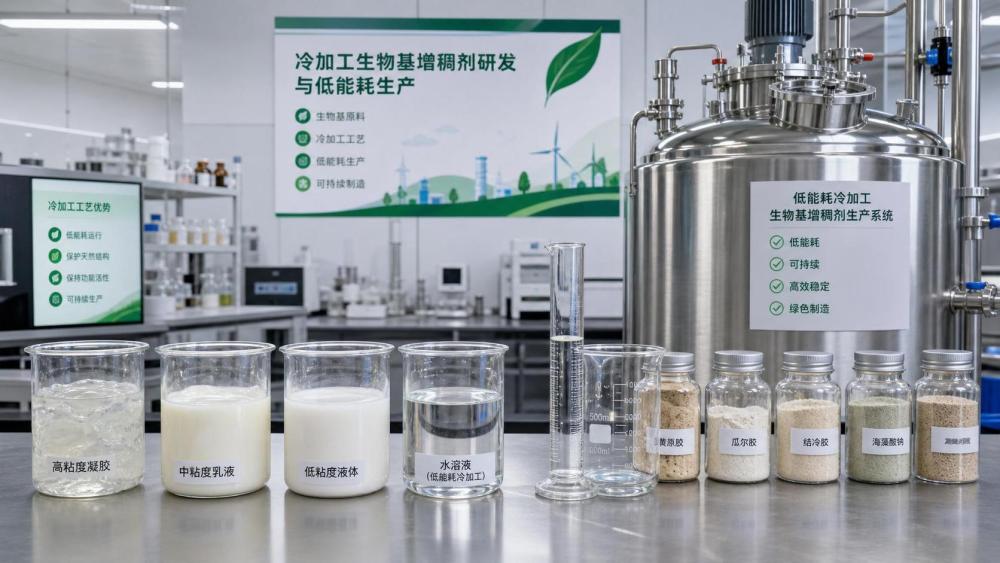
Cold-process bio-based thickeners answer several of those needs at once. They can hydrate or disperse without full thermal activation, allowing lower-temperature production and more flexible line scheduling.
In food, this may support chilled sauces, dairy alternatives, fillings, and beverage systems. In personal care, it is relevant for gels, emulsions, cleansing systems, and leave-on formats containing heat-sensitive actives.
The interest is not purely environmental. Lower heat exposure can also protect volatile notes, sensitive antioxidants, botanical extracts, peptides, and other premium ingredients that lose value when processing becomes too aggressive.
Still, low-energy production is not automatically low-risk. A thickener that works beautifully in a pilot beaker may behave very differently in a full-scale tank with different shear, water quality, order of addition, and hold time.
What cold-process bio-based thickeners really include
The category covers more than one chemistry. It may include xanthan gum, sclerotium gum, certain cellulose derivatives, starch-based systems, pectin blends, guar derivatives, algal materials, and multifunctional hydrocolloid combinations.
Some thickeners build viscosity quickly in cold water. Others need controlled dispersion, pH adjustment, or synergistic pairing with salts, gums, proteins, or surfactants to reach the target texture.
That is why cold-process bio-based thickeners should not be treated as a simple one-to-one replacement category. Their performance depends on matrix chemistry, desired flow behavior, and how the product will be filled, stored, transported, and used.
In practical terms, the best question is not whether a material is bio-based or cold processable. The better question is what kind of rheological architecture it creates under real manufacturing conditions.
The main performance trade-offs in low-energy production
The strongest advantage of cold-process bio-based thickeners is processing efficiency. The main compromise is that efficiency may come with narrower formulation windows.
Viscosity build versus viscosity control
Some systems hydrate fast and create immediate body. That can be useful for rapid batching, but it may also increase the risk of fisheyes, lumping, or uneven dispersion.
Other systems develop viscosity more gradually. They are easier to handle, yet may disappoint when a product requires sharp yield value or fast suspension of particles.
Natural positioning versus texture refinement
A bio-based origin supports brand positioning, but sensory quality still decides commercial success. Some natural hydrocolloids produce stringiness, sliminess, cloudiness, or drag that clashes with premium expectations.
This is especially visible in sauces, serum gels, fragranced washes, and anti-aging emulsions, where consumers expect both naturality and a highly polished sensory profile.
Energy savings versus stability margin
Heat often helps fully solubilize, activate, or stabilize functional ingredients. When that thermal step is reduced, the system may become more sensitive to pH drift, electrolytes, alcohol, oils, or microbial stress.
As a result, a cold-process formula can look efficient at the mixer but reveal syneresis, phase separation, viscosity drop, or poor freeze-thaw stability later in distribution.
Lower utilities versus higher ingredient cost
Cold-process bio-based thickeners may reduce utility consumption and shorten production time. Yet some advanced grades carry a higher unit price, especially when they are optimized for instant hydration or multifunctional sensory performance.
The real comparison should include total system economics, not raw material price alone.
Where the trade-offs show up most clearly
Across FFAI’s coverage areas, cold-process bio-based thickeners rarely fail in the same way. Their pressure points depend on application purpose.
Food and beverage systems
In dairy, desserts, sauces, and fillings, the challenge is usually balancing process simplicity with spoonability, sheen, suspension, and shelf stability. A small rheology shift can alter perceived richness or freshness.
Fragrance and personal care bases
In fragranced gels, shampoos, and emulsions, thickener choice affects fragrance bloom, foam profile, pumpability, and visual clarity. Compatibility with surfactants and essential oils becomes more important than headline viscosity.
High-end actives and sensitive systems
For peptide serums or antioxidant-rich products, cold processing can preserve efficacy claims. The risk is that delicate actives may sit in a less forgiving physical matrix unless the thickener network is carefully tuned.
Home and fabric care formats
In cleaning products, the key issue is often salt tolerance, surfactant compatibility, and stable pouring behavior. A low-energy process helps cost control, but rheology collapse under storage remains a common concern.
A better framework for evaluating options
The most useful evaluation model is cross-functional. Cold-process bio-based thickeners should be screened through technical, commercial, regulatory, and sensory lenses at the same time.
- Check hydration behavior under actual plant shear, not only lab mixing.
- Measure viscosity over time, because some systems drift after 24 or 48 hours.
- Test compatibility with preservatives, salts, acids, alcohols, proteins, oils, and surfactants.
- Assess sensory effects such as drag, stringiness, opacity, residue, or flavor masking.
- Model total cost, including cycle time, waste reduction, utilities, and reformulation burden.
- Review claim support, documentation, and regional compliance early.
This is where intelligence-led review becomes valuable. FFAI’s perspective is useful because thickener selection is rarely isolated from preservation strategy, fragrance behavior, active stability, or final market positioning.
What strong decisions usually look like
Strong choices do not assume that the most natural material, the cheapest grade, or the fastest-processing option will win. They define what must not fail in the finished product.
If a product depends on elegant sensory identity, texture refinement deserves more weight. If line efficiency is the bottleneck, rapid hydration and process robustness may matter more. If exports are involved, documentation and regional acceptability can become decisive.
Cold-process bio-based thickeners are best viewed as formulation tools with strategic upside, not universal replacements. Their value rises when the processing model, ingredient matrix, and brand promise are aligned from the start.
The next useful step is to build a short comparison set around three things: required texture, process limits, and claim priorities. From there, pilot work should focus less on ideal viscosity and more on stability margin, sensory fit, and total production reality.
Related News
- Ingredient Application Guidance for Home Care: Common Formulation MistakesJul 10, 2026Surfactant Chemistry Architect
- Cold-Process Bio-Based Thickeners: Performance Trade-Offs in Low-Energy ProductionJun 29, 2026Surfactant Chemistry Architect
- How to Assess Consumer Goods Ingredients for Household ProductsJun 28, 2026Surfactant Chemistry Architect
- Green Chemistry Surfactants: Market Shifts, Compliance Pressure, and R&D PrioritiesJun 20, 2026Surfactant Chemistry Architect
Related News
- 00
0000-00
Can biomimetic peptides in cosmetics reduce the look of wrinkles? - 00
0000-00
How to assess a bio-based thickener manufacturer's batch consistency - 00
0000-00
Verifying halal status of hydrocolloid ingredients in the Middle East - 00
0000-00
How to interpret active matter on a surfactant specification sheet - 00
0000-00
How Do You Test Hydrocolloid Viscosity After Changing a Thickener?
Surfactant Chemistry Architect
Weekly Insights
Stay ahead with our curated technology reports delivered every Monday.