





Green chemistry surfactants are moving into the center of formulation strategy
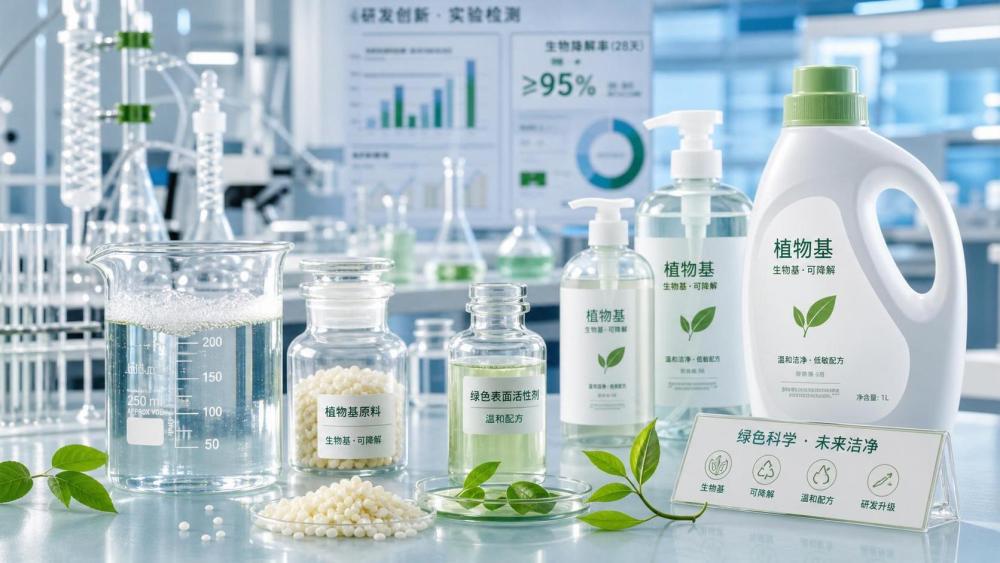
Green chemistry surfactants are no longer a side topic shaped only by sustainability messaging.
They are becoming a board-level issue across FMCG, personal care, home care, food-adjacent processing, and specialty ingredients.
The shift is visible in three places at once: regulation, retailer requirements, and formulation economics.
That combination matters because surfactants sit at the intersection of cleaning power, sensory performance, biodegradability, and claims credibility.
For FFAI, this is not an isolated chemicals story.
It connects directly with clean-label pressures, fragrance delivery, mildness in premium beauty, and the broader race for safe, high-purity ingredients.
In practical terms, green chemistry surfactants now influence how brands defend margin, maintain export readiness, and position future product lines.
Why this change is becoming harder to ignore
The strongest signal is that compliance expectations are moving faster than legacy formulation habits.
Biodegradability, aquatic toxicity, residual impurities, petrochemical dependence, and traceability are now discussed together.
That raises the bar for conventional surfactant systems, especially where older chemistries still deliver attractive short-term cost performance.
At the same time, buyers are no longer satisfied with broad sustainability claims.
They increasingly ask whether a surfactant is bio-based, readily biodegradable, sulfate-free, palm-linked, low-irritation, or compatible with sensitive formulas.
This is especially important in sectors where ingredient stories shape premium positioning.
High-end shampoos, skin cleansers, fragrance carriers, and specialty emulsions are judged not only by performance, but by ingredient logic.
From recent market behavior, the issue is no longer whether green chemistry surfactants will grow.
The real question is which chemistries will scale without creating new cost or compliance bottlenecks.
The pressure comes from several directions at once
- Regulatory scrutiny is tightening around ingredient safety, biodegradation pathways, and environmental fate.
- Retailers and global brands are refining restricted substance lists and preferred chemistry frameworks.
- Consumers increasingly connect cleansing ingredients with scalp health, skin barrier support, and overall product safety.
- Investors and procurement teams are paying closer attention to feedstock resilience and carbon exposure.
Compliance is reshaping the market faster than headline demand suggests
One common mistake is to read green chemistry surfactants only through consumer sentiment.
In reality, compliance pressure is doing much of the heavy lifting.
Export-oriented businesses now face a patchwork of rules, disclosures, and documentation expectations across regions.
That affects ingredient approval timelines, reformulation costs, and even launch sequencing.
FFAI’s perspective is especially relevant here because surfactant choices increasingly sit beside broader safety files.
In cosmetics, surfactant systems must align with claims around mildness, dermatological tolerance, and notification readiness.
In food-contact or food-adjacent processing environments, documentation discipline matters just as much as chemistry selection.
The businesses moving early are not chasing abstract compliance perfection.
They are reducing the risk of sudden reformulation under time pressure.
Raw material transitions are changing cost logic, not just ingredient labels
A second shift is happening upstream.
Green chemistry surfactants often depend on bio-based, fermentation-derived, amino acid, sugar-based, or responsibly sourced oleochemical inputs.
That creates a very different supply equation from traditional petroleum-linked surfactant systems.
The result is a more complex cost-performance conversation.
Some green chemistry surfactants still carry a price premium.
Yet the premium cannot be judged by raw material cost alone.
Mildness, lower irritation risk, sensory improvement, premium claims support, and lower compliance friction all change the value equation.
This is why amino acid surfactants have gained strategic attention in beauty and scalp care.
They may raise formula cost, but they can also support a higher-value market position.
For businesses operating across food, fragrance, and beauty-adjacent ingredient ecosystems, that logic is familiar.
Premium ingredients rarely win on cost alone.
They win when they improve performance, de-risk compliance, and strengthen product storytelling together.
Where the cost debate is becoming more nuanced
- Lower dosage opportunities can offset part of the input premium.
- Milder systems may reduce the need for compensating additives.
- Cleaner claims can support better shelf positioning and export acceptance.
- Feedstock diversification can reduce long-term exposure to fossil-linked volatility.
R&D priorities are moving from replacement to system redesign
The earlier phase of market adoption focused on substitution.
Teams asked which green chemistry surfactants could replace conventional molecules with minimal disruption.
That approach is now proving too narrow.
Current leaders are redesigning surfactant systems around total formulation behavior.
They are testing foam profile, viscosity balance, fragrance compatibility, preservative interaction, active stability, rinse feel, and packaging fit as one package.
This is where green chemistry surfactants become highly relevant to FFAI’s broader intelligence lens.
In fragranced products, surfactant architecture can affect scent release and deposition behavior.
In anti-aging or sensitive-skin formulas, surfactant mildness can influence how actives are perceived in use.
In thickened systems, rheology and cleansing behavior must remain compatible.
The market is rewarding integrated formulation intelligence, not isolated ingredient swapping.
The most relevant R&D questions now
- Can green chemistry surfactants maintain performance across water hardness and temperature variation?
- Do they support fragrance bloom, active delivery, and desired sensory texture?
- How stable is the system under transport, storage, and multi-market packaging conditions?
- Which documentation gaps could slow approval in regulated export channels?
The impact is spreading across more than one application layer
It would be too narrow to see green chemistry surfactants only through laundry or shampoo categories.
The effects are spreading across ingredient strategy, brand architecture, and portfolio design.
In personal care, the strongest driver is the combination of mildness, sulfate-free positioning, and premium sensory claims.
In home care, biodegradability and concentrated formats are gaining weight.
In fragrance-led systems, surfactant choice increasingly affects solubilization and odor presentation.
Even in food-adjacent hygiene and processing environments, safer chemistry narratives matter more than before.
This broader reach explains why green chemistry surfactants now deserve cross-functional review.
The implications touch formulation, regulatory affairs, sourcing, claims development, and capital planning at the same time.
What deserves attention over the next planning cycle
The next phase will likely favor businesses that treat green chemistry surfactants as a strategic portfolio decision.
Watching price alone will miss the more important signals.
What matters is whether a surfactant platform can travel across regions, claims frameworks, and product families without repeated disruption.
A practical response starts with disciplined comparison rather than broad enthusiasm.
- Map current surfactant use against compliance risk, claim ambition, and market exposure.
- Identify where green chemistry surfactants can create value beyond simple substitution.
- Review supplier data depth, feedstock transparency, and formulation support capability.
- Prioritize trials in categories where mildness, premiumization, or export readiness already matter.
- Build staged reformulation plans instead of waiting for forced change.
Green chemistry surfactants are not a passing narrative inside the broader ingredient economy.
They reflect a deeper market reset around safer chemistry, better sensory design, and more defensible formulation systems.
The businesses that read the shift early will be better positioned to balance compliance pressure with innovation timing.
That is where the next competitive gap is likely to open.
Related News
- Ingredient Application Guidance for Home Care: Common Formulation MistakesJul 10, 2026Surfactant Chemistry Architect
- Cold-Process Bio-Based Thickeners: Performance Trade-Offs in Low-Energy ProductionJun 29, 2026Surfactant Chemistry Architect
- How to Assess Consumer Goods Ingredients for Household ProductsJun 28, 2026Surfactant Chemistry Architect
- Green Chemistry Surfactants: Market Shifts, Compliance Pressure, and R&D PrioritiesJun 20, 2026Surfactant Chemistry Architect
Related News
- 00
0000-00
Can biomimetic peptides in cosmetics reduce the look of wrinkles? - 00
0000-00
How to assess a bio-based thickener manufacturer's batch consistency - 00
0000-00
Verifying halal status of hydrocolloid ingredients in the Middle East - 00
0000-00
How to interpret active matter on a surfactant specification sheet - 00
0000-00
How Do You Test Hydrocolloid Viscosity After Changing a Thickener?
Surfactant Chemistry Architect
Weekly Insights
Stay ahead with our curated technology reports delivered every Monday.