





Why does ingredient application guidance for home care matter so much in daily-use formulas?
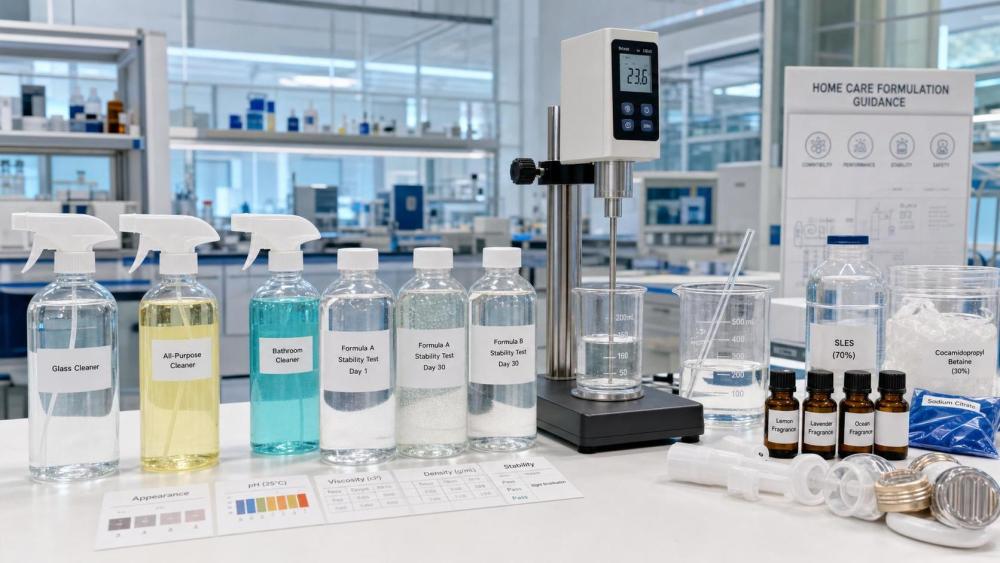
Most home care formulas do not fail in the lab first. They fail after transport, storage, dilution, or repeated consumer use.
That is why ingredient application guidance for home care has become a practical control tool, not just an R&D reference.
A product may look stable at filling, yet separate in winter, lose fragrance in summer, or trigger corrosion in trigger sprayers.
In real operations, the common formulation mistakes are rarely dramatic. They are usually small mismatches between ingredient behavior and final use conditions.
Home care systems are especially sensitive because surfactants, preservatives, fragrances, solvents, thickeners, dyes, and packaging all interact.
This is where FFAI’s cross-category perspective becomes useful. Its work on washing surfactants, preservatives, thickeners, and fragrance science reflects the same formulation logic needed in household products.
The core question is simple: are ingredients being selected for headline performance, or for stable, compliant, market-ready performance?
When a cleaner underperforms, is surfactant choice usually the first place to look?
Very often, yes. Surfactant selection is one of the most frequent sources of avoidable formulation trouble.
A strong degreasing profile on paper does not guarantee good ingredient application guidance for home care in actual use.
One common mistake is choosing surfactants only by foam level. Foam can support user perception, but it does not equal cleaning efficiency.
Another mistake is ignoring water hardness. An anionic system that works in soft water may lose cleaning power or clarity in mineral-rich regions.
Low-temperature behavior also matters. Some systems become hazy, overly viscous, or phase-unstable after cold storage.
The better approach is to match the surfactant package to the cleaning target, dilution habit, and packaging format.
- Kitchen degreasers need grease removal, rinse profile, and hard-surface compatibility.
- Laundry liquids need soil suspension, enzyme tolerance, and long-term viscosity control.
- Dishwashing liquids need foam persistence, grease cutting, and hand-feel balance.
FFAI often highlights how small rheology changes can reshape user experience. That same thinking applies here.
If the surfactant system strips too aggressively, the formula may clean well but create irritation complaints or surface dullness.
If it is too mild or overloaded with nonionics, grease release may become inconsistent, especially after dilution.
Why do stable-looking formulas still fail preservation and fragrance compatibility checks?
Because visual stability is only one layer of formulation quality. Microbial robustness and fragrance compatibility sit beneath the surface.
A preservative system can pass a simple screen, then weaken after pH drift, fragrance addition, or raw material variation.
This is one of the more expensive common formulation mistakes, since it often appears late in shelf-life or market testing.
Fragrance creates a second layer of risk. Essential oil components, solvents, and aroma chemicals may reduce clarity or destabilize viscosity.
They may also interact with packaging seals, especially in concentrated sprays or refill systems.
Good ingredient application guidance for home care treats preservation and fragrance as part of the system architecture, not finishing touches.
A practical screening table helps make that visible before scale-up.
In other words, a clear liquid is not automatically a safe liquid. Stability has to be functional, microbiological, and commercial.
Are thickening and system balance being judged too late?
In many projects, yes. Viscosity is often adjusted near the end, even though it influences nearly every stage of use.
That creates a false sense of control. A formula may hit target viscosity, yet still pour badly, trap air, or show phase weakness.
FFAI’s coverage of hydrocolloids and rheological behavior offers a useful reminder: texture is not decoration. It is part of performance.
For home care, ingredient application guidance should separate three questions.
- Does the product stay uniform through shipping and storage?
- Does it dispense consistently from the intended package?
- Does the consumer experience match the cleaning promise?
A thickener that works in one surfactant matrix may collapse in another. Salt-thickened systems are especially vulnerable to fragrance and electrolyte changes.
Associative thickeners may improve flow and cling, but they need careful compatibility screening with solvents and nonionic loads.
The practical mistake is treating viscosity as a single number. The better method is to review flow, recovery, temperature response, and filling behavior together.
What should be checked before scale-up if the lab batch already looks fine?
This is where ingredient application guidance for home care becomes operational rather than theoretical.
A lab pass should trigger more questions, not fewer. Scale-up changes shear, mixing order, aeration, heating, and hold times.
Even a robust bench formula can shift when raw materials arrive from a different source or with a different active range.
A short pre-launch review usually catches the most expensive mistakes.
- Confirm pH before and after aging, not only at batch release.
- Test freeze-thaw and elevated temperature storage on finished packs.
- Verify fragrance, dye, and preservative using final water quality.
- Check sprayability, foaming, or pour behavior after transport simulation.
- Review regional compliance claims against actual ingredient composition.
The compliance point deserves attention. Claims such as biodegradable, gentle, natural, or antibacterial can create risk if ingredient support is weak.
FFAI’s intelligence model is relevant here because formulation success is not only molecular. It also depends on regulatory fit and market credibility.
How can teams reduce common formulation mistakes without slowing development?
The answer is not endless testing. It is better decision sequencing.
Strong ingredient application guidance for home care starts by defining the non-negotiables early: soil type, package type, target viscosity, fragrance style, preservation window, and claim boundaries.
After that, build the formula in layers. First cleanability. Then system stability. Then sensory refinement. Then cost optimization.
More common formulation mistakes appear when teams reverse that sequence and optimize cost or aesthetics before technical fit.
A simple working rule helps.
That structure keeps development moving while still protecting product reliability.
What does better ingredient application guidance for home care look like in practice?
It looks less like a static ingredient list and more like a decision map built around risks, interactions, and use conditions.
The best guidance connects surfactant science, preservative logic, rheology, fragrance behavior, and compliance review in one flow.
That is also why FFAI’s broader view across food preservation, sensory chemistry, thickeners, and actives is relevant beyond its core sectors.
Different industries use different end products, but the same principle applies: ingredients only deliver value when system interactions are understood early.
For home care, the practical next step is to review current formulas against the failure points that appear most often.
- Check whether cleaning tests reflect actual consumer dilution.
- Reconfirm preservative performance after full fragrance loading.
- Compare viscosity targets with dispensing and storage behavior.
- Review packaging compatibility before commercial release.
- Align claims with verified ingredient and stability data.
That review usually reveals where common formulation mistakes are recurring and where ingredient application guidance for home care needs to become more precise.
Better formulas are rarely the result of one miracle raw material. They come from disciplined choices made at the right stage.
Related News
- Ingredient Application Guidance for Home Care: Common Formulation MistakesJul 10, 2026Surfactant Chemistry Architect
- Cold-Process Bio-Based Thickeners: Performance Trade-Offs in Low-Energy ProductionJun 29, 2026Surfactant Chemistry Architect
- How to Assess Consumer Goods Ingredients for Household ProductsJun 28, 2026Surfactant Chemistry Architect
- Green Chemistry Surfactants: Market Shifts, Compliance Pressure, and R&D PrioritiesJun 20, 2026Surfactant Chemistry Architect
Related News
- 00
0000-00
Can biomimetic peptides in cosmetics reduce the look of wrinkles? - 00
0000-00
How to assess a bio-based thickener manufacturer's batch consistency - 00
0000-00
Verifying halal status of hydrocolloid ingredients in the Middle East - 00
0000-00
How to interpret active matter on a surfactant specification sheet - 00
0000-00
How Do You Test Hydrocolloid Viscosity After Changing a Thickener?
Surfactant Chemistry Architect
Weekly Insights
Stay ahead with our curated technology reports delivered every Monday.