





On July 14, 2026, a new compliance signal emerged for suppliers serving the EU professional cleaning market: ECHA formally adopted Annex XVII restriction No. 89, setting limits on APEOs and certain branched LAS derivatives in industrial cleaning formulations from October 1, 2026. For exporters of heavy-duty detergent actives, this is not simply a regulatory update in text form; it directly touches formulation choices, alternative surfactant qualification, shipment readiness, and the risk of customs disruption for non-compliant goods.
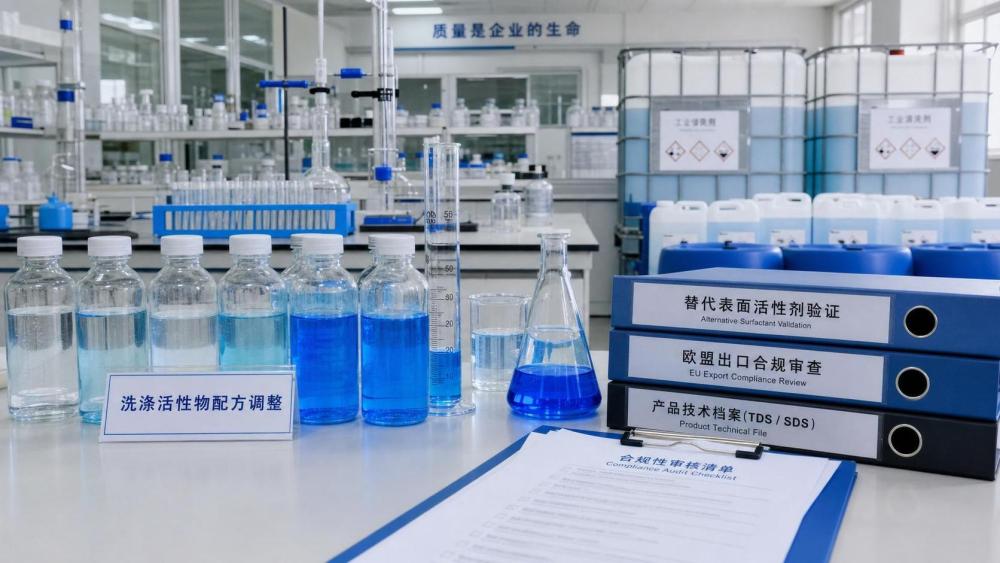
What the adopted restriction confirms
The confirmed facts are limited but commercially significant. ECHA has formally adopted Annex XVII restriction No. 89. The measure limits alkylphenol ethoxylates (APEOs) and certain branched LAS derivatives in industrial cleaning formulations, and the effective date provided is October 1, 2026. The event date associated with this development is July 14, 2026. The information also makes clear that suppliers exporting heavy-duty detergent actives to EU professional markets may need either reformulation or certification of alternative linear surfactants, and that non-compliant shipments face the risk of customs rejection at EU ports.
Where the pressure is likely to appear first
Export programs tied to EU professional buyers
From an industry perspective, exporters are the first group likely to feel the operational effect because the restriction is directly linked to goods entering EU professional markets. The main pressure point is shipment compliance before dispatch, especially where existing product lines still rely on the restricted substances. What deserves closer attention is whether export documentation, technical descriptions, and product compliance files are aligned with the new restriction before goods move into customs-controlled channels.
Raw material selection and formulation adjustment
Suppliers and manufacturers involved in detergent actives and industrial cleaning formulations may be affected at the procurement and formulation stage. The event summary indicates a practical shift toward reformulation or certification of alternative linear surfactants. Analysis shows that this turns raw material selection into an immediate compliance issue rather than a purely technical purchasing decision. Businesses in this part of the chain should pay close attention to whether current inputs remain suitable for EU-bound formulations and whether supporting technical and compliance records are adequate for customer review.
Compliance, testing, and certification support functions
Certification-related service providers and testing support functions may also see a more active role because the summary specifically refers to certification of alternative linear surfactants. Observably, this does not by itself confirm a single mandatory certification route, but it does indicate that proof of compliance will matter more in commercial transactions. For relevant service providers and internal compliance teams, the operational focus is likely to include technical files, supporting test materials, product declarations, and consistency between product composition and documents presented to customers or customs-facing processes.
Procurement and delivery planning on the buyer side
Buyers sourcing heavy-duty detergent actives for EU professional use may need to reassess supplier qualification and delivery timing. The reason is straightforward: non-compliant shipments risk rejection at EU ports, which can affect supply continuity even before any downstream use begins. From a procurement perspective, this makes supplier screening, product specification confirmation, and delivery schedule review more important, particularly where contracts or tenders depend on uninterrupted supply.
Practical checkpoints before the effective date
Review whether current formulations create an EU market exposure
Analysis shows that companies should first identify which exported products are tied to EU professional market applications and whether those formulations involve the substances named in the restriction summary. This is a narrow but necessary starting point because the business risk described in the input is linked specifically to industrial cleaning formulations and EU-bound trade.
Check the readiness of alternative surfactant evidence
Where businesses are moving toward alternative linear surfactants, the immediate practical issue is not only substitution but also how that substitution is evidenced. Based on the provided summary, companies should closely examine whether existing technical files, specification sheets, compliance statements, and any certification-related materials are sufficient for customer review and shipment release. Since detailed execution criteria were not provided, this remains an area to monitor rather than a settled compliance checklist.
Revisit shipment documents and delivery commitments
Because the stated risk includes customs rejection at EU ports, exporters should pay attention to the trade-facing side of compliance, not only the formulation itself. Observably, product descriptions, compliance declarations, and delivery commitments may need review to reduce the risk of mismatch between what is shipped and what can be accepted under the new restriction once it takes effect.
Monitor how market-facing documents begin to change
What deserves closer attention is the downstream expression of the rule in commercial practice. Even without further confirmed details, businesses should watch for changes in procurement specifications, tender documents, customer qualification requirements, and requests for technical proof. The current information does not confirm those changes have already occurred in a uniform way, but it does suggest that such adjustments would be commercially relevant.
How this development is best understood now
Analysis shows that this is more appropriately understood as an adopted rule with a clear execution signal rather than a speculative policy discussion. The restriction has been formally adopted and an effective date has been provided, which gives the market a concrete compliance timeline. At the same time, the available information remains limited on detailed enforcement practice, documentation thresholds, and how consistently alternative surfactant certification expectations will be applied in actual transactions. For that reason, the development should be read as both a landed regulatory change and a trigger for continued monitoring of practical implementation.
What the market should take from this signal
The industry significance of this event lies in the fact that it connects substance restrictions directly with export readiness, formulation decisions, and port-entry risk. It would be premature to claim a uniform market outcome from the limited facts provided, but it is reasonable to view this as a concrete compliance change that can affect procurement, qualification, and delivery planning for EU professional cleaning business. At present, it is more appropriate to understand the development as a rule already moving into execution, while many operational details still need close observation through market practice and compliance follow-up.
Basis of this article and points that still require verification
This article is based on the user-provided news title, event date, and event summary. For developments of this type, relevant source categories usually include official notices, publications from regulatory bodies, customs or trade authority updates, industry association communications, standard-setting documents, and reporting by authoritative media. No specific official source link was provided in the input, so the exact official link remains to be verified on an ongoing basis. Further observation is still needed regarding detailed policy wording, certification practice, procurement document changes, market feedback, and how affected companies implement compliance before and after the stated effective date.
Related News
- How biodegradable surfactants for laundry affect cold-water cleaningSep 15, 2026Surfactant Chemistry Architect
- EU REACH Restriction Tightens Rules for Detergent ActivesJul 15, 2026Surfactant Chemistry Architect
- Surfactant Technology Guide: Performance, Cost, and Formulation Trade-OffsJun 20, 2026Surfactant Chemistry Architect
- How Washing Surfactants Affect Cleaning Power and ResidueJun 08, 2026Surfactant Chemistry Architect
Related News
- 00
0000-00
What drives personal care ingredient price volatility in sourcing - 00
0000-00
What drives micelles price differences in cosmetic formulations? - 00
0000-00
How to assess color stability from a natural food colors manufacturer - 00
0000-00
When does amino acid surfactant powder improve cleanser mildness? - 00
0000-00
How to verify a cosmetic nanotechnology supplier's safety documentation
Surfactant Chemistry Architect
Weekly Insights
Stay ahead with our curated technology reports delivered every Monday.