





Washing surfactants sit at the center of cleaning performance, even when they stay invisible to the eye. They decide how quickly grease loosens, how foam behaves, how easily soils rinse away, and whether fabrics, hair, or hard surfaces feel clean rather than coated.
That balance matters more today because FMCG formulas are judged on several fronts at once. Cleaning must be strong, residue must stay low, sensory experience must feel right, and ingredient choices increasingly face scrutiny for safety, biodegradability, and compliance.
Within the broader ingredient landscape tracked by FFAI, washing surfactants are not isolated raw materials. They interact with fragrance systems, preservatives, thickeners, and cosmetic actives, shaping both product efficacy and user experience from the first dose to the final rinse.
Why surfactant choice changes the whole cleaning result
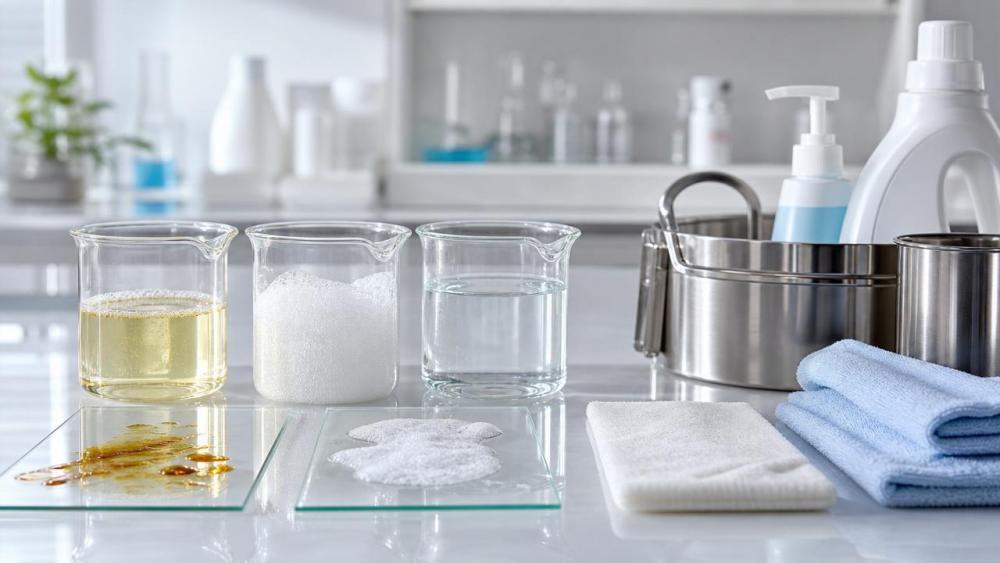
A simple molecular design explains a complex result. Washing surfactants have a water-loving head and an oil-loving tail, allowing them to bridge water and oily soil that normally resist each other.
Once enough surfactant is present, micelles form. These tiny structures surround grease, pigments, sebum, and soil fragments, helping move them away from fibers, skin, hair, or equipment surfaces.
Cleaning power is not only about removing dirt. It also includes how fast wetting begins, how evenly the formula spreads, how much foam appears, and how completely the wash liquor carries soils away.
Residue enters the picture when that process is incomplete. Unremoved soil, excess surfactant, poorly rinsed polymers, or perfume-heavy deposits can stay behind and reduce the feeling of true cleanliness.
Not all washing surfactants behave the same way
In practical use, different classes of washing surfactants create different trade-offs. A formula that performs well in one setting may disappoint in another because the soil type, water quality, and substrate are different.
Common surfactant families
This is why modern formulations often blend several washing surfactants instead of relying on one. The goal is to combine detergency, rinseability, mildness, and sensory performance without creating unstable or sticky systems.
FFAI’s ingredient view is useful here because surfactants rarely work alone. Thickener selection can change soil suspension, fragrances can affect perceived residue, and actives in personal care systems can shift rinse feel.
What really drives cleaning power
Users often judge cleaning by visible foam, but foam is only one signal. Washing surfactants clean mainly through wetting, emulsification, soil detachment, dispersion, and prevention of redeposition during rinsing.
Greasy soils usually require strong oil interaction. Particulate soils need good suspension and transport. Protein-rich soils may need help from enzymes or pH adjustment, because surfactants alone may not solve the whole problem.
Water hardness also changes the outcome. Calcium and magnesium ions can reduce the efficiency of some washing surfactants, increase dosage demand, and sometimes contribute to dull films or incomplete rinse performance.
Temperature matters as well. Some systems perform better in warm water because oils soften and micelle action improves. Others are designed for cold wash efficiency, now a major concern in energy-saving consumer products.
- Dose too low, and soils remain attached.
- Dose too high, and rinse burden may increase.
- Wrong surfactant blend, and foam may look good while detergency stays average.
- Poor suspension control, and removed soil can redeposit on the surface.
Why residue becomes a practical problem
Residue is more than a cosmetic issue. On fabrics, it can reduce softness, trap odors, or create a gray cast over time. On hair and scalp, it can lead to heaviness, buildup, or an unclean afterfeel.
On hard surfaces, residue may cause streaking, tackiness, or faster re-soiling. In industrial or repeated-use settings, this can also distort performance checks because surfaces appear washed but remain chemically loaded.
Several formulation factors contribute to residue:
- Surfactants with weaker rinse-off under local water conditions
- Excessive fragrance oils or conditioning additives
- Thickener systems that hold deposits on the surface
- Insufficient rinse volume or short contact management
- Mismatch between formula and target soil type
This is where washing surfactants affect perception as much as chemistry. A product can be technically effective, yet still feel inferior if the after-rinse touch suggests buildup.
Where these trade-offs show up most clearly
The influence of washing surfactants becomes easier to judge when looking at actual use settings rather than abstract chemistry.
Typical application situations
In each case, the best washing surfactants are not simply the strongest. They are the ones matched to substrate sensitivity, rinse conditions, and expected sensory outcome.
What to check when comparing formulations
A useful evaluation starts with the wash environment, not just the ingredient list. Surfactant performance changes once pH, water hardness, viscosity, fragrance load, and supporting ingredients are considered together.
Several checks usually reveal whether a system is balanced:
- Observe how quickly oily soil breaks and disperses.
- Compare rinse water demand under realistic use conditions.
- Check for slip, tack, or coated feel after drying.
- Review whether hard water sharply reduces performance.
- Assess fragrance and thickener effects on perceived residue.
- Consider biodegradability and compliance for target markets.
This broader view matches the FFAI approach to formulation intelligence. Ingredient success comes from interaction quality, not isolated claims. A surfactant that cleans well on paper may underperform once paired with the wrong sensory or stability system.
Why current market signals point to smarter surfactant decisions
The market is moving toward lower-residue, milder, and more biodegradable washing surfactants. That trend is visible across household cleaners, scalp care, premium laundry, and formulas linked to clean-label or safety-led positioning.
Amino acid surfactants and other mild systems attract attention because they can improve skin or hair feel while supporting premium product narratives. Still, cost alone does not guarantee better performance.
What matters is whether the formula delivers the right cleaning depth without leaving a chemical footprint. In many categories, better rinse performance now creates more value than louder foam or aggressive stripping.
A practical next step is to compare washing surfactants by use scenario, water condition, residue tolerance, and sensory target. That framework makes it easier to judge whether a formulation needs stronger soil lifting, gentler cleansing, or cleaner rinsing before any final selection.
Related News
- How biodegradable surfactants for laundry affect cold-water cleaningSep 15, 2026Surfactant Chemistry Architect
- EU REACH Restriction Tightens Rules for Detergent ActivesJul 15, 2026Surfactant Chemistry Architect
- Surfactant Technology Guide: Performance, Cost, and Formulation Trade-OffsJun 20, 2026Surfactant Chemistry Architect
- How Washing Surfactants Affect Cleaning Power and ResidueJun 08, 2026Surfactant Chemistry Architect
Related News
- 00
0000-00
Can biomimetic peptides in cosmetics reduce the look of wrinkles? - 00
0000-00
How to assess a bio-based thickener manufacturer's batch consistency - 00
0000-00
Verifying halal status of hydrocolloid ingredients in the Middle East - 00
0000-00
How to interpret active matter on a surfactant specification sheet - 00
0000-00
How Do You Test Hydrocolloid Viscosity After Changing a Thickener?
Surfactant Chemistry Architect
Weekly Insights
Stay ahead with our curated technology reports delivered every Monday.