





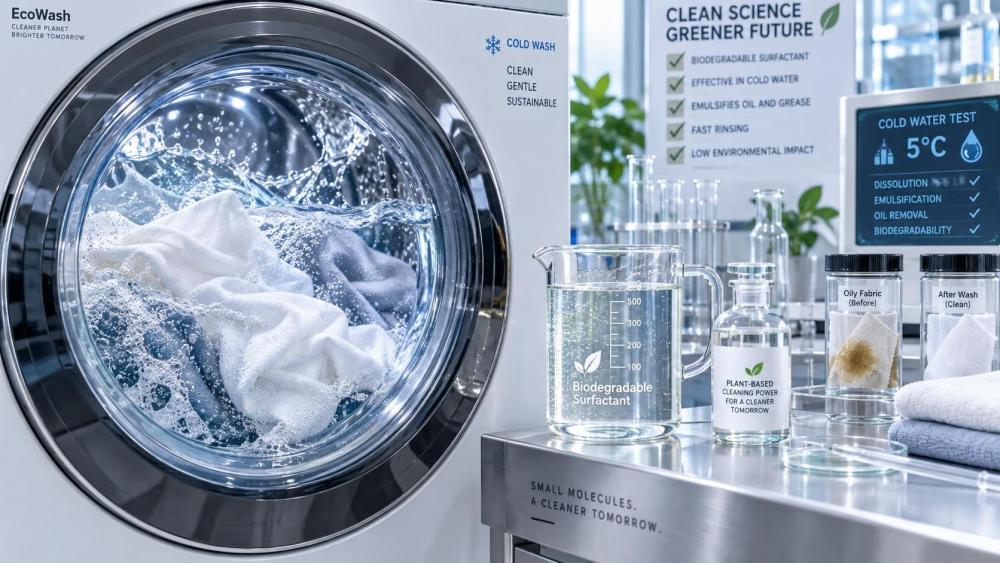
Cold-water laundering changes the balance of forces that make detergents work. Lower temperature slows wetting, reduces the rate at which greasy soils soften or liquefy, can delay surfactant dissolution, and may weaken the activity of some cleaning enzymes. Biodegradable surfactants for laundry can perform well under these conditions, but biodegradability itself does not predict cold-water detergency. The decisive question is whether the selected surfactant system forms effective micelles, wets fabric rapidly, remains soluble in the finished product and wash liquor, and works with builders, polymers, enzymes, and foam-control components at the intended wash temperature and water hardness.
This distinction matters because a formulation can satisfy an accepted biodegradability criterion while still giving poor wash results at 15–25°C. Conversely, a strong cold-water surfactant package may create trade-offs in foam, viscosity, enzyme stability, salt tolerance, or cost. Evaluation therefore needs to separate environmental fate from in-use cleaning performance, then examine where the two requirements interact.
Why cold water exposes formulation weaknesses
In a warm wash, heat assists several processes at once. Sebum and cooking oils become less viscous; crystalline fatty components soften; surfactants dissolve more readily; diffusion into textiles accelerates; and the physical removal of soil is aided by increased molecular motion. A cold wash removes much of that assistance.
The practical result is especially visible with body soils. Sebum is not a single material: it contains triglycerides, free fatty acids, wax esters, squalene, cholesterol-derived materials, particulate matter, and soil transferred from skin contact. At lower temperature, its more hydrophobic and wax-like fractions can remain firmly associated with cotton, polyester, and blended fabrics. Food soils present another challenge. Oils may be retained in a protein or starch matrix, while dried residues require wetting and swelling before they can be detached.
A surfactant package that depends mainly on elevated temperature to mobilize oily soil will lose cleaning margin in cold water. The formulation must instead compensate through rapid interfacial adsorption, efficient emulsification, appropriate micelle structure, effective soil suspension, and, where relevant, a compatible enzyme system.
Biodegradability and cold-water detergency are different tests
“Biodegradable” is often treated as though it describes a single product property. It does not. It describes the susceptibility of a substance to biological breakdown under defined test conditions. Those conditions are not equivalent to a domestic wash cycle, a wastewater treatment plant under variable loading, or a cold-water detergent use environment.
For surfactants, ready biodegradability is commonly assessed with methods in the OECD 301 series. These are screening tests designed to determine whether a substance meets specified biodegradation criteria under aerobic laboratory conditions. The OECD 302 series addresses inherent biodegradability and is not interchangeable with a ready-biodegradability result. The test method, endpoint, inoculum, concentration, and applicable regulatory framework all affect what a claim can support.
In the European Union, surfactants in detergents are subject to biodegradability requirements under Regulation (EC) No 648/2004 on detergents. Its framework focuses on ultimate aerobic biodegradation of surfactants and refers to specified test methods. This is a compliance matter for detergent ingredients placed on the EU market; it is not proof that a product cleans effectively at 20°C, nor does it establish performance against a particular stain type.
A technical review should therefore avoid a common shortcut: selecting a surfactant because it is readily biodegradable and assuming that sustainability status transfers automatically to washing performance. The environmental profile must be assessed against relevant standards and documentation, while cold-water cleaning must be demonstrated in representative formulation and wash tests.
The surfactant functions that matter most below 30°C
Surfactants remove soil by reducing interfacial tension, wetting fibers, dislodging soil, emulsifying oily material, and maintaining detached matter in the wash liquor. These functions overlap but are not identical. A system that wets quickly may not provide the best oily-soil emulsification; one that suspends particulate soil effectively may generate excessive foam in a horizontal-axis machine.
Anionic surfactants are frequently central to laundry detergency because they provide strong soil removal, particularly when paired with suitable builders and nonionic co-surfactants. Their cold-water behavior depends on alkyl-chain distribution, counterion form, electrolyte concentration, and phase behavior. If a surfactant approaches its Krafft point under use conditions, solubility can become a problem. The Krafft point is the temperature above which an ionic surfactant’s solubility rises sharply enough for micelles to form. A material with inadequate low-temperature solubility can appear acceptable in a warm laboratory preparation but dissolve slowly or incompletely in cold washing.
Nonionic surfactants often make an important contribution to greasy-soil removal because their hydrophilic–lipophilic balance can be tuned for oil emulsification and wetting. However, cloud point behavior, interaction with enzymes, and compatibility with anionic surfactants require attention. A nonionic surfactant that separates or loses effective solubility in a high-electrolyte system can undermine both product stability and wash performance.
Amphoteric and zwitterionic materials may be used to modify mildness, foam profile, electrolyte tolerance, or formulation behavior. Their value in laundry is formulation-specific rather than automatic. Some can support wetting and foam stability, but too much persistent foam is a liability in low-water and high-efficiency machines. Machine type, wash liquor volume, mechanical action, and rinse conditions must therefore be part of the evaluation, rather than treating foam volume as a universal measure of cleaning power.
Biosurfactants and surfactants derived from renewable feedstocks can be relevant options where biodegradability and feedstock origin are both under review. Their technical assessment should remain the same as for conventional materials: active matter, impurity profile, critical micelle concentration, low-temperature solubility, odor, color, pH response, microbial robustness, and interaction with the rest of the detergent system. “Bio-based” and “biodegradable” describe different attributes and should not be used as substitutes for one another.
Micelle formation is necessary, but the micelle is not the whole cleaning mechanism
Micelles provide a means to incorporate hydrophobic soil into the wash liquor. Their hydrophobic interiors can solubilize certain oily components, while their hydrophilic outer surfaces allow the resulting assemblies to remain dispersed in water. In cold water, the rate at which surfactant molecules reach interfaces and organize into effective aggregates becomes more important because soil is less mobile and less softened by heat.
Yet focusing only on micelle formation can lead to misleading conclusions. Detergency is also governed by adsorption at the fabric–soil interface, roll-up and displacement of oily films, mechanical agitation, water hardness, alkalinity, polymeric anti-redeposition control, and rinsing. A surfactant may form micelles at low temperature and still fail to remove a strongly anchored sebum film if wetting is slow or if the emulsified soil redeposits onto fabric.
The critical micelle concentration, or CMC, can help characterize surfactant behavior, but it should not be treated as a stand-alone ranking metric. Laundry wash liquors contain mixed surfactants, salts, builders, polymers, enzymes, fragrance oils, and dissolved soil. These components alter aggregate structure substantially. Mixed micelles may be more effective than either surfactant alone, but the same interactions may also create viscosity drift, turbidity, or phase separation in a concentrated liquid detergent.
Hard water can change the answer
Cold-water performance cannot be judged only in deionized water. Calcium and magnesium ions alter anionic surfactant behavior, may reduce available active surfactant, and can contribute to deposits or reduced detergency when sequestration is inadequate. Builders and chelants are therefore not peripheral ingredients. They determine how much of the surfactant system remains functionally available and influence the removal of particulate and oily soil.
The appropriate builder strategy depends on product format, region-specific ingredient requirements, pH target, and wastewater considerations. Carbonate-based alkalinity can support removal of fatty soils, but excessive alkalinity may not suit all fabrics or enzyme systems. Citrate, zeolite, polycarboxylate dispersants, and other chelation or sequestration approaches may each serve different roles. Their combined impact must be assessed at cold temperature because dissolution kinetics can differ markedly from those observed in warm water.
Hard-water testing should include realistic ranges rather than a single nominal condition. A formulation that performs well at one hardness level may show poor particulate suspension or greasy-soil removal when calcium loading increases. It is also necessary to examine whether residual mineral salts interact with anti-redeposition polymers or alter the liquid product’s low-temperature storage stability.
Enzyme compatibility often determines whether low-temperature cleaning is credible
Cold-water detergents commonly rely more heavily on enzymes to compensate for the loss of thermal assistance. Proteases address protein-containing stains, amylases target starch, lipases contribute to fatty soil removal, and cellulases may support fabric care or cleaning effects depending on the system. Their contribution is highly stain-dependent: a lipase does not replace surfactant emulsification, and a protease cannot solve a waxy sebum problem by itself.
Surfactants can stabilize or destabilize enzymes depending on concentration, charge, impurities, water activity, pH, and interactions with other formulation materials. Preservatives, solvents, fragrance components, oxidants, and high levels of certain surfactants can all affect retained enzyme activity during storage. In powder systems, moisture uptake and enzyme granule protection become central. In liquids, the relevant question is not simply whether an enzyme survives initial blending, but whether it retains useful activity throughout the product’s intended shelf life.
Cold-wash validation should also recognize that enzyme kinetics are temperature-sensitive. A formulation may contain an enzyme compatible with the surfactant system but still show limited stain removal at the selected wash temperature and cycle duration. Testing must use time-temperature conditions that reflect the intended appliance program rather than relying on warm-water benchmarks.
Foam control is a performance requirement, not an aesthetic preference
High foam can be mistaken for cleaning strength, especially in hand-wash contexts, but excessive or persistent foam can reduce mechanical action, interfere with rinsing, and trigger control issues in automatic machines. Cold water can make foam behavior less predictable because foam drainage and collapse may slow, while soil load and water hardness can either suppress or modify foam depending on the formulation.
Biodegradable surfactant systems should therefore be evaluated for dynamic foam generation and foam decay under the intended wash conditions. Static cylinder tests may be useful for screening, but they do not reproduce pump circulation, drum movement, liquor ratio, soil loading, or rinse behavior. Antifoam selection also requires care: a defoamer can solve an in-wash foam problem while causing dispersion instability, reduced cleaning, or visible residues if poorly matched to the surfactant phase.
What a defensible cold-water evaluation should compare
A meaningful assessment starts with the finished formulation, not the neat surfactant alone. The following evidence is more decision-useful than a generic biodegradability statement:
- Low-temperature dissolution and clarity: Examine product dilution and wash-liquor appearance at the lowest intended wash temperature, including hard-water conditions. For powders, assess dissolution, residue, and caking risk; for liquids, assess haze, phase separation, and viscosity change after low-temperature storage.
- Soil-specific detergency: Test separately against sebum or synthetic body soil, particulate soil, protein stains, starch stains, and representative food-oil stains. A single composite stain score can conceal meaningful failures.
- Fabric and machine relevance: Include cotton, polyester, and blends where appropriate. Hydrophobic synthetic fibers can retain oils differently from cotton, and machine mechanics strongly influence results.
- Anti-redeposition behavior: Measure whiteness maintenance or particulate redeposition under realistic soil loading. Soil that has been removed but not kept dispersed remains a cleaning failure.
- Foam and rinse performance: Evaluate dynamic foam under the intended liquor ratio and cycle mechanics, then assess residual surfactant or visible carryover after rinse conditions.
- Biodegradability documentation: Confirm the relevant test method, substance identity, concentration range, and scope of supplier evidence. A result for one homolog distribution or derivative cannot automatically be assigned to another.
Comparative testing needs controlled variables. If two surfactant packages are compared at different total active levels, alkalinity, builder concentrations, or enzyme loads, the result may reflect formulation imbalance rather than inherent surfactant superiority. Equalizing total active matter is useful for early screening, but a second evaluation at optimized use levels is often necessary because surfactant efficiency and formulation tolerance differ.
Claims require precision
Environmental claims are vulnerable when they compress several distinct properties into a single phrase. “Biodegradable surfactants” does not mean the complete detergent is biodegradable in the same manner or under the same standard. It does not establish lower aquatic toxicity, lower carbon footprint, renewable feedstock content, or improved cleaning efficiency. Each claim has its own evidence requirements.
For technical documentation, the most useful approach is to state the identity and role of the surfactant, the applicable biodegradability basis, the test framework where disclosure is appropriate, and the formulation-level limits of the claim. Performance claims should be tied to defined wash conditions: temperature, water hardness, dosage, soil type, fabric, machine configuration, and cycle duration. This avoids treating a controlled laboratory result as a universal statement about cold-water cleaning.
The strongest formulation decisions come from treating sustainability compliance and low-temperature performance as linked but separate design constraints. A biodegradable surfactant system is viable for cold-water laundry when it remains soluble and active at use temperature, removes the soils that matter, controls foam within the target appliance environment, supports enzymes and polymers, resists redeposition, and is backed by biodegradability evidence relevant to the market in which the detergent will be placed. No individual surfactant property can answer all of those questions.
Related News
- How biodegradable surfactants for laundry affect cold-water cleaningSep 15, 2026Surfactant Chemistry Architect
- EU REACH Restriction Tightens Rules for Detergent ActivesJul 15, 2026Surfactant Chemistry Architect
- Surfactant Technology Guide: Performance, Cost, and Formulation Trade-OffsJun 20, 2026Surfactant Chemistry Architect
- How Washing Surfactants Affect Cleaning Power and ResidueJun 08, 2026Surfactant Chemistry Architect
Related News
- 00
0000-00
Verifying halal status of hydrocolloid ingredients in the Middle East - 00
0000-00
How to interpret active matter on a surfactant specification sheet - 00
0000-00
What Quality Checks Should You Run on Fragrance Ingredient Suppliers? - 00
0000-00
How to assess a flavor chemistry manufacturer's batch consistency - 00
0000-00
What drives fragrance ingredients price changes in bulk orders?
Surfactant Chemistry Architect
Weekly Insights
Stay ahead with our curated technology reports delivered every Monday.