





Hard water does not affect all anionic surfactant ingredients equally. Calcium and magnesium can reduce the effectiveness of some surfactants by forming poorly soluble salts, while others remain sufficiently soluble but show changes in foam, viscosity, deposition, or cleaning performance. The outcome depends on the surfactant’s molecular structure and on the complete formulation, not simply on whether the ingredient is anionic.
Soap is particularly vulnerable to hardness-related precipitation. Many synthetic anionics are more tolerant, but that does not make them immune to changes in water composition. A useful comparison therefore requires controlled hardness, a defined use concentration, and performance measurements that reflect the intended cleaning task.
What calcium and magnesium do to anionic surfactants
Water hardness is primarily associated with dissolved calcium and magnesium ions. Anionic surfactants carry a negatively charged hydrophilic group in water, so these positively charged ions can interact with the surfactant headgroup. The strength and consequences of that interaction vary with headgroup chemistry, the hydrophobic chain, concentration, temperature, and the surrounding ingredients.
One possible result is the formation of an insoluble or sparingly soluble calcium or magnesium salt. When surfactant leaves the solution as a precipitate, less remains available to adsorb at interfaces, form micelles, and assist in soil removal. The solid may also deposit on fabric, hair, equipment, or other surfaces.
Hardness can affect performance without producing a visible precipitate. Divalent ions screen electrostatic repulsion between anionic headgroups and can change micelle size and shape, interfacial adsorption, and interactions with polymers or other surfactants. Those changes may alter viscosity, foam stability, or the way a formulation releases and suspends soil.
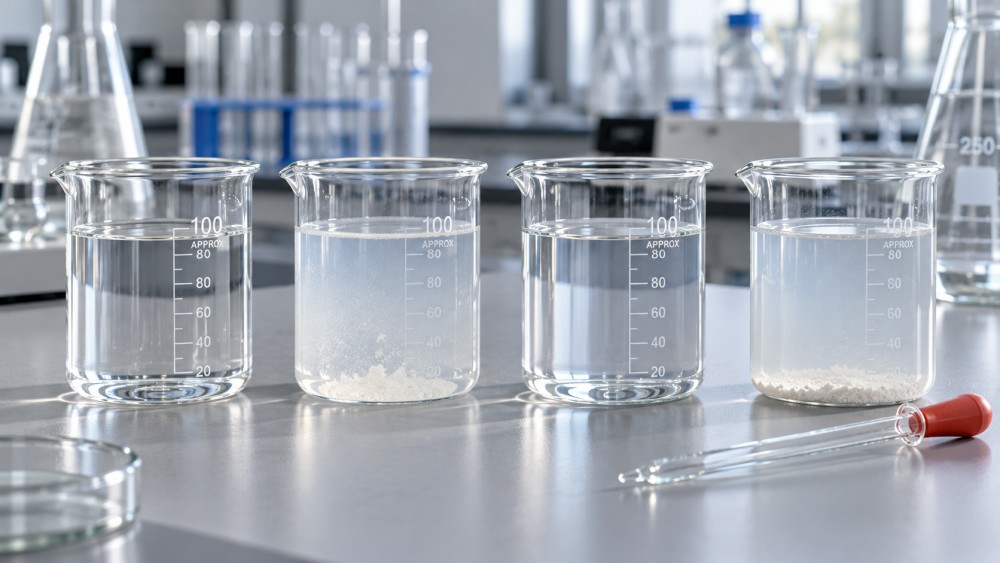
The distinction matters during evaluation. A clear solution is not necessarily performing well, and a loss of foam is not proof that all cleaning ability has been lost. Conversely, a product can generate substantial foam while leaving deposits or failing to remove a particular soil.
How surfactant chemistry changes hardness tolerance
Fatty acid soaps are the clearest example of hardness sensitivity. Sodium and potassium salts of fatty acids can react with calcium and magnesium to form poorly soluble soaps, commonly recognized as soap scum. The extent depends on the fatty acid composition, pH, temperature, and water chemistry. In a wash system, hardness can therefore consume part of the soap before it contributes effectively to cleaning, while the resulting deposits can affect rinsing and surface feel.
Alkyl sulfates, such as sodium lauryl sulfate, generally tolerate hard water better than conventional soap, but their behavior is not uniform across chain lengths and conditions. Their calcium and magnesium salts can have limited solubility under some conditions, particularly when concentration, temperature, or other formulation ingredients favor precipitation. A suitable laboratory screening range is therefore more informative than a blanket claim of “hard-water compatible.”
Alkyl ether sulfates, including sodium laureth sulfate, introduce ethoxy groups between the hydrophobic chain and sulfate headgroup. Ethoxylation can improve water solubility and hard-water tolerance relative to a corresponding non-ethoxylated alkyl sulfate, although performance depends on the distribution and average number of ethoxy units. More ethoxylation also changes other properties, so hardness tolerance should not be considered independently of foam, viscosity response, and cleansing behavior.
Alkylbenzene sulfonates, including linear alkylbenzene sulfonate (LAS), are widely used in laundry formulations and can perform in hard water when supported by an appropriate formulation. They are nevertheless affected by calcium and magnesium. The balance among surfactant level, builders, soil load, and wash conditions determines how much useful activity remains during washing.
Other anionics, such as alpha-olefin sulfonates, sulfosuccinates, and amino-acid-derived surfactants, should be assessed by specific grade rather than by family name alone. Their response depends on molecular structure, chain distribution, counterion, and formulation. A mild skin feel or a sulfate-free description does not establish resistance to calcium precipitation or guarantee stable foam in hard water.
Why hardness numbers need context
Hardness is commonly expressed as milligrams per liter of calcium carbonate equivalent, or mg/L as CaCO3. This is a common reporting basis, not a statement that all the hardness is present as calcium carbonate. It allows calcium and magnesium contributions to be expressed on a comparable equivalent basis.
Two waters with the same total hardness can still behave differently. Their calcium-to-magnesium ratios, alkalinity, pH, and other dissolved salts may differ. Calcium and magnesium do not necessarily form equally soluble salts with a given surfactant, and alkalinity can influence precipitation and the activity of water-conditioning ingredients.
For a controlled comparison, record both the total hardness and how the test water was prepared. If the application requires robustness across different water supplies, include more than one calcium-to-magnesium ratio rather than relying on a single synthetic water. Natural water can provide an additional check, but its composition should be characterized; otherwise, a performance difference cannot confidently be attributed to hardness alone.
Temperature also changes the interpretation. A surfactant that is soluble during a warm wash may become cloudy or form crystals on cooling. This should be distinguished from a calcium-induced deposit by testing the same concentration and temperature in low-hardness water. Some anionic surfactants have a Krafft temperature below which solubility falls substantially; hardness and low temperature can interact to make the practical boundary more restrictive.
Formulation strategies and their limits
Bind or manage hardness ions. Chelating agents and detergent builders reduce the concentration or effects of free calcium and magnesium. Depending on the chemistry, they may bind ions in solution, exchange ions, precipitate hardness, or help prevent unwanted scale. Their effectiveness depends on dose, pH, competing ions, and the time available during use. The total amount of hardness is a useful starting point for calculation, but it is not a complete dosing rule: other ingredients and soils can also interact with the conditioning system.
For example, a laundry formulation may use a builder system to support surfactant performance in the wash liquor. A shampoo has different constraints: clarity, viscosity, scalp compatibility, rinse feel, and permitted ingredient use all matter. A water-conditioning approach that suits a powder detergent cannot automatically be transferred to a personal-care product.
Use mixed surfactant systems deliberately. Combining an anionic surfactant with amphoteric or nonionic surfactants can modify micelle behavior, foam, solubility, and deposition. A blend may retain acceptable performance at a hardness level where an individual component performs poorly. The improvement is formulation-specific, however, and should be demonstrated against the relevant endpoint rather than inferred from the ingredient list.
Control pH and electrolyte loading. For soap-containing products, pH affects the balance between soluble soap and protonated fatty acid; lowering pH too far can produce fatty acid separation independently of water hardness. In other systems, added salts influence micellar structure and viscosity. A thickened product may thin, thicken excessively, or become unstable when diluted into water with a different ionic composition. Adjustments made to improve appearance in the concentrate should therefore be checked again at use dilution.
Consider the whole soil-removal system. Dispersants, anti-redeposition polymers, solvents, enzymes, and other ingredients can affect the final result. An increase in chelant may improve clarity without resolving particulate redeposition. Likewise, replacing a hardness-sensitive surfactant may reduce residue but change oil removal or foam. The preferred change is the one that corrects the limiting failure without creating a more consequential one elsewhere.
Designing a meaningful comparison
Ingredient screening should begin with matched active surfactant concentration rather than equal weight of commercial product, because supplied grades can contain different amounts of water, salts, and other components. Record active matter and relevant composition information from the supplier’s specification. Even at matched active concentration, a comparison is a formulation screen rather than a pure molecular comparison if the grades contain different solvents or electrolytes.
Use a low-hardness control and a defined series of harder waters covering the intended application range. Hold dilution, mixing, temperature, pH, contact time, and soil loading constant. If the goal is to isolate surfactant behavior, test simplified systems; if the goal is product selection, also test the complete formulations. Both are needed when a builder or co-surfactant may mask an ingredient’s intrinsic sensitivity.
Measurements should follow the failure mode:
- Solubility and stability: observe haze, sediment, phase separation, and viscosity after mixing and during relevant storage or use temperatures. Specify observation time, since a system may initially appear clear before a deposit develops.
- Foam: measure initial foam and its retention under controlled agitation, with and without representative soil. Foam height alone should not be used as a substitute for cleaning performance.
- Cleaning: use representative soils and substrates, with controlled application and rinsing. For laundry, include soil removal and redeposition; for a shampoo, assess relevant sebum removal and rinse behavior.
- Residue: inspect or measure deposits on the substrate and equipment after repeated use where accumulation is relevant. A single rinse may not reveal a persistent deposition problem.
Use replicates and a defined acceptance limit for each endpoint. Compare results not only at the nominal use concentration but also at realistic dilution extremes. An ingredient may pass in a concentrated screening solution and fail after dilution, when builder capacity, surfactant availability, and water hardness have a different relationship.
Reading the result correctly
If a formulation fails only in hard water, a follow-up test with a suitable chelant can help determine whether free hardness ions are involved. Improvement after chelant addition supports that explanation, but it does not by itself identify whether precipitation, altered micelle behavior, or deposition caused the original failure. Measuring solids, dissolved calcium, and cleaning performance separately can narrow the cause.
If the product fails in both soft and hard water, the issue may instead be insufficient surfactant, unsuitable soil compatibility, pH, temperature, or another formulation constraint. If hardness reduces foam but not cleaning, reformulating solely to recover foam may not be necessary unless foam is itself a functional or user-acceptance requirement.
The most useful specification is therefore an operating window: the water compositions, temperatures, dilutions, and soils under which the finished formulation meets defined cleaning, stability, and residue criteria. A single “hard-water resistant” claim cannot substitute for that evidence.
Related News
- 67 Food and Related Standards Take Effect in November, Including Surfactant Test StandardNov 02, 2026Surfactant Chemistry Architect
- How do anionic surfactant ingredients perform in hard water?Nov 02, 2026Surfactant Chemistry Architect
- How biodegradable surfactants for laundry affect cold-water cleaningSep 15, 2026Surfactant Chemistry Architect
- EU REACH Restriction Tightens Rules for Detergent ActivesJul 15, 2026Surfactant Chemistry Architect
Related News
- 00
0000-00
Wissen Research: Global Cosmetics Market to Reach $497.2 Billion by 2031 - 00
0000-00
Can biomimetic peptides improve skin firmness? - 00
0000-00
China Records 543 New Cosmetic Ingredients, Including 167 in 2026 - 00
0000-00
How to check a fragrance raw material specification for IFRA compliance - 00
0000-00
Australia and New Zealand Weigh Wider Steviol Glycoside Use in Griddle Products
Surfactant Chemistry Architect
Weekly Insights
Stay ahead with our curated technology reports delivered every Monday.