





Food preservative ingredients for cheese can delay unwanted mold growth, but their value depends on where contamination occurs and how the cheese is made, packed, and stored. Natamycin is generally used as a surface antifungal; sorbates can also inhibit molds, although permitted applications differ by cheese category and market. Moisture, pH, application coverage, packaging, and refrigeration all affect the outcome.
For a technical evaluator, the decision is therefore broader than choosing an antimicrobial. The task is to identify the likely spoilage route, select an ingredient that can reach it, verify legal use in each destination, and demonstrate that the finished product meets its intended shelf life.
Start with the cheese and the contamination route
Mold problems often begin after a successful production step. A wheel may acquire spores during handling or ripening; a block may be contaminated at cutting; shredded cheese may pick up spores across a large exposed surface. An ingredient applied before those events cannot be assumed to protect every newly exposed surface.
Separate external growth from internal defects. A surface treatment is a logical candidate for mold on the rind or cut face. Growth in cracks, mechanical openings, or poorly sealed packs calls for investigation of contamination, cheese structure, and packaging integrity as well. Visible mold may also coexist with yeast or bacterial spoilage, which requires a broader diagnostic approach.
Cheese style sets practical boundaries. A hard cheese with an intact rind presents a different exposure from a moist fresh cheese or shredded product. Deliberately mold-ripened cheeses need particular care: an antifungal may interfere with the cultures responsible for appearance and flavor. Any use must be evaluated against the product specification and applicable rules.
Compare food preservative ingredients for cheese
The table is a screening tool, not a list of universally authorized uses. The same substance can be permitted for one cheese category, treatment method, or destination and restricted for another. A supplier’s general food-grade specification does not establish that a particular finished cheese is compliant.
Natamycin: evaluate surface coverage before dose
Natamycin acts against many yeasts and molds and is used in cheese applications where surface spoilage is the target. It binds to ergosterol in fungal cell membranes, disrupting membrane function. Its limited movement into cheese makes it useful for surface protection, but also means that untreated interiors and surfaces exposed later in the process should not be assumed to be protected.
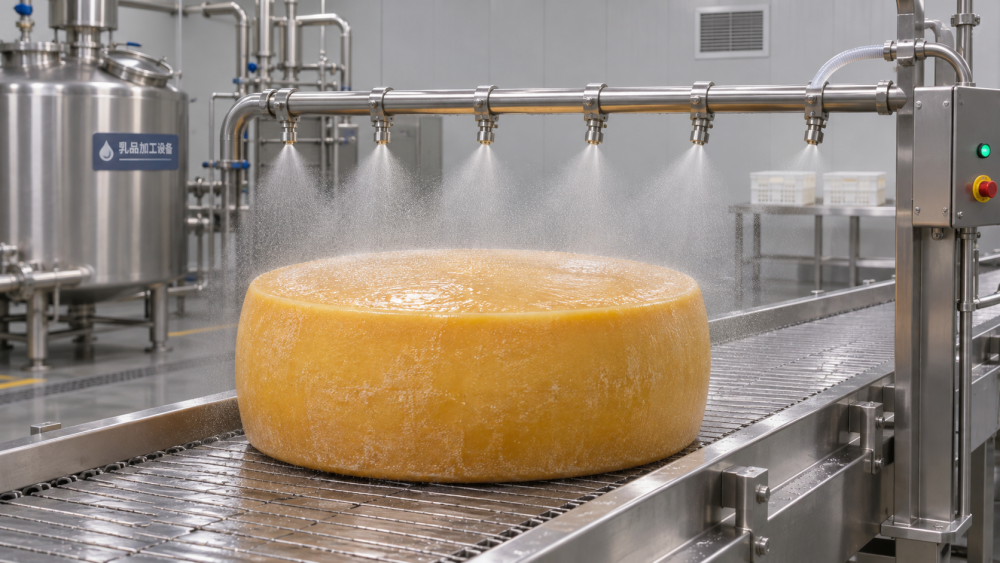
Application can include dipping or spraying a cheese surface, or incorporation into a coating where permitted. For sliced or shredded products, an evaluator should examine the actual application configuration and legal status rather than assume a wheel-treatment process is transferable. Coverage can vary with surface moisture, geometry, equipment setup, and handling after treatment.
A practical trial should sample difficult locations: wheel edges, uneven rinds, interfaces between stacked pieces, and areas that receive less spray. Measure treatment uniformity using a suitable validated method, and relate the results to spoilage observations. Check whether subsequent cutting, abrasion, condensation, or contact with packaging changes the protection at the point of sale.
Natamycin does not provide broad bacterial control. If the problem includes gas formation, slime, or pathogens, use organism identification and a separate food-safety assessment rather than treating an antifungal result as evidence of overall microbial safety.
Sorbates: assess pH, distribution, and flavor
Sorbic acid and its salts, including potassium sorbate, can inhibit molds and yeasts. Their performance is strongly influenced by pH: the undissociated acid is generally the more active form, and its proportion increases as pH decreases. A supplier’s result in an acidic model system therefore cannot be applied automatically to a cheese with a different pH or buffering capacity.
For a surface application, coverage and migration affect how much active material remains where spores can grow. For an authorized formulation use, mixing and partitioning within the cheese matrix matter. Fat, moisture, salt, and local pH differences can make activity uneven even when the calculated addition is uniform.
Evaluate flavor and appearance alongside microbiology. Sorbate can affect sensory quality or interact with the product environment, so a technically effective treatment still needs tasting and appearance checks through the proposed shelf life. Confirm the permitted substance, application, and maximum level for the precise cheese and market before setting a trial target.
When other preservation approaches merit a trial
Propionates and related salts
Propionates have established uses in some food categories, particularly baked goods, but that history is not proof of a suitable cheese application. Cheese pH, moisture, flavor, permitted uses, and required antimicrobial spectrum may make another approach more appropriate. Include a propionate in screening only after confirming a plausible application and the relevant legal pathway.
Protective cultures and cultured ingredients
Selected cultures or cultured ingredients may suppress spoilage through competition or antimicrobial metabolites. Their effect depends on the organism, its viability where relevant, processing conditions, and interactions with starter and ripening cultures. A culture that performs well in one cheese may alter acid development or flavor in another.
Request strain identification where applicable, manufacturing specifications, stability data, and evidence in a comparable cheese matrix. Descriptions such as “natural” or “clean label” do not establish efficacy, regulatory status, or the finished-product declaration. Those questions must be reviewed for the specific ingredient and claim.
Build a shelf-life test that reflects the supply chain
Bench screening can eliminate weak candidates, but final selection should rest on a representative finished product. A robust protocol links the proposed preservative to the contamination event it is expected to manage.
- Define failure. Specify the target organisms or spoilage group, the sampling method, unacceptable visible growth, and sensory or package criteria. Distinguish a quality endpoint from a food-safety endpoint.
- Characterize the matrix. Record cheese type, pH, water activity, moisture, salt, surface condition, and relevant ripening stage. Include normal production variability, not just an ideal laboratory batch.
- Choose meaningful controls. Compare untreated product with the current commercial process and each candidate treatment. Keep the packaging and handling conditions comparable.
- Reproduce exposure. Assess contamination associated with cutting, shredding, coating, or packing. Where a challenge study is justified, use appropriate spoilage organisms, inoculation sites, and a qualified laboratory protocol.
- Test the distribution route. Include intended storage temperatures and justified excursions, package opening where relevant, and the time between manufacture and consumption. Record condensation and seal failures.
- Review the full result. Assess microbial findings, visible mold, flavor, texture, appearance, treatment coverage, and analytical compliance at defined intervals through the proposed shelf life.
A challenge test is an evaluation under specified conditions, not a guarantee for every batch. Natural spoilage studies and production monitoring add evidence about real contamination patterns. If failure occurs only at a cut edge or seal, improving the process may deliver more value than increasing preservative use.
Check authorization and labeling by destination
Regulatory review must match the finished product and use. Identify the cheese category, ingredient identity, intended technological function, application method, and destination country. Then check the current applicable legislation and any conditions of use, including limits, restrictions, and labeling requirements.
For the European Union, evaluators can consult the applicable consolidated rules under Regulation (EC) No 1333/2008 and the relevant Union list for the food category. In the United States, review the applicable FDA regulations and any relevant standard of identity for the cheese. Other markets may classify or restrict the same application differently. Legal references and amendments should be checked at the time of commercialization.
Pay attention to how a limit is expressed. A surface limit, a concentration in a coating, and a concentration in the finished cheese are different measurements. Confirm the analytical method, sampling depth or area where relevant, and the point at which compliance is assessed. Technical and regulatory teams should agree on those details before a supplier specification is approved.
Also verify whether the ingredient must appear in the ingredient statement, how it is named, and whether a coating has separate declaration implications. Supplier documents should cover identity, purity, contaminants, allergen and cross-contact information where relevant, and batch traceability. A certificate of analysis supports incoming control; it does not replace finished-product compliance testing.
Compare total cost at the point of sale
Price per kilogram of preservative is a poor standalone metric. A surface treatment may require a dosing system, coating preparation, coverage checks, cleaning, and additional labor. A culture-based approach may require changes to fermentation control or longer validation. Both can affect throughput and finished-product consistency.
Compare candidates using cost per saleable unit across a defined production volume. Include ingredient consumption, application losses, equipment and maintenance, analytical testing, packaging changes, rejected product, and expected shelf-life performance. Treat projected reductions in returns or waste as assumptions until supported by plant or customer data.
Supply continuity belongs in the same assessment. Review lead times, minimum order quantities, shelf life of the ingredient, storage requirements, alternate manufacturing sites, and change-notification terms. A low-cost material that requires frequent line adjustments or cannot be sourced consistently may be the more expensive choice.
Make the selection with a documented decision gate
For a cheese whose main problem is external mold, begin by assessing an authorized surface treatment and the consistency of its application. Consider sorbates where the product’s pH, sensory profile, permitted use, and distribution support them. Investigate protective cultures or other approaches where they fit the cheese process and can be validated against the actual spoilage organisms.
Before approval, assemble one decision record linking the legal assessment, supplier specifications, pilot results, shelf-life protocol, sensory findings, and operating cost. The preferred option is the one that controls the identified spoilage route consistently under the intended commercial conditions and remains compliant throughout the target market.
Related News
- Which preservatives help prevent mold growth on cheese?Nov 25, 2026Food Preservation Scientist
- Türkiye Notifies WTO of Draft Food Additives Regulation AmendmentsNov 09, 2026Food Preservation Scientist
- Chinese Zeolite Advance Removes Precious Metals from Food Preservative and Flavor ChemistryOct 28, 2026Food Preservation Scientist
- Flavour preservation failures caused by oxygen exposure in beveragesOct 01, 2026Food Preservation Scientist
Related News
- 00
0000-00
Which preservatives help prevent mold growth on cheese? - 00
0000-00
UK–EU SPS Agreement Raises Food Safety and Supply Chain Questions - 00
0000-00
Nestlé CEO Says Reformulation Faces Limits Amid Ultra-Processed Food Backlash - 00
0000-00
New York Governor Vetoes GRAS Disclosure and Food Additive Ban Bill - 00
0000-00
How to check if natural flavor ingredients are GRAS
Food Preservation Scientist
Weekly Insights
Stay ahead with our curated technology reports delivered every Monday.