





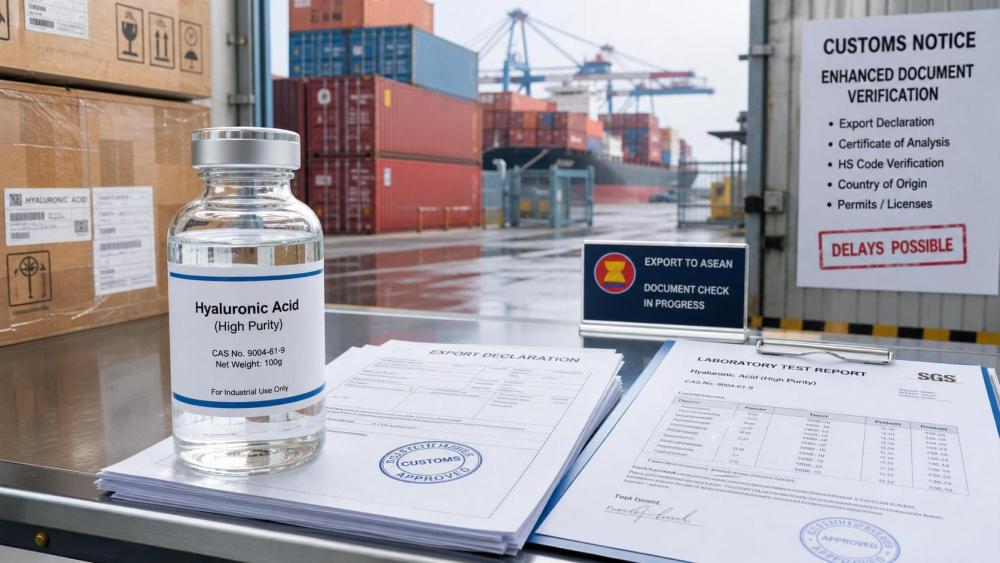
Effective July 10, 2026, China Customs has suspended expedited "Green Channel" clearance for exports of high-purity hyaluronic acid with purity above 99.5% to ASEAN markets while enhanced GMP-related documentation is reviewed. For exporters, manufacturers, procurement teams, and cross-border supply chain operators, the immediate issue is not only the policy change itself, but also the added paperwork and a longer export timeline that may affect shipment scheduling, delivery commitments, and document readiness.
What Has Changed at the Border
The confirmed change took effect on 2026-07-10. China Customs has suspended the fast-track "Green Channel" clearance arrangement for shipments of high-purity hyaluronic acid exceeding 99.5% purity when those exports are destined for ASEAN countries.
The suspension is tied to enhanced review of GMP documentation. Under the updated clearance requirement, shipments must now be pre-submitted with manufacturing records, stability test reports, and labeling compliance materials specific to ASEAN markets.
According to the provided event summary, the practical effect is an added 5 to 7 working days to export lead time.
Where the Immediate Pressure Is Likely to Appear
Exporters facing a longer pre-clearance cycle
From an industry perspective, direct trading companies are likely to feel the impact first because the change sits directly in the export clearance process. The main pressure point is timing: cargo that previously moved through an expedited route now depends on fuller document preparation and review before shipment can proceed.
What deserves closer attention is whether internal export teams already hold complete manufacturing and testing files in a submission-ready format, and whether ASEAN-bound orders have been scheduled with enough buffer to absorb the additional 5 to 7 working days.
Manufacturers under closer document scrutiny
For manufacturing businesses, the issue is less about customs handling alone and more about how production records connect to export execution. Analysis shows that manufacturing records and stability test reports are no longer background compliance materials; they become operational documents that can directly affect shipment timing.
The practical impact may appear in batch release coordination, document retrieval speed, and alignment between quality, regulatory, and export teams.
ASEAN-focused buyers and procurement teams watching delivery reliability
Procurement functions and downstream buyers linked to ASEAN orders may need to reassess delivery expectations. The confirmed additional lead time does not by itself indicate supply disruption, but it does introduce a new scheduling variable for replenishment planning, order confirmation, and contract communication.
Observably, the key concern for buyers is whether suppliers can consistently provide compliant paperwork and maintain predictable dispatch windows under the revised process.
Logistics and service providers adjusting handoff timing
Supply chain service providers, including forwarding and trade support teams, may also be affected because shipment release timing now depends more heavily on pre-submitted documentation. The business impact is likely to be concentrated in booking coordination, customs preparation sequencing, and communication around revised export milestones.
What Companies Should Monitor Now
Track whether the documentation review framework changes further
The current confirmed fact is the suspension of expedited clearance pending enhanced GMP documentation review. Companies should distinguish between the rule already in force and any later clarification that may define how long the suspension will remain, whether review standards become more detailed, or whether additional submission requirements are introduced.
Check document completeness before cargo scheduling
Because manufacturing records, stability test reports, and ASEAN-specific labeling compliance now need to be submitted in advance, companies should focus on whether these materials are complete, internally consistent, and ready before shipment booking. In practical terms, document readiness may become as important as production readiness for ASEAN-bound exports in this product category.
Recalculate delivery commitments for ASEAN orders
Analysis shows that the added 5 to 7 working days should be treated as an operational planning issue rather than a minor paperwork adjustment. Sales, customer service, and account teams may need to revisit promised dispatch dates, update delivery assumptions, and communicate revised lead times to customers where relevant.
Review labeling compliance by destination market
The reference to ASEAN-specific labeling compliance is a concrete point of attention. Businesses serving multiple ASEAN destinations should pay close attention to whether their export labeling files are organized and reviewable in line with destination-market requirements, since this now forms part of the pre-submission burden noted in the event summary.
Why This Looks More Like a Compliance Signal Than a Market Conclusion
Observably, this development is best read as a compliance and process signal rather than a final statement on trade demand or long-term supply conditions. The confirmed change affects the route and timing of customs clearance for a defined product category and destination region, but the provided information does not establish a broader market outcome beyond that.
Analysis shows that the strongest immediate message is about documentation quality becoming more tightly linked to border efficiency. It is more appropriate to understand this as a short-term operational change with potentially wider implications if similar review practices persist or expand, which is why continued monitoring matters.
How the Industry Should Read the Move for Now
At this stage, the most grounded interpretation is that high-purity hyaluronic acid exports to ASEAN are entering a more document-intensive clearance phase starting July 10, 2026. The measurable near-term effect is the loss of expedited clearance and an added 5 to 7 working days in export lead time.
From an industry perspective, the significance lies in execution discipline rather than in any confirmed structural shift in trade. Companies most exposed are those handling manufacturing documentation, export submission, delivery commitments, and ASEAN labeling compliance. For now, this is better understood as a policy-driven operational adjustment that warrants close observation rather than an established long-term outcome.
Basis of This Report and What Still Needs Verification
This article is based on the user-provided news title, event date, and event summary regarding the suspension of expedited customs clearance for high-purity hyaluronic acid shipments from China to ASEAN. The analysis above separates confirmed facts from editorial observation and does not rely on additional unverified data.
For this type of industry update, commonly relevant source categories may include official customs notices, company disclosures, industry association updates, authoritative media coverage, and standards-related documentation. A specific official source link was not provided in the input, so the underlying official notice and any later clarification still require ongoing verification.
Further attention should remain on whether customs authorities provide updated wording, whether submission requirements are refined in practice, and whether the current suspension remains a temporary procedural measure or develops into a longer-running compliance checkpoint.
Related News
- Galderma Marks 30 Years of Hyaluronic Acid Injectable InnovationOct 24, 2026Cosmeceutical Formulator
- Sihuan Pharmaceutical’s Two Self-Developed Aesthetic Products Approved in Hong KongOct 21, 2026Cosmeceutical Formulator
- Does Low-Molecular-Weight Hyaluronic Acid Work Better in Leave-Ons?Oct 23, 2026Cosmeceutical Formulator
- How high purity actives for serums reduce formula instability riskSep 30, 2026Cosmeceutical Formulator
Related News
- 00
0000-00
2026 Osong Cosmetics and Beauty Expo Concludes in South Korea - 00
0000-00
How to compare cosmetic active compounds by their cost in use - 00
0000-00
HKBU Showcases DR2 Following NMPA Registration as a New Cosmetic Ingredient - 00
0000-00
How to use ingredient market insights to forecast sourcing costs - 00
0000-00
Galderma Marks 30 Years of Hyaluronic Acid Injectable Innovation
Cosmeceutical Formulator
Weekly Insights
Stay ahead with our curated technology reports delivered every Monday.