





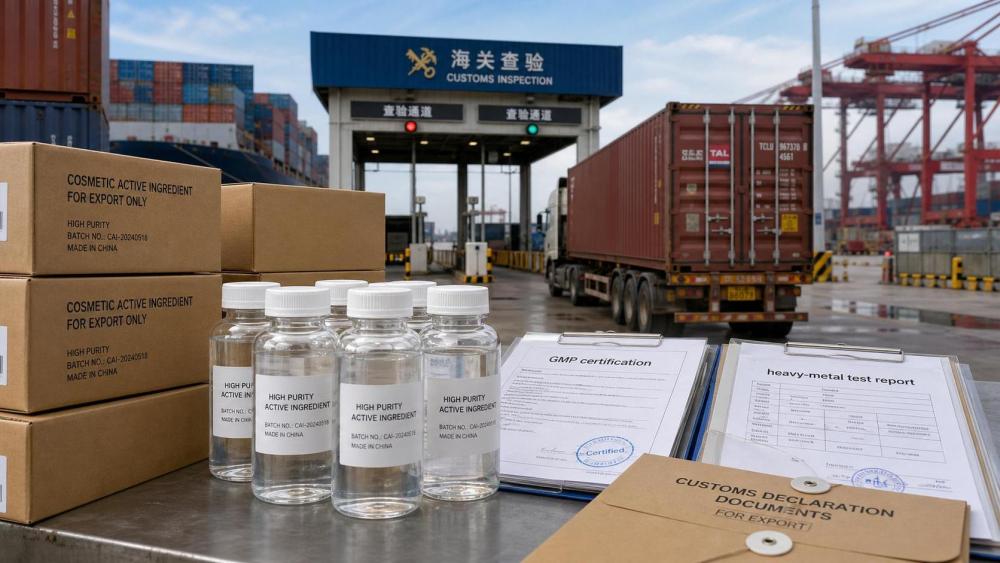
On July 10, 2026, China Customs suspended expedited "Green Channel" clearance for high-purity hyaluronic acid exports bound for Thailand, Vietnam, and Indonesia while updated GMP certification and heavy-metal test reports are being verified under ASEAN Cosmetic Directive Annex III. For suppliers, distributors, and buyers involved in premium dermocosmetic actives, the immediate issue is not only a customs procedure change, but a direct extension of lead times and a likely rise in landed costs in affected ASEAN routes.
What has changed in the export process
The confirmed change took effect on 2026-07-10. China Customs suspended the fast-track inspection arrangement referred to as the "Green Channel" for shipments of high-purity hyaluronic acid exported to Thailand, Vietnam, and Indonesia.
The suspension is pending verification of updated GMP certification and heavy-metal test reports. The verification requirement is tied to ASEAN Cosmetic Directive Annex III, as stated in the provided event summary.
According to the same summary, lead times have been extended by 5 to 8 working days. It also states that landed costs are increasing for distributors importing premium dermocosmetic actives.
Where the pressure is likely to appear first
Exporters and direct trading parties face documentation risk
From an industry perspective, exporters shipping high-purity hyaluronic acid into the three named ASEAN markets are the first group likely to feel the impact. Their exposure is concentrated in shipment preparation, customs submission, and release timing, because the suspended fast-track route was tied to inspection efficiency. What deserves closer attention is whether all required GMP and heavy-metal documentation is current, complete, and aligned with the stated verification expectations.
Distributors may absorb longer cycles and higher import costs
Distributors importing premium dermocosmetic actives are directly referenced in the event summary as facing higher landed costs. Analysis shows that the operational effect is likely to be felt in purchasing schedules, inventory turnover, and delivery commitments, because an additional 5 to 8 working days can disrupt timing even when demand remains unchanged. The key issue for this group is cost pass-through versus margin compression.
Downstream buyers may see slower replenishment rather than immediate market disruption
For procurement teams and downstream application businesses using premium dermocosmetic actives, the more immediate concern is replenishment timing rather than any confirmed structural shortage. Observably, the event points to a customs and compliance bottleneck, so buyers should watch for shipment scheduling changes, revised delivery windows, and possible adjustments in supplier communication around documentation status.
Supply chain service providers will need tighter exception handling
Logistics and trade service providers may also be affected where they manage export documentation, customs coordination, and delivery planning for affected routes. Analysis shows that the practical pressure point is visibility: delays linked to document verification require clearer milestone tracking and more precise handoffs between exporters, customs agents, and import-side partners.
What companies should watch now
Whether the suspension remains limited or becomes more procedural
What deserves closer attention is the next official wording around the suspension. The current confirmed fact is limited to the pause in expedited clearance for specific HA exports to Thailand, Vietnam, and Indonesia. Companies should distinguish between a suspension of fast-track handling and a broader trade restriction, because the business response differs significantly.
The readiness of GMP and heavy-metal supporting files
The event summary specifically links the suspension to verification of updated GMP certification and heavy-metal test reports. In practical terms, companies should review whether the documentation supporting affected shipments is updated, internally consistent, and readily retrievable for customs and customer-side review.
Contract timing and customer communication
Because lead times have already been extended by 5 to 8 working days according to the provided information, shipment planning and customer communication become immediate operational issues. Analysis shows that delivery promises, reorder timing, and buffer assumptions may need short-term revision, especially for high-value active ingredients moving on planned production or launch schedules.
Cost tracking in affected ASEAN lanes
The summary confirms rising landed costs for distributors importing premium dermocosmetic actives. Companies should therefore watch not only freight or customs timing, but the total cost impact on the specific Thailand, Vietnam, and Indonesia lanes covered by the suspension. This is especially relevant where pricing agreements were built on shorter clearance assumptions.
Why this matters beyond a single customs notice
Analysis shows that this development is best read as a compliance-sensitive trade signal rather than a standalone logistics delay. The trigger described in the summary is document verification tied to updated GMP certification and heavy-metal test reports under ASEAN Cosmetic Directive Annex III, which means the issue sits at the intersection of customs handling, regulatory documentation, and commercial delivery performance.
It is more appropriate to understand this as a short-term operational disruption with potential longer-term significance if verification requirements remain tight or become more formalized in day-to-day export practice. At this stage, however, the confirmed information does not establish a broader policy shift beyond the stated suspension and its immediate timing and cost effects. Continued observation is still necessary.
How the market should read the current signal
For now, the most balanced reading is that the event creates immediate execution pressure for HA shipments into three ASEAN destinations, while also highlighting how documentation readiness can quickly affect cross-border movement of premium cosmetic actives. The strongest confirmed effects are longer lead times and higher landed costs in the affected trade flow.
Observably, this should not yet be treated as a definitive long-term restructuring of the market. It is better understood as an active industry development that warrants close monitoring, especially by exporters, distributors, procurement teams, and supply chain coordinators with exposure to Thailand, Vietnam, and Indonesia.
Basis of this report and what still needs verification
This article is based on the user-provided news title, event date, and event summary concerning the suspension of expedited customs clearance for high-purity hyaluronic acid shipments to ASEAN on 2026-07-10.
For developments of this kind, commonly relevant source categories may include official customs notices, company disclosures, industry association updates, authoritative media reporting, and standard or regulatory documents. No specific official source link was provided in the input, so the underlying notice and any subsequent implementation details still require ongoing verification.
Further follow-up should focus on whether China Customs issues updated procedural language, whether verification expectations for GMP certification and heavy-metal test reports are clarified, and whether the current suspension remains limited to the named destinations and product context described in the provided summary.
Related News
- Galderma Marks 30 Years of Hyaluronic Acid Injectable InnovationOct 24, 2026Cosmeceutical Formulator
- Sihuan Pharmaceutical’s Two Self-Developed Aesthetic Products Approved in Hong KongOct 21, 2026Cosmeceutical Formulator
- Does Low-Molecular-Weight Hyaluronic Acid Work Better in Leave-Ons?Oct 23, 2026Cosmeceutical Formulator
- How high purity actives for serums reduce formula instability riskSep 30, 2026Cosmeceutical Formulator
Related News
- 00
0000-00
2026 Osong Cosmetics and Beauty Expo Concludes in South Korea - 00
0000-00
How to compare cosmetic active compounds by their cost in use - 00
0000-00
HKBU Showcases DR2 Following NMPA Registration as a New Cosmetic Ingredient - 00
0000-00
How to use ingredient market insights to forecast sourcing costs - 00
0000-00
Galderma Marks 30 Years of Hyaluronic Acid Injectable Innovation
Cosmeceutical Formulator
Weekly Insights
Stay ahead with our curated technology reports delivered every Monday.