





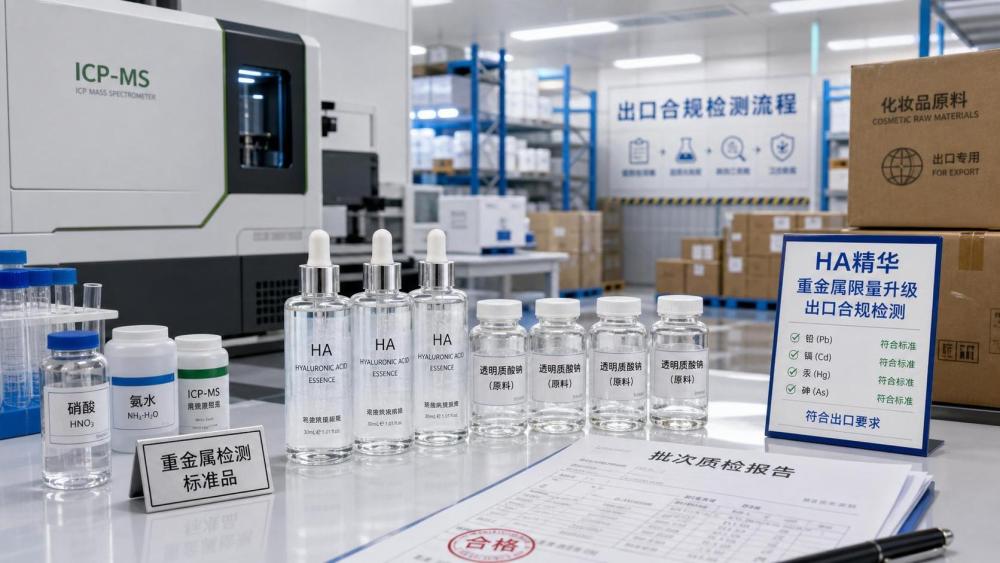
On 10 July 2026, Brazil’s ANVISA moved to tighten impurity control for high-purity hyaluronic acid used in dermocosmetic anti-aging serums, lowering the permitted limits for lead (Pb) and arsenic (As) and tying compliance to full ICP-MS batch certification from 1 October 2026. For ingredient suppliers, exporters, dermocosmetic manufacturers, distributors, and testing-related service providers, this is worth close attention because the change is no longer only a standards discussion: customs inspections have already intensified, and non-certified shipments are reportedly facing higher rejection rates in Brazil.
Tighter thresholds and a clearer certification trigger
According to the provided information, ANVISA Resolution RDC No. 42/2026 reduces the maximum allowable lead content in HA-based anti-aging serums from 5 ppm to 1.2 ppm and the maximum allowable arsenic content from 5 ppm to 0.8 ppm. The rule is scheduled to take effect on 1 October 2026.
The same summary states that the change is aligned with updates in ISO 22716:2024 Annex D and requires full ICP-MS batch certification. It also states that Brazilian distributors have reported rising rejection rates for non-certified hyaluronic acid shipments since customs inspections intensified in July 2026.
Where the pressure is likely to appear first
Imported raw material transactions face a tighter documentary bar
From an industry perspective, traders and export-facing suppliers are likely to feel the first impact because the new limits are paired with a batch-level certification requirement. The practical pressure point is not only product specification, but whether each shipment can be supported by ICP-MS documentation that is consistent with the new thresholds. Where documents are incomplete, outdated, or not matched to the shipped batch, customs clearance and delivery timing may become more exposed to disruption.
Formulators and manufacturers need to check incoming compliance assumptions
For dermocosmetic manufacturers using high-purity hyaluronic acid in anti-aging serums, the change may affect raw-material qualification, incoming inspection, and release planning. Analysis shows that a supplier relationship that previously relied on broader impurity tolerance may no longer be sufficient once the lower Pb and As limits take effect. What deserves closer attention is whether internal procurement specifications, supplier approval files, and quality documents are still aligned with the new Brazilian requirement.
Distributors and channel operators carry rising rejection and delivery risk
For distributors already handling shipments into Brazil, the reported increase in rejection rates for non-certified HA cargo suggests that the operational burden may shift into customs coordination, stock planning, and customer delivery commitments. Observably, this is relevant not only to compliance staff but also to commercial teams, because any disruption tied to certification gaps can quickly turn into delayed fulfillment, replacement pressure, or contract friction.
Testing and certification-related services become more central to shipment readiness
Testing service providers and compliance support firms may see greater demand because the rule change explicitly points to full ICP-MS batch certification. The key issue is less about a general quality claim and more about whether laboratory evidence is available in the form required by the transaction and regulatory review process. Companies involved in documentation review should therefore pay attention to consistency between test reports, batch identity, and shipment files.
What companies should review before the October deadline
Recheck whether batch documents match the new thresholds
Analysis shows that one immediate task is to verify whether existing test reports and supplier files reflect the lower Pb and As limits rather than older thresholds. Companies shipping into Brazil should pay particular attention to whether batch certification is complete and current, especially where goods may enter the market close to the 1 October 2026 effective date.
Review procurement language and supplier qualification files
What deserves closer attention is the wording used in purchasing specifications, quality agreements, and supplier qualification materials. If those documents still reference legacy impurity limits or do not clearly require ICP-MS batch certification, firms may face avoidable compliance gaps at the point of import, release, or customer acceptance.
Build more time into delivery and customs planning
Observably, intensified inspections since July 2026 create a practical timing issue even before the formal effective date arrives. Companies relying on Brazilian distribution channels may need to review lead times, shipment sequencing, and document readiness so that certification checks do not collide with committed delivery windows.
Keep watching for execution detail rather than assuming all practice is settled
The provided information confirms the rule change, its effective date, the ISO alignment, the certification requirement, and the reported customs trend. It does not provide fuller execution detail beyond that. For that reason, firms should continue monitoring how compliance expectations are expressed in official communications, transaction documents, and market-facing requirements rather than assuming every operational question has already been resolved.
How this change is best understood at this stage
From an industry perspective, this development is more appropriate to understand as a clear compliance tightening with early enforcement signals already visible in trade flows. The lower heavy-metal limits matter on their own, but the stronger signal is that certification and border scrutiny are moving closer together. At the same time, analysis should remain disciplined: the available information supports closer attention to enforcement direction, but it does not support broad claims about final market outcomes beyond the reported rejection trend.
A narrower rule, but a wider supply-chain signal
In practical terms, this is not just a formulation standard update for HA-based anti-aging serums. It also affects how suppliers document quality, how import-facing businesses prepare shipments, and how distributors assess delivery risk in Brazil. At present, it is more appropriate to read the development as an implemented rule change with visible execution pressure, while continuing to watch how certification practice, customs review, and downstream commercial requirements evolve in the market.
Basis of this article and what still needs verification
This article is based on the user-provided news title, event date, and event summary. For developments of this kind, the source types typically relevant include official regulatory notices, publications from supervisory authorities, customs or trade administration updates, industry association materials, standards organization documents, and reporting from authoritative trade media. A specific official source link was not provided in the input, so the underlying documentation should continue to be verified. Follow-up attention should remain on detailed regulatory wording, certification interpretation, procurement and tender document changes, market feedback, and how companies are executing against the new requirement in practice.
Related News
- Galderma Marks 30 Years of Hyaluronic Acid Injectable InnovationOct 24, 2026Cosmeceutical Formulator
- Sihuan Pharmaceutical’s Two Self-Developed Aesthetic Products Approved in Hong KongOct 21, 2026Cosmeceutical Formulator
- Does Low-Molecular-Weight Hyaluronic Acid Work Better in Leave-Ons?Oct 23, 2026Cosmeceutical Formulator
- How high purity actives for serums reduce formula instability riskSep 30, 2026Cosmeceutical Formulator
Related News
- 00
0000-00
Bairun Nine-Month Profit Up 20.4% to RMB 662m; Flavors and Fragrances Also Grow - 00
0000-00
How biomimetic peptides work in anti-aging skincare formulations - 00
0000-00
2026 Osong Cosmetics and Beauty Expo Concludes in South Korea - 00
0000-00
How to compare cosmetic active compounds by their cost in use - 00
0000-00
HKBU Showcases DR2 Following NMPA Registration as a New Cosmetic Ingredient
Cosmeceutical Formulator
Weekly Insights
Stay ahead with our curated technology reports delivered every Monday.