





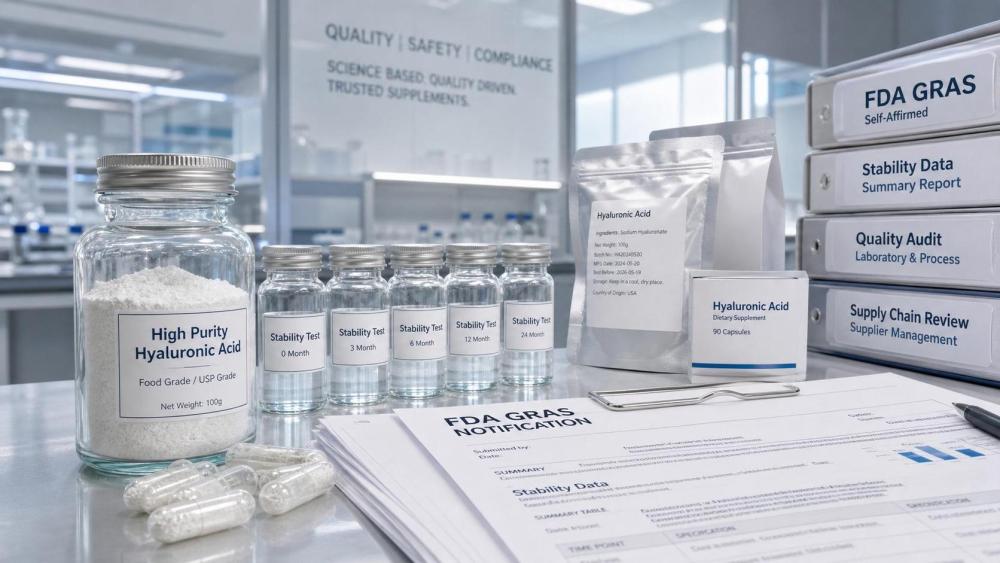
On 9 July 2026, the US FDA clarified a new documentation expectation for GRAS notifications covering oral hyaluronic acid with purity above 95%, requiring 24-month accelerated stability data under ICH Q1B conditions for new submissions with immediate effect. For companies supplying or sourcing high-purity HA for the US dietary supplement market, especially exporters in China and Korea and the brands that rely on their dossiers, this is not just a technical filing change but a practical shift that may affect market entry, shelf approval, procurement review, and submission readiness.
A narrower filing path for new oral HA submissions
The confirmed change is limited but clear. The FDA issued guidance described as non-binding in form but operationally binding in practice for new GRAS notifications involving oral hyaluronic acid above 95% purity. Under that clarification, such notifications must now include 24-month accelerated stability data prepared under ICH Q1B conditions.
The timing is also explicit: the requirement applies immediately to new submissions. The summary further indicates that existing GRAS letters lacking this data may no longer be sufficient to support market entry or retailer shelf approval for affected products.
The impact identified in the provided information is concentrated on Chinese and Korean HA manufacturers exporting to US dietary supplement brands.
Where the pressure is likely to appear first
Export-side dossier owners may face a documentation gap
From an industry perspective, exporters of high-purity oral HA are likely to feel the first direct effect because the new expectation sits at the dossier level. Where a supplier has relied on earlier GRAS support materials without the newly specified stability package, the immediate issue is whether those materials still satisfy customer onboarding or product launch requirements for new US business.
The business impact may therefore appear in compliance review, customer qualification, submission preparation, and shipment planning rather than only in laboratory work. What deserves closer attention is whether product files used in commercial discussions still match what US buyers now expect to see before approving supply.
US supplement brands and ingredient buyers may tighten intake reviews
For dietary supplement brands and procurement teams buying high-purity HA, the change may alter how supplier files are screened. If existing GRAS letters without the specified stability data no longer support market entry or retailer shelf approval, buyers may need to revisit whether current document sets remain usable for new product launches, retailer submissions, or internal compliance sign-off.
In practice, this can affect sourcing timelines, supplier comparisons, and the order in which purchasing decisions are made. The key point is not only whether an ingredient is available, but whether the supporting GRAS package is still acceptable for the intended US commercial pathway.
Channel and shelf-approval processes may become a gatekeeping step
The summary specifically mentions retailer shelf approval, which means the effect may extend beyond regulatory filing teams into commercial channel review. For companies preparing launches, a document gap at the GRAS support stage could become a downstream issue during listing or approval discussions with retail counterparts.
Analysis shows this may matter most where launch schedules depend on pre-agreed compliance files, technical documentation, and approval windows. Even without a formal ban described in the provided information, an operational documentation shortfall can still delay execution.
What companies should examine now
Check whether current GRAS support packages match the new expectation
Companies handling oral HA above 95% purity should first identify which US-facing projects depend on GRAS materials prepared before this clarification. Observably, the immediate practical question is whether the available file already contains the 24-month accelerated stability data under ICH Q1B conditions now expected for new submissions.
Review contract, sourcing, and launch documents for hidden dependencies
Businesses should also examine where existing GRAS letters are referenced in procurement files, technical packets, customer qualification documents, or launch schedules. If those materials were assumed to be sufficient for US market entry or shelf approval, the assumption itself may now need rechecking.
Watch for changes in execution language from customers and channels
The provided information does not include detailed enforcement mechanics, so it would be premature to describe a settled market-wide practice. What deserves closer attention is whether US brands, distributors, or retail review teams begin asking for the newly specified stability data as a standard precondition for onboarding, approval, or continued project progression.
Reassess delivery timing where submission readiness matters
Where supply arrangements are linked to near-term new submissions, companies may need to revisit delivery expectations and internal planning assumptions. This is less about confirmed disruption and more about managing the possibility that documentation readiness, rather than physical supply, becomes the pacing factor in execution.
Why this reads as an execution signal
Analysis shows this development is better understood as an execution-level compliance signal than as a purely theoretical guidance update. Although the summary describes the FDA position as non-binding in form, it also makes clear that it is operationally binding for new submissions, which is why the market impact can emerge quickly even without a broader rulemaking narrative in the provided information.
At the same time, it is still too early to treat every downstream consequence as settled fact. It is more appropriate to understand this as a live compliance shift whose full commercial effect will depend on how submission reviewers, brand owners, and shelf-approval processes apply the new expectation in practice.
How this update is best understood for now
For the HA ingredient trade linked to US oral supplement use, the significance of this development lies in a raised evidentiary threshold for new GRAS notifications involving purity above 95%. The immediate concern is not abstract policy change, but whether existing documentation remains commercially usable in market-entry and approval workflows.
A neutral reading is that this is already a meaningful filing and market-access signal, while the broader extent of disruption still requires observation. Companies closest to US submission support, procurement qualification, and retailer-facing approval processes are likely to have the clearest near-term reason to review their document position.
Basis of this article and what still needs verification
This article is based on the user-provided title, event date, and event summary. Information of this kind is commonly followed through sources such as regulatory announcements, releases from supervisory authorities, trade or customs-related notices, industry association updates, standard-setting documents, and reporting by established professional media.
No specific official source link was provided in the input, so the exact original publication path still needs to be verified. Observably, the areas that warrant continued follow-up include any further policy wording, execution interpretation for GRAS-related reviews, changes in retailer or buyer documentation requests, and practical market feedback from affected exporters and supplement supply chains.
Related News
- Galderma Marks 30 Years of Hyaluronic Acid Injectable InnovationOct 24, 2026Cosmeceutical Formulator
- Sihuan Pharmaceutical’s Two Self-Developed Aesthetic Products Approved in Hong KongOct 21, 2026Cosmeceutical Formulator
- Does Low-Molecular-Weight Hyaluronic Acid Work Better in Leave-Ons?Oct 23, 2026Cosmeceutical Formulator
- How high purity actives for serums reduce formula instability riskSep 30, 2026Cosmeceutical Formulator
Related News
- 00
0000-00
2026 Osong Cosmetics and Beauty Expo Concludes in South Korea - 00
0000-00
How to compare cosmetic active compounds by their cost in use - 00
0000-00
HKBU Showcases DR2 Following NMPA Registration as a New Cosmetic Ingredient - 00
0000-00
How to use ingredient market insights to forecast sourcing costs - 00
0000-00
Galderma Marks 30 Years of Hyaluronic Acid Injectable Innovation
Cosmeceutical Formulator
Weekly Insights
Stay ahead with our curated technology reports delivered every Monday.