





On 2026-07-06, Japan’s Ministry of Health, Labour and Welfare (MHLW) signaled a stricter compliance path for microbial-fermented hyaluronic acid with purity at or above 95% in FOSHU applications. The practical change is not only about technical review standards, but also about what evidence can still be used for market access: US GRAS letters that had previously been accepted are no longer sufficient on their own. For ingredient suppliers, FOSHU-oriented product developers, regulatory teams, and cross-border procurement functions, this is worth close attention because it may affect dossier preparation, supplier qualification, submission timing, and delivery expectations.
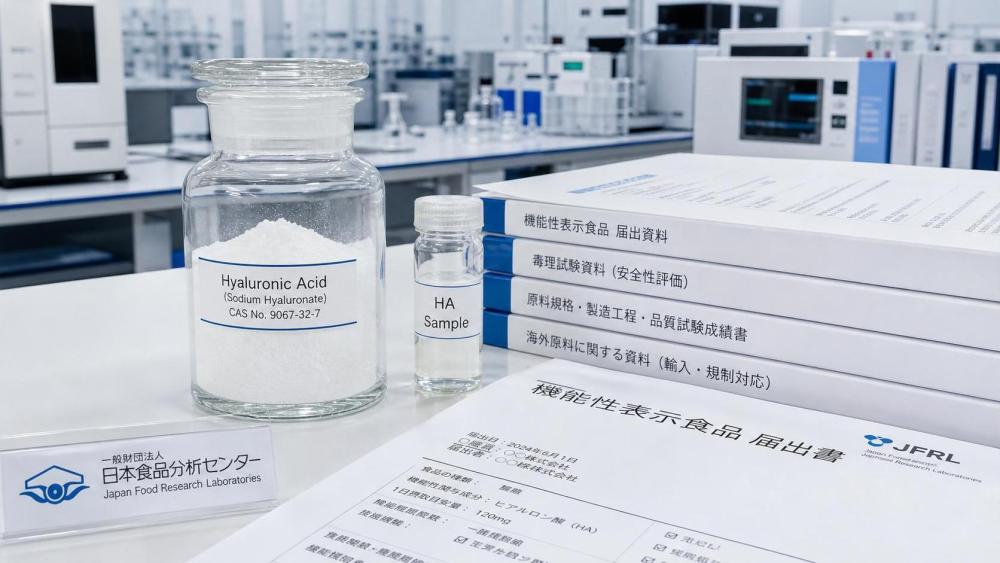
What the announced change clearly establishes
The confirmed facts are limited but important. MHLW announced on 2026-07-06 that microbial-fermented hyaluronic acid with purity of 95% or higher now requires a full JECFA-style toxicological dossier for FOSHU listing. The required submission includes a 90-day oral toxicity study. At the same time, US GRAS letters that had previously been accepted no longer suffice for this purpose.
The change therefore concerns the review basis for FOSHU listing of this specific ingredient category and raises the evidentiary threshold attached to that review route.
Where the pressure is likely to show up first
For ingredient suppliers serving FOSHU-related demand
From an industry perspective, suppliers of high-purity microbial-fermented HA may be affected first because the rule change shifts the burden from equivalency-style acceptance toward a fuller toxicological package. The main business impact is likely to appear in regulatory document readiness, customer technical support, and qualification discussions with downstream buyers. What deserves closer attention is whether existing product files were built around GRAS-based acceptance and now need to be supplemented for FOSHU-related use cases.
For product developers and manufacturers targeting FOSHU listing
Manufacturers using this ingredient in products intended for FOSHU listing may need to reassess submission assumptions, especially where project planning relied on previously accepted GRAS letters. The likely pressure points are dossier completeness, submission sequencing, and coordination between formulation, regulatory, and external testing documentation. Analysis shows that this is less about a routine paperwork update and more about whether the evidentiary package still matches the review expectation.
For procurement and cross-border supply functions
Procurement teams and import-facing commercial functions may also feel the effect because supplier selection can no longer be judged only on basic ingredient specifications or prior US regulatory references. In practice, buyers may need to pay closer attention to whether suppliers can support a full JECFA-style toxicological dossier for the relevant FOSHU pathway. This can affect sourcing decisions, contracting assumptions, and delivery planning where compliance documentation is a condition for commercial progress.
For testing and compliance support providers
Observably, service providers involved in regulatory support, dossier preparation, and testing documentation may see a shift in client demand toward toxicology-backed submissions rather than reliance on legacy equivalency materials. The direct implication is not confirmed project volume, but a change in the type of compliance support the market may require.
What companies should watch in the near term
Recheck whether existing files still fit the FOSHU route
Companies working with high-purity microbial-fermented HA should review whether their current document sets rely heavily on US GRAS letters. If so, the immediate issue is not that all uses are automatically blocked, but that the FOSHU listing route now points to a different evidentiary standard for the ingredient category described in the announcement.
Prepare for a higher documentation threshold
Analysis shows that firms should pay attention to the completeness and format of toxicological materials, including the now-mentioned 90-day oral toxicity study. Because the input does not provide detailed procedural guidance, it is more appropriate to treat this as a signal to verify submission expectations rather than assume a fully defined operational checklist already exists.
Review procurement timing and supplier qualification logic
Where commercial plans depend on FOSHU positioning, companies may need to revisit procurement schedules and supplier screening criteria. What deserves closer attention is whether technical files, declarations, and supporting studies are aligned with the new review expectation before launch, bid, or supply commitments are made. If those materials are incomplete, timeline assumptions may need to be handled more cautiously.
Track how the wording is reflected in market documents
Observably, the next practical signals may emerge through regulatory communication, customer compliance requests, specification documents, and other execution-facing paperwork. Since the announcement summary does not include detailed implementation language, companies should continue checking how this stricter review basis is reflected in actual submission practice and commercial documentation.
Why this reads as more than a technical clarification
As an editorial observation, this update is better understood as an execution signal around evidentiary standards rather than a minor wording change. The key point is that previously accepted US GRAS letters no longer suffice for the relevant FOSHU listing context, which suggests that comparability arguments now carry less weight than a dedicated toxicological dossier for the specified ingredient profile.
At the same time, it would be premature to overstate the downstream effect beyond what has been provided. The available information confirms a higher review threshold for microbial-fermented HA at 95% purity or above in FOSHU listing, but it does not by itself define the full pace of implementation, the detailed review workflow, or the broader treatment of adjacent product categories. Those elements still require observation.
How this development is best understood now
The industry significance of this announcement lies in the shift from prior reliance on GRAS-based acceptance toward a fuller toxicological evidence model for a clearly identified ingredient and application route. For businesses connected to FOSHU-related planning, the immediate value of this information is operational: it signals that compliance assumptions, supplier documentation, and project timelines may need to be reviewed.
At present, it is more appropriate to understand this as a rule application change with concrete compliance implications, while still recognizing that execution details and market response remain subject to further verification.
Basis of this article and points that still need checking
This article is based on the user-provided news title, event date, and summary concerning MHLW’s 2026-07-06 announcement on FOSHU listing requirements for microbial-fermented hyaluronic acid with purity at or above 95%.
For developments of this type, relevant source categories usually include official government announcements, regulatory authority releases, trade or customs-related notices, industry association communications, standard-setting documents, and reporting by established professional media. A specific official source link was not provided in the input, so the underlying text and any later implementation details still need ongoing verification.
Items that remain worth monitoring include any detailed procedural clarification, the exact compliance interpretation used in certification or listing practice, changes in customer or bid documentation, industry feedback, and how companies adjust dossier preparation and supplier qualification in response.
Related News
- Galderma Marks 30 Years of Hyaluronic Acid Injectable InnovationOct 24, 2026Cosmeceutical Formulator
- Sihuan Pharmaceutical’s Two Self-Developed Aesthetic Products Approved in Hong KongOct 21, 2026Cosmeceutical Formulator
- Does Low-Molecular-Weight Hyaluronic Acid Work Better in Leave-Ons?Oct 23, 2026Cosmeceutical Formulator
- How high purity actives for serums reduce formula instability riskSep 30, 2026Cosmeceutical Formulator
Related News
- 00
0000-00
2026 Osong Cosmetics and Beauty Expo Concludes in South Korea - 00
0000-00
How to compare cosmetic active compounds by their cost in use - 00
0000-00
HKBU Showcases DR2 Following NMPA Registration as a New Cosmetic Ingredient - 00
0000-00
How to use ingredient market insights to forecast sourcing costs - 00
0000-00
Galderma Marks 30 Years of Hyaluronic Acid Injectable Innovation
Cosmeceutical Formulator
Weekly Insights
Stay ahead with our curated technology reports delivered every Monday.