





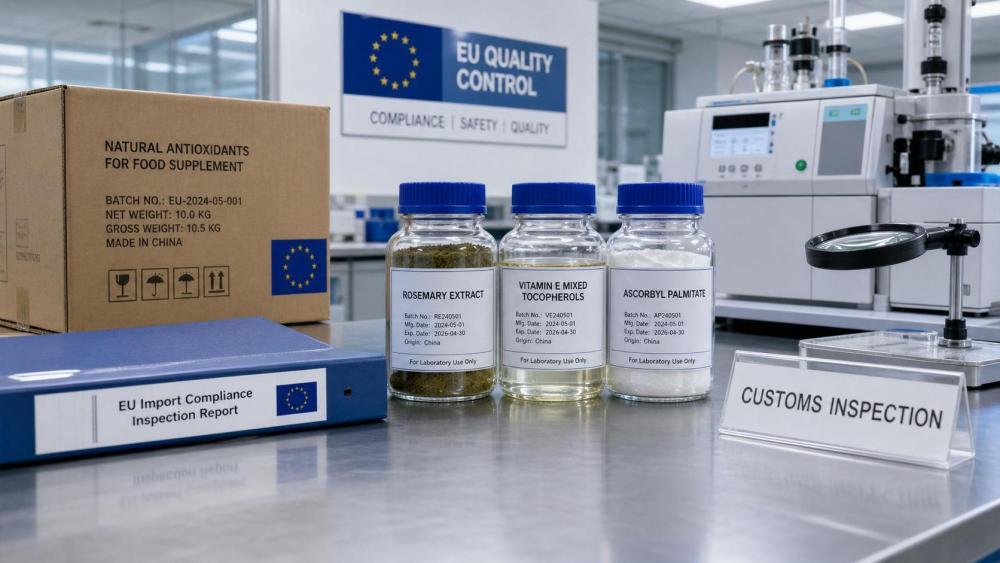
On 2026-07-06, the European Commission published Regulation (EU) 2026/1389, updating Annex III requirements for certain natural antioxidants imported into the EU. The change introduces ISO 17025-accredited laboratory verification for rosemary extract (E392), tocopherol blends (E306-E309), and ascorbyl palmitate (E304), with border rejection set to begin for non-compliant shipments on 1 August 2026. For exporters, ingredient suppliers, and EU food and supplement manufacturers, this is not just a technical adjustment; it directly affects import compliance, documentation readiness, supplier qualification, and delivery planning.
What the regulation now requires
The confirmed facts are limited but clear. Regulation (EU) 2026/1389 was published by the European Commission on 2026-07-06. It requires ISO 17025-accredited lab verification for three imported product groups entering the EU: rosemary extract (E392), tocopherol blends (E306-E309), and ascorbyl palmitate (E304). The rule applies to imports into the EU, and shipments that do not meet the requirement will face border rejection starting 1 August 2026.
The event summary also makes clear that the immediate commercial impact falls on exporters of natural food preservatives and antioxidants that supply EU food and supplement manufacturers.
Where the operational pressure is likely to appear
Export shipments face a tighter entry condition
From an industry perspective, exporters are the first group affected because the new requirement is tied directly to import acceptance. The practical issue is no longer only product supply, but whether each shipment can be supported by verification from an ISO 17025-accredited laboratory. This means export documentation, pre-shipment compliance checks, and release timing become more sensitive than before.
EU buyers will need closer supplier verification
For food and supplement manufacturers purchasing these antioxidants, the rule change raises a procurement-side question: whether existing suppliers can consistently provide compliant verification for the covered products. What deserves closer attention is that sourcing decisions may now depend not only on price and specification alignment, but also on whether compliance documents are ready in a form acceptable for import clearance.
Testing and compliance support become part of delivery readiness
For laboratories and compliance-related service providers, the change points to a more formal role in trade execution. Analysis shows that testing is no longer just a quality support function in this context; it becomes part of the import threshold for the listed antioxidants. Businesses involved in coordinating shipment files, technical dossiers, and customs-facing documents will need to track this requirement closely.
What companies should review now
Check whether covered products are already mapped correctly
Companies trading in rosemary extract (E392), tocopherol blends (E306-E309), and ascorbyl palmitate (E304) should first confirm whether these products are present in current export, sourcing, or supply contracts linked to the EU market. This is a basic but necessary step before any document or testing workflow can be adjusted.
Review laboratory qualification and report readiness
Observably, the most immediate compliance point is the ISO 17025-accredited lab requirement. Companies should pay attention to whether their current testing arrangements match that condition and whether supporting reports can be prepared in time for import procedures. Since the provided information does not include detailed execution guidance, this should be treated as a compliance review priority rather than as a settled procedural checklist.
Reassess lead times and shipment planning
Because non-compliant shipments will face border rejection from 1 August 2026, businesses should closely monitor the effect on lead times, shipment release schedules, and purchase planning. The confirmed facts do not specify how review timing or border handling will operate in practice, so companies should remain cautious about delivery commitments tied to the affected product categories.
Watch for changes in buyer documentation requests
It is more appropriate to understand this as a signal that technical documents, supplier files, and import-related paperwork may receive closer scrutiny. Exporters and suppliers should therefore monitor whether EU customers begin updating purchasing terms, technical specifications, or compliance documentation requests in response to the regulation.
Why this matters beyond a narrow testing update
Analysis shows that this development is best read as an execution-focused rule change rather than a general policy statement. The regulation links market access for specific antioxidant imports to accredited verification and sets a clear enforcement date for border rejection. That gives the market a concrete compliance trigger, even though some practical details may still need closer observation through official implementation and commercial response.
From an industry perspective, the key issue is not only the existence of a new requirement, but how quickly it becomes embedded in supplier approval, shipment release, and procurement control processes. That is why this update deserves attention from both trade-facing and manufacturing-facing teams.
How the market should read this development
At this stage, the event is more appropriately understood as an already defined compliance change with a near-term enforcement consequence, rather than as a distant policy signal. The confirmed facts support a clear conclusion: affected imports will need ISO 17025-accredited lab verification, and non-compliant shipments risk rejection at the EU border from 1 August 2026. At the same time, the market still needs to observe how implementation language, buyer requirements, and day-to-day compliance practice develop around this rule.
Basis of this article and what still needs verification
This article is based on the user-provided news title, event date, and event summary. For developments of this kind, relevant source categories typically include official regulatory notices, publications from supervisory or trade authorities, customs-related notices, industry association updates, standard-setting documents, and reporting by authoritative trade media. A specific official source link was not provided in the input, so further verification remains necessary. Observably, the areas that still require continued attention include detailed implementation wording, certification and testing interpretation, possible changes in procurement and tender documents, market feedback, and how affected companies carry the rule into actual shipment and compliance practice.
Related News
- How to assess a food antioxidants distributor’s traceability practicesOct 11, 2026Food Preservation Scientist
- How natural antioxidants for oils can prevent rancidity in storageSep 25, 2026Food Preservation Scientist
- How to choose natural antioxidants for beverages with longer shelf lifeAug 23, 2026Food Preservation Scientist
- EU Tightens MRLs for Three Pesticides, Prompting Raw Material Checks for Natural Antioxidant ExportsAug 17, 2026Food Preservation Scientist
Related News
- 00
0000-00
2026 Osong Cosmetics and Beauty Expo Concludes in South Korea - 00
0000-00
How to compare cosmetic active compounds by their cost in use - 00
0000-00
HKBU Showcases DR2 Following NMPA Registration as a New Cosmetic Ingredient - 00
0000-00
How to use ingredient market insights to forecast sourcing costs - 00
0000-00
Galderma Marks 30 Years of Hyaluronic Acid Injectable Innovation
Food Preservation Scientist
Weekly Insights
Stay ahead with our curated technology reports delivered every Monday.