





On July 1, 2026, the U.S. FDA released a draft supplementary guide on GRAS exemptions for natural food antioxidants, introducing a clearer data expectation for both new submissions and existing GRAS-recognized materials. For suppliers, exporters, formulators, and food application teams serving the U.S. and Canada markets, the development is worth close attention because it shifts part of the compliance focus from ingredient identity alone to performance retention inside the final food system.
What the draft guide requires
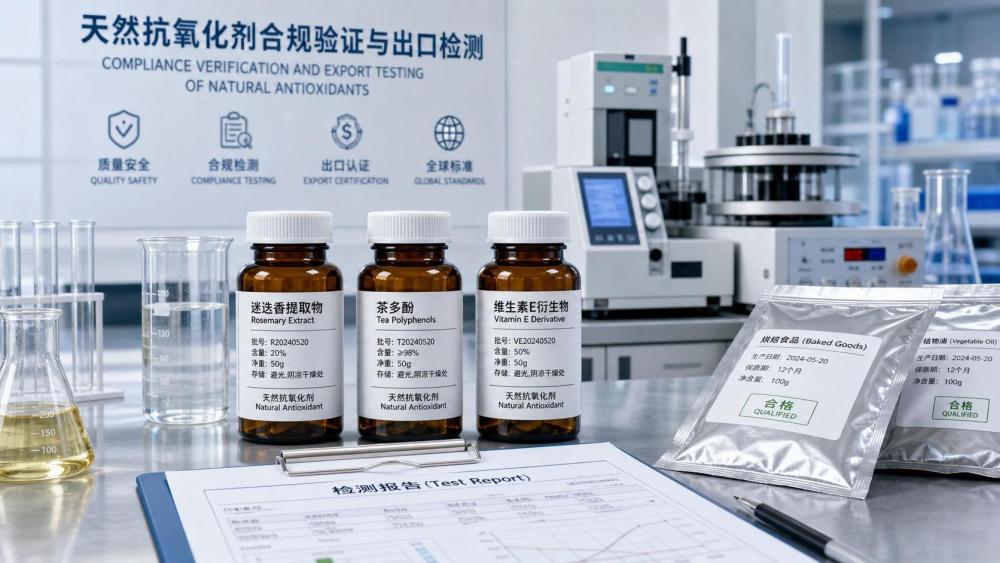
According to the information provided, the FDA draft applies to natural antioxidants under GRAS exemption pathways, including examples such as rosemary extract, tea polyphenols, and vitamin E derivatives. The draft states that both newly notified products and existing GRAS-recognized natural antioxidants must provide accelerated stability test data covering more than three months.
The stated purpose of that requirement is to show that, within the terminal food system, the antioxidant can retain at least 90% of its activity. The information provided also indicates that this requirement is expected to directly affect formulation validation processes and certification timelines for Chinese suppliers exporting antioxidant products to the U.S. and Canada markets.
Where the pressure is likely to appear first
Export-oriented ingredient suppliers may face a longer validation path
From an industry perspective, suppliers selling natural antioxidants into North America may be affected first because the draft links market access more closely to stability evidence in the end-use food matrix. The main pressure point is likely to be document preparation, validation sequencing, and the time needed to complete supporting studies before customer submission or renewal steps move forward.
Formulation and application teams may need tighter coordination
Analysis shows that the requirement is not only about the antioxidant ingredient itself, but about how it performs in the final food system. That means formulation, technical service, and application verification teams may need to pay closer attention to how test materials are selected, how end-use conditions are defined, and whether the submitted data aligns with the intended food application.
Buyers and downstream users may review supplier readiness more closely
For procurement teams and downstream food manufacturers, the likely impact is operational rather than theoretical. What deserves closer attention is whether current suppliers can provide stability data that matches the applicable product form and usage scenario, and whether this adds time to approval, substitution, or revalidation decisions.
Certification and cross-border service processes could become more time-sensitive
Observably, service providers involved in regulatory support, submission preparation, and export coordination may also see changes in workflow. If stability data becomes a routine expectation for both new and existing materials, document completeness, study timing, and customer communication may become more critical in delivery planning.
What companies should track now
Watch for any change in the FDA's final wording
The current document is described as a draft guide. Analysis shows that companies should distinguish between the policy signal already visible now and the final compliance details that may still evolve. The immediate task is to monitor how the FDA ultimately defines scope, evidence expectations, and applicability to existing GRAS-recognized ingredients.
Review whether core products already have usable stability support
For businesses handling rosemary extract, tea polyphenols, vitamin E derivatives, or similar natural antioxidants, a practical point of attention is whether current technical files already include more than three months of accelerated stability data tied to the terminal food system. If not, the likely gap is not only scientific, but also commercial, because customer review and export scheduling may depend on it.
Separate regulatory signaling from business execution
What deserves closer attention is the distinction between a published draft and actual downstream implementation. Even before any final rule position is clarified, customers may begin asking suppliers about data readiness, validation plans, and documentation status. Companies may therefore need to prepare communication materials and internal timelines before formal enforcement expectations are fully settled.
Prepare for cycle-time effects in export business
The information provided specifically notes an impact on Chinese suppliers exporting to the U.S. and Canada. From an operational perspective, businesses may need to review submission lead times, customer commitments, and document handoff processes, especially where certification timing or formulation verification already sits on a tight schedule.
Why this looks like more than a routine documentation update
Analysis shows that this development can be read as a signal that evidence expectations around natural antioxidants are moving closer to demonstrated in-system performance. That does not automatically mean a final regulatory outcome has been fixed, but it does suggest that data quality and application relevance may carry more weight in future GRAS-related work for these materials.
It is more appropriate to understand this as a policy signal with practical near-term consequences, rather than as a completed regulatory endpoint. The reason the industry should continue watching it is that draft guidance can influence customer expectations and internal compliance planning even before final language is confirmed.
How the market may need to frame this update
At this stage, the most balanced reading is that the FDA draft introduces a more explicit stability-data expectation for natural food antioxidants and that this may affect verification and certification timing for export business linked to North America. The confirmed facts are limited to the draft release, the stated data requirement, the activity-retention threshold, and the indicated impact on Chinese suppliers.
For industry participants, the immediate significance is not a proven market outcome but a clearer compliance direction. It is more appropriate to understand this as a development that warrants active monitoring, early data preparation, and closer customer communication, especially where U.S. and Canada market access depends on GRAS-related documentation.
Basis of this article and what still needs verification
This article is based on the user-provided news title, event date, and event summary. For this type of industry update, source categories usually relevant to verification include official regulatory notices, company disclosures, industry association updates, authoritative media coverage, and standards-related documents.
No specific official source link was provided in the input, so the exact official publication record and any later revision still need ongoing verification. Follow-up attention should remain on whether the FDA issues further clarification, whether the draft wording changes, and how the requirement is reflected in practical submission and export workflows.
Related News
- How to assess a food antioxidants distributor’s traceability practicesOct 11, 2026Food Preservation Scientist
- How natural antioxidants for oils can prevent rancidity in storageSep 25, 2026Food Preservation Scientist
- How to choose natural antioxidants for beverages with longer shelf lifeAug 23, 2026Food Preservation Scientist
- EU Tightens MRLs for Three Pesticides, Prompting Raw Material Checks for Natural Antioxidant ExportsAug 17, 2026Food Preservation Scientist
Related News
- 00
0000-00
2026 Osong Cosmetics and Beauty Expo Concludes in South Korea - 00
0000-00
How to compare cosmetic active compounds by their cost in use - 00
0000-00
HKBU Showcases DR2 Following NMPA Registration as a New Cosmetic Ingredient - 00
0000-00
How to use ingredient market insights to forecast sourcing costs - 00
0000-00
Galderma Marks 30 Years of Hyaluronic Acid Injectable Innovation
Food Preservation Scientist
Weekly Insights
Stay ahead with our curated technology reports delivered every Monday.