





On June 29, 2026, Japan’s Ministry of Health, Labour and Welfare (MHLW) tightened the maximum limits for arsenic (As) and cadmium (Cd) in Natural Antioxidants such as tea polyphenols and rosemary extract, with the new requirements taking effect immediately on the day of announcement. For exporters, ingredient suppliers, processors, and buyers linked to the Japanese market, the development deserves attention because it changes compliance thresholds without a transition period and directly affects access to the JAS organic certification supply chain.
What the New MHLW Notice Confirms
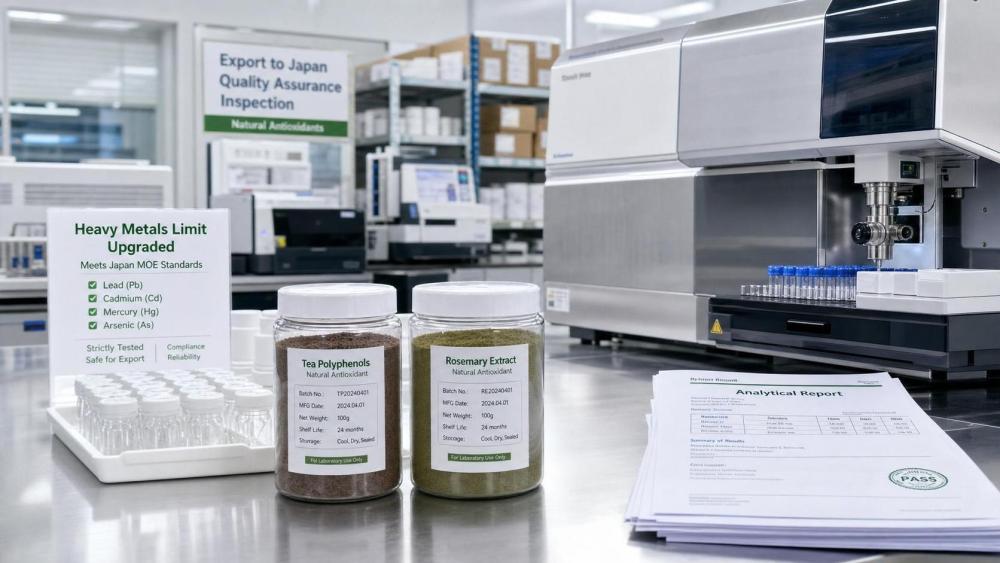
According to the information provided, MHLW issued a notice on June 29, 2026 lowering the maximum residue limits for arsenic and cadmium in Natural Antioxidants. The arsenic limit was reduced to 0.5 mg/kg from 0.625 mg/kg, and the cadmium limit was reduced to 0.1 mg/kg from 0.125 mg/kg. The new rule became effective on the same day it was released.
The confirmed scope mentioned in the input includes Natural Antioxidants such as tea polyphenols and rosemary extract. The same input also states that Chinese export companies must immediately provide third-party ICP-MS full-spectrum heavy metal reports; otherwise, they cannot enter Japan’s JAS organic certification supply chain.
Where the Immediate Pressure May Appear
Export-facing ingredient shipments
From an industry perspective, direct exporters are likely to face the most immediate pressure because the rule is already in force. The impact is likely to concentrate on shipment qualification, customs-facing documentation, and client-side compliance review, especially where products are sold into Japan with organic supply chain requirements.
Raw material sourcing and upstream control
Analysis shows that raw material procurement teams may be affected where tea polyphenols, rosemary extract, or related Natural Antioxidants are sourced from multiple suppliers. The main issue is not only the lower limits themselves, but whether upstream suppliers can support them with third-party ICP-MS heavy metal documentation that matches buyer expectations for Japanese market entry.
Processing and manufacturing handover points
For processors and manufacturers using these antioxidant ingredients, the likely impact sits at the handover between procurement, quality control, and customer delivery. What deserves closer attention is whether existing stock, ongoing orders, and released batches can still be documented in a way that satisfies downstream requirements tied to Japan and the JAS organic certification supply chain.
Buyers and supply chain service providers
Buyers, traders, and supply chain service providers may also see immediate changes in document checks, supplier screening, and delivery scheduling. Observably, the rule matters not only as a technical limit update, but as a gatekeeping condition for participation in a specific certified supply chain.
What Companies Should Check Now
Whether current test reports still match the new thresholds
Companies serving Japan should first verify whether existing arsenic and cadmium reports remain usable under the revised limits of 0.5 mg/kg and 0.1 mg/kg. This is a practical issue because the change took effect immediately, leaving little room between regulatory notice and business execution.
Whether third-party ICP-MS documentation is ready for review
The provided information makes third-party ICP-MS full-spectrum heavy metal reports a near-term compliance focus for Chinese exporters. In practical terms, firms should pay attention to whether those reports are complete, current, and aligned with customer or certification-chain review requirements before goods move forward.
Which business lines depend on the JAS organic supply chain
Not every shipment may face the same level of exposure. Analysis shows that the most sensitive business lines are those that rely on entry into Japan’s JAS organic certification supply chain. Companies should identify those orders, customers, and product categories first, because the commercial consequence described in the input is direct exclusion from that supply chain where the required documentation is missing.
How to separate policy wording from execution risk
What deserves closer attention is the difference between the text of the rule and how business interruption may occur in practice. The confirmed fact is that the limits have been lowered and are already effective; the operational question for companies is how quickly testing, document exchange, and customer acceptance can be synchronized under the new thresholds.
Why This Looks Like More Than a Routine Parameter Update
Observably, this development is best read as an immediate compliance event rather than a distant policy signal, because the implementation date is the same as the announcement date. At the same time, it should not yet be overstated as a broader market conclusion beyond the facts provided. Analysis shows that the practical significance comes from the combination of tighter heavy metal limits and the stated requirement for third-party ICP-MS reporting for Chinese exporters seeking access to the JAS organic certification supply chain.
It is more appropriate to understand this as a targeted but high-priority regulatory change that affects documentation readiness, supplier qualification, and transaction continuity. Continued attention is warranted because the current input confirms the rule change and its immediate supply chain consequence, while further operational interpretation may still depend on later official clarification or downstream enforcement practice.
How the Industry May Best Read the Change
At this stage, the clearest takeaway is that Japan’s latest move creates an immediate compliance threshold change for certain Natural Antioxidants and raises the importance of verifiable heavy metal testing in export business linked to JAS organic certification. From an industry perspective, this is neither a minor wording revision nor a basis for sweeping conclusions. It is more appropriate to understand it as a concrete short-term regulatory adjustment with potential longer-term signaling value, and one that companies should address through testing, documentation, and supply chain communication rather than assumption.
Basis of This Article and Ongoing Verification
This article is based on the user-provided news title, event date, and event summary. For this type of industry update, common source categories may include official notices, company disclosures, industry association releases, authoritative media coverage, and standards-related documents. The specific official source link was not provided in the input, so continued verification remains necessary. Follow-up attention should remain on any later official wording, implementation clarification, and document-review expectations affecting trade access and JAS organic certification supply chain participation.
Related News
- How to assess a food antioxidants distributor’s traceability practicesOct 11, 2026Food Preservation Scientist
- How natural antioxidants for oils can prevent rancidity in storageSep 25, 2026Food Preservation Scientist
- How to choose natural antioxidants for beverages with longer shelf lifeAug 23, 2026Food Preservation Scientist
- EU Tightens MRLs for Three Pesticides, Prompting Raw Material Checks for Natural Antioxidant ExportsAug 17, 2026Food Preservation Scientist
Related News
- 00
0000-00
2026 Osong Cosmetics and Beauty Expo Concludes in South Korea - 00
0000-00
How to compare cosmetic active compounds by their cost in use - 00
0000-00
HKBU Showcases DR2 Following NMPA Registration as a New Cosmetic Ingredient - 00
0000-00
How to use ingredient market insights to forecast sourcing costs - 00
0000-00
Galderma Marks 30 Years of Hyaluronic Acid Injectable Innovation
Food Preservation Scientist
Weekly Insights
Stay ahead with our curated technology reports delivered every Monday.