





On July 15, 2026, the European Commission’s emergency notice turned a formulation issue into an immediate trade and compliance matter for food and cosmetics raw materials containing HP-Alginate or HP-Xanthan. The measure deserves close attention from importers, modified hydrocolloid exporters, procurement teams, contract manufacturers, and customs-facing supply chain operators because it directly affects customs clearance, supporting documentation, and near-term delivery arrangements.
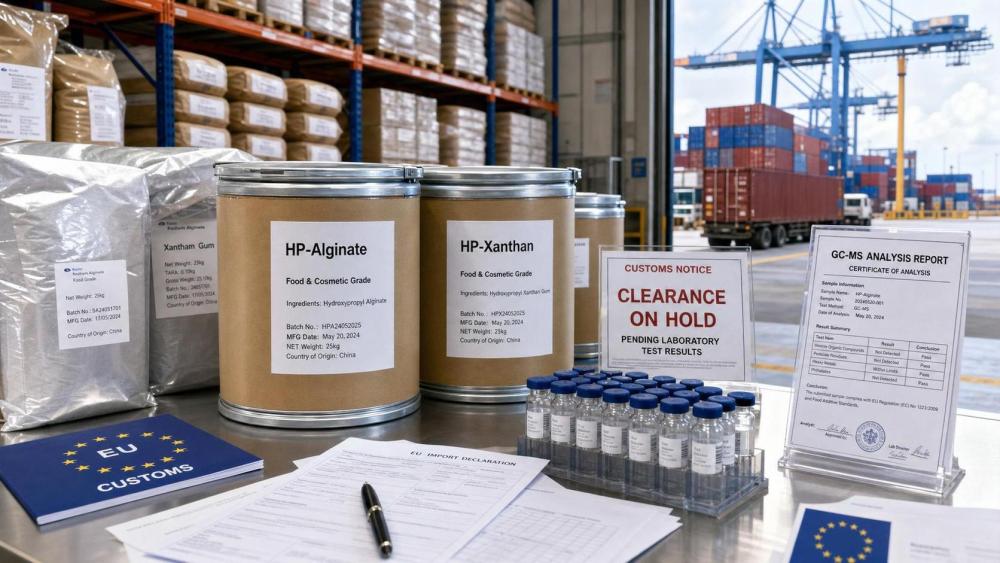
What the Commission Notice Confirms
According to the information provided, the European Commission issued an emergency notification on June 30, 2026, under reference EC/FFAI/2026/071. The notice followed the detection of a risk related to undeclared propylene oxide residues in certain hydroxypropyl-modified alginates.
From July 15, all food and cosmetic raw materials containing HP-Alginate or HP-Xanthan are subject to a suspension of customs clearance. Importers are required to submit third-party GC-MS residue test reports. The information provided also indicates that major Chinese exporters of modified colloids need to start process verification and corrective testing work immediately.
Where the Pressure Appears First in the Supply Chain
Import clearance becomes the first operational bottleneck
From an industry perspective, importers and traders are likely to face the most immediate disruption because the measure is tied directly to customs release. The impact is not abstract: without the required third-party GC-MS documentation, cargo handling and customs timelines may be interrupted. What deserves closer attention is whether existing shipments, in-transit lots, and newly booked orders can meet the documentation requirement in time.
Exporters of modified hydrocolloids face process and evidence scrutiny
For manufacturers and exporters of HP-Alginate and HP-Xanthan, the issue extends beyond a single shipment. Analysis shows that the practical pressure point is the link between production process control and documentary proof. The notice raises the importance of validating whether current manufacturing and quality documentation can support residue-related claims, especially when customers or importers request updated testing records before shipment.
Downstream users may see procurement and formulation delays
Food and cosmetics companies that purchase these materials may be affected through procurement schedules, raw material release timing, and production planning. Observably, even where demand remains unchanged, the need for third-party residue reports can slow supplier confirmation, purchase approval, and incoming material acceptance. Buyers should therefore watch not only product availability, but also whether supplier documentation remains consistent across batches and delivery windows.
Logistics and compliance service providers will need faster coordination
Customs brokers, testing coordinators, and other supply chain service providers may also see immediate workload changes. Their role becomes more sensitive where shipment timing depends on the completeness of residue testing documents. In practical terms, communication gaps between exporter, importer, and testing party could become as disruptive as the regulatory measure itself.
What Companies Should Watch Now
Separate confirmed requirements from possible future adjustments
The confirmed requirement in the provided information is clear: customs clearance is suspended from July 15 for affected materials unless importers provide third-party GC-MS residue reports. Companies should distinguish this confirmed rule from any assumptions about how long the measure may last or whether its scope could later change. That distinction matters for customer communication and shipment planning.
Review affected SKUs and open orders without delay
Businesses handling HP-Alginate or HP-Xanthan should identify which products, pending shipments, and customer contracts fall within the stated scope. The practical concern is not only inventory already prepared for export, but also purchase commitments and delivery promises that depend on uninterrupted EU entry procedures.
Check whether process verification and testing records are decision-ready
The provided information specifically notes the need for Chinese modified colloid exporters to begin process verification and corrective testing. Analysis shows that this is not only a laboratory issue. Companies need to assess whether their internal records, third-party reports, and product declarations are aligned closely enough to support importer filing and customer review without delay.
Prepare for tighter buyer and importer questions
Procurement teams and importers are likely to ask more detailed questions about residue testing status, batch-level support documents, and timing for compliant release. What deserves closer attention is the gap between having a technical explanation and having documents that are usable in trade execution. Firms should be ready to respond on both points.
Why This Looks Like More Than a Routine Documentation Issue
Analysis shows that this development should not be read simply as an isolated paperwork adjustment. The trigger described in the notice is a residue risk tied to undeclared propylene oxide in certain hydroxypropyl-modified alginates, and the regulatory response directly links market access to third-party testing evidence. That makes the event meaningful both as an immediate operational disruption and as a signal that compliance expectations around modified hydrocolloid processing and declaration may be receiving closer scrutiny.
At the same time, it is more appropriate to understand this as a live regulatory development rather than a settled long-term outcome. The current facts confirm a suspension and a testing requirement, but they do not, based on the provided information, establish the duration, final enforcement path, or any broader expansion beyond the named ingredients. Continued observation is therefore necessary.
How This News Is Best Interpreted at This Stage
At this stage, the most balanced reading is that the measure represents an immediate short-term trade constraint with potentially broader compliance implications if scrutiny remains focused on hydroxypropyl-modified hydrocolloids. For the industry, the near-term priority is execution: testing, documentation, shipment review, and customer communication. The longer-term meaning still needs verification through subsequent official wording and implementation practice.
Basis of This Article and Ongoing Verification
This article is based on the user-provided news title, event date, and event summary. For developments of this kind, common source types usually include official notices, company statements, industry association updates, authoritative media coverage, and standards or compliance documents. No specific official source link was provided in the input, so the original publication link and any later updates still need to be continuously verified. Follow-up attention should focus on any further official clarification about scope, documentation standards, and implementation at the customs clearance level.
Related News
- How to assess a bio-based thickener manufacturer's batch consistencyOct 16, 2026Food Rheology Expert
- Verifying halal status of hydrocolloid ingredients in the Middle EastOct 15, 2026Food Rheology Expert
- Why Can Xanthan Gum Lose Viscosity After Adding Electrolytes?Oct 18, 2026Food Rheology Expert
- How Do You Test Hydrocolloid Viscosity After Changing a Thickener?Oct 17, 2026Food Rheology Expert
Related News
- 00
0000-00
2026 Osong Cosmetics and Beauty Expo Concludes in South Korea - 00
0000-00
How to compare cosmetic active compounds by their cost in use - 00
0000-00
HKBU Showcases DR2 Following NMPA Registration as a New Cosmetic Ingredient - 00
0000-00
How to use ingredient market insights to forecast sourcing costs - 00
0000-00
Galderma Marks 30 Years of Hyaluronic Acid Injectable Innovation
Food Rheology Expert
Weekly Insights
Stay ahead with our curated technology reports delivered every Monday.