





Molecular Gastronomy Texture Control Starts With the Real Texture Target
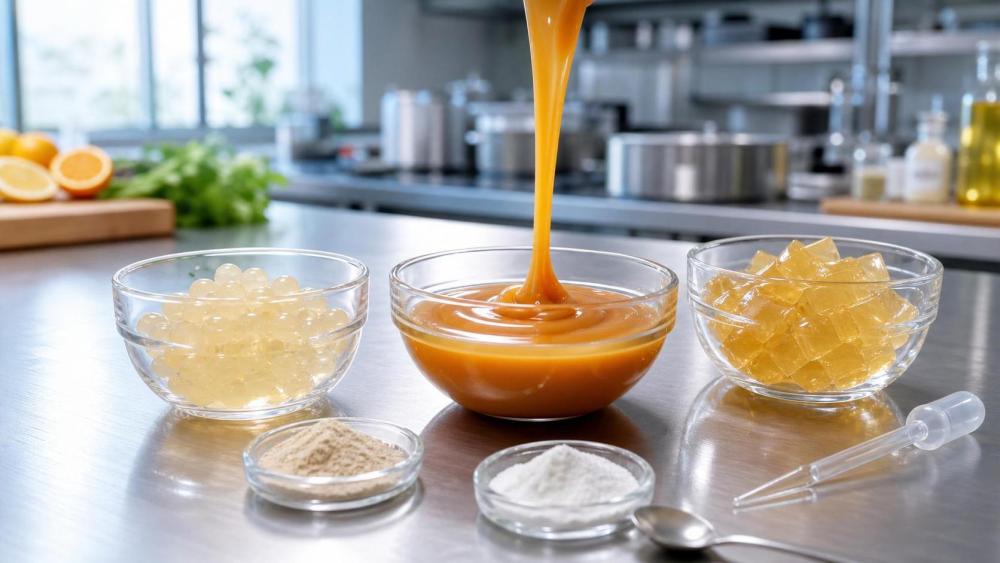
In molecular gastronomy texture control, xanthan and alginate rarely compete as simple substitutes.
They answer different texture questions, and the better choice depends on flow, shape retention, ion balance, and service conditions.
That distinction matters well beyond the plate.
Across global FMCG innovation, hydrocolloids influence sensory identity, processing stability, and clean-label positioning at the same time.
FFAI tracks this intersection closely because texture is never just texture.
It affects flavor release, visual appeal, shelf behavior, and whether a formulation performs consistently from pilot trial to scaled production.
When teams discuss molecular gastronomy texture control, the useful question is not which hydrocolloid is stronger.
The useful question is what kind of control the application actually needs.
Why the Same Texture Brief Leads to Different Ingredient Decisions
A glossy spoon sauce, a fluid gel, and a bursting sphere may all sound like premium textures.
In practice, their functional demands are very different.
Xanthan excels when molecular gastronomy texture control needs viscosity under low dosage, shear-thinning flow, and broad pH tolerance.
It is often the quieter workhorse behind sauces, dressings, coulis, and suspended particulates.
Alginate becomes relevant when structure must form through calcium interaction.
That makes it central to spherification, formed gels, and textures where shape matters more than pour behavior.
The difference also reflects wider formulation logic seen across food, fragrance, and active ingredient systems.
Some materials are chosen for flow management.
Others are chosen for triggered structure formation.
Molecular gastronomy texture control works best when those mechanisms are understood before bench trials begin.
When Pourability, Suspension, and Heat Stability Matter More Than Shape
Many high-frequency applications look dramatic on the menu but behave like classic rheology problems.
A hot glaze must cling without becoming pasty.
A herb emulsion should suspend flecks evenly.
A reduced fruit sauce needs body without starch opacity.
In these cases, xanthan is usually the cleaner fit for molecular gastronomy texture control.
Its shear-thinning profile lets the product rest thick and flow smoothly when stirred, pumped, or plated.
That behavior is valuable in kitchens and in scaled food systems because handling conditions change throughout the process.
Another practical advantage is tolerance.
Xanthan usually remains functional across acidic sauces, salt-containing systems, and moderate thermal exposure.
For FFAI-style intelligence work, this matters because global formulations rarely live in ideal laboratory conditions.
They move through transit, reheating, holding time, and variable water quality.
If the texture brief says silky movement, stable suspension, and repeatable service, xanthan usually deserves first evaluation.
Where Spheres, Beads, and Cuttable Gels Shift the Decision Toward Alginate
The judgment changes when the texture target is structural rather than rheological.
A liquid-centered olive bead, a caviar-style pearl, or a shaped fruit gel depends on controlled gelation.
Here, alginate is often the defining tool in molecular gastronomy texture control.
Its performance relies on calcium availability, diffusion rate, and contact time.
That means the result is influenced by more than the alginate percentage alone.
Base acidity, soluble solids, native calcium in the recipe, and holding time all affect membrane strength and bite.
This is where many early trials fail.
A formula may look correct on paper yet set too quickly, produce a thick shell, or leak during storage.
In actual application, alginate works best when the workflow is designed around it.
Bath concentration, rinse step, dwell time, and service window must all be defined.
That is why molecular gastronomy texture control with alginate is less forgiving, but more visually transformative.
Different Application Conditions Change the Better Choice
A quick comparison helps, but the value lies in how these conditions alter the decision.
This is why molecular gastronomy texture control cannot be reduced to a single best ingredient.
The better material is the one aligned with the real process, not the most famous culinary technique.
The Common Misread Is Treating Similar Textures as Identical Problems
One frequent mistake is choosing by visual reference alone.
A thickened puree and a fluid gel may look similar in a spoon test, yet fail differently during service.
Another mistake is focusing on dosage while ignoring water composition and ion load.
With alginate, hidden calcium from dairy, mineral water, or fruit can shift gelation unexpectedly.
With xanthan, overuse can create slimy perception even when viscosity targets are met.
There is also a cost-related misjudgment.
A low-cost ingredient is not truly efficient if rework, short holding time, or texture drift increases operational waste.
FFAI often frames this as a total sensory performance question.
The texture system has to support flavor release, appearance, compliance expectations, and production repeatability together.
A More Reliable Way to Choose Xanthan vs Alginate
In practical molecular gastronomy texture control, selection improves when a few checkpoints are clarified early.
- Define the failure mode that matters most: separation, thinness, shell rupture, or excessive chew.
- Map the process path: blending, heating, resting, dosing, rinsing, and service time.
- Check pH, calcium exposure, and salt load before setting the trial range.
- Evaluate mouthfeel after ten minutes and after one hour, not only at the first tasting.
- Compare sensory elegance with operational tolerance, not with visual novelty alone.
If the system must survive variation, xanthan often offers broader security.
If the system must create a defined structure on cue, alginate is usually the sharper instrument.
Some advanced applications combine them with other gums, but the base decision still starts with the dominant texture mechanism.
Before Finalizing Molecular Gastronomy Texture Control, Confirm the Full Use Case
Choosing xanthan vs alginate is ultimately a context decision.
Molecular gastronomy texture control works when texture goals, process conditions, and sensory expectations are read together.
Xanthan usually wins when smooth flow, suspension, and resilience under changing conditions define success.
Alginate becomes the better choice when calcium-triggered structure and visual precision carry the concept.
The next useful step is to document the exact service window, base chemistry, and texture failure point before comparing trial data.
That kind of disciplined comparison is where FFAI-style ingredient intelligence becomes genuinely valuable, especially when sensory ambition must still meet stability, safety, and scalable execution.
Related News
- How to assess a bio-based thickener manufacturer's batch consistencyOct 16, 2026Food Rheology Expert
- Verifying halal status of hydrocolloid ingredients in the Middle EastOct 15, 2026Food Rheology Expert
- Why Can Xanthan Gum Lose Viscosity After Adding Electrolytes?Oct 18, 2026Food Rheology Expert
- How Do You Test Hydrocolloid Viscosity After Changing a Thickener?Oct 17, 2026Food Rheology Expert
Related News
- 00
0000-00
2026 Osong Cosmetics and Beauty Expo Concludes in South Korea - 00
0000-00
How to compare cosmetic active compounds by their cost in use - 00
0000-00
HKBU Showcases DR2 Following NMPA Registration as a New Cosmetic Ingredient - 00
0000-00
How to use ingredient market insights to forecast sourcing costs - 00
0000-00
Galderma Marks 30 Years of Hyaluronic Acid Injectable Innovation
Food Rheology Expert
Weekly Insights
Stay ahead with our curated technology reports delivered every Monday.