





On June 30, 2026, Brazil’s health regulator ANVISA announced a new registration route for certain amino acid surfactants, shortening import approval from the usual 90 days to 8 working days. The measure applies to products that meet OECD SIDS assessment requirements and do not rely on animal testing data, with examples including sodium cocoyl glycinate and disodium lauroyl glutamate. For raw material exporters, importers, formulation manufacturers, and compliance teams, the update is worth close attention because it links faster market access to documented natural-origin content and lifecycle carbon reporting.
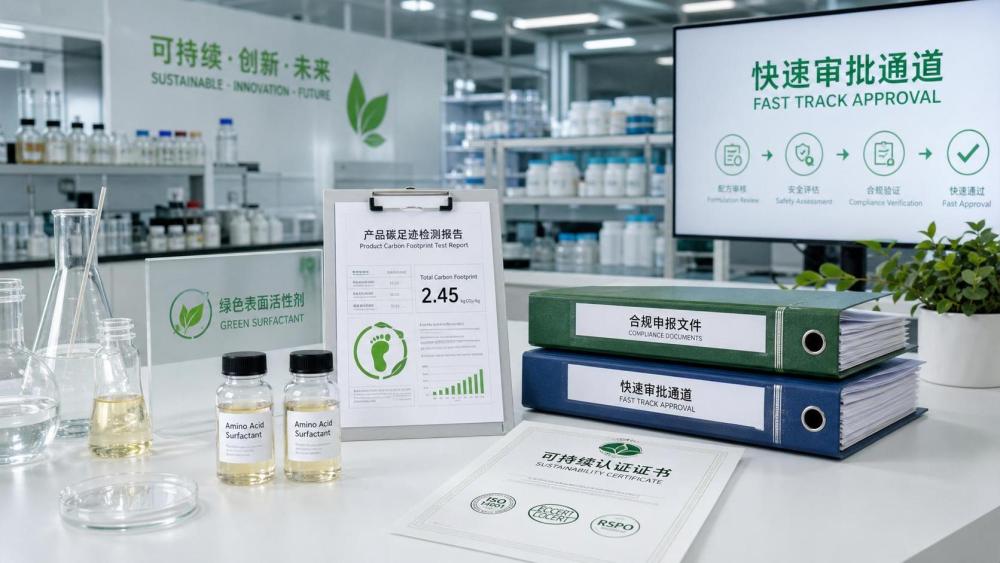
What ANVISA Confirmed on June 30
According to the information provided, ANVISA opened a “Green Surfactant Fast Track” pathway on June 30, 2026 for amino acid surfactants that satisfy two stated conditions: they must be covered by OECD SIDS assessment and they must not use animal testing data.
The fast-track route was described as applicable to products such as sodium cocoyl glycinate and disodium lauroyl glutamate. Under this pathway, the review period is reduced from the regular 90 days to 8 working days.
The same route also requires applicants to submit ISO 16128 certification for natural content and a full lifecycle carbon footprint report.
Where the Immediate Business Impact May Appear
Import registration teams may see documentation pressure shift forward
From an industry perspective, companies directly handling import registration may be affected first because the shorter review window changes where the operational burden sits. The time saved in approval may depend less on downstream waiting and more on whether technical files, certification materials, and carbon reporting are complete before submission.
What deserves closer attention is whether internal regulatory workflows are prepared for a pathway that appears faster on paper but more document-dependent in practice.
Raw material suppliers may face closer scrutiny on qualification packages
Suppliers of amino acid surfactants may be affected through product qualification and customer support. The stated criteria tie market access not only to the surfactant category itself, but also to supporting evidence around OECD SIDS alignment, the absence of animal testing data, ISO 16128 natural-origin certification, and lifecycle carbon footprint reporting.
For suppliers, the likely pressure point is the ability to provide complete and consistent dossiers to importers and downstream buyers.
Formulators and downstream users may gain planning flexibility
For manufacturers that depend on imported surfactants in formulations, a shorter approval period could influence procurement timing, launch scheduling, and inventory planning. Analysis shows that this does not automatically guarantee smoother supply, but it may improve planning visibility for companies using eligible materials.
The key variable to watch is whether the required supporting documents are already available for the specific grades being sourced.
Supply chain service providers may need to adjust lead-time assumptions
Service providers involved in customs preparation, regulatory coordination, and delivery scheduling may also need to revise assumptions around approval timing. Observably, when a regulator compresses a formal review period, communication between suppliers, importers, and logistics partners becomes more sensitive to document readiness and filing accuracy.
What Companies Should Watch Next
Distinguish the policy signal from operational eligibility
Analysis shows that the headline change is the 8-working-day review timeline, but the practical question is which products can actually enter through this route without gaps in supporting materials. Companies should separate general interest in the fast track from product-by-product eligibility assessment.
Check whether current dossiers match the stated entry conditions
For businesses already trading amino acid surfactants into Brazil, an immediate checkpoint is whether existing documentation aligns with the announced criteria. The conditions named in the provided information are specific enough that regulatory and commercial teams may need to verify file completeness before adjusting delivery or sales commitments.
Prepare customer communication around timing and conditions
Importers and suppliers may also need to communicate carefully with customers. A shorter official approval window can easily be misunderstood as a universal acceleration. What deserves closer attention is how companies explain that the pathway is tied to defined conditions and reporting requirements, rather than to the entire surfactant category without limitation.
Keep watching for further official clarification
Observably, the announcement gives the core framework, but businesses should continue monitoring whether ANVISA issues additional wording, procedural clarification, or implementation detail. That matters for submission planning, document interpretation, and timeline commitments across commercial teams.
Why This Looks More Like a Policy Signal Than a Final Market Outcome
This section is analysis rather than confirmed fact. It is more appropriate to understand this update as a targeted regulatory signal tied to greener surfactant positioning, rather than as a complete market outcome already realized across the supply chain.
The reason is straightforward: the announcement combines faster approval with stricter documentary expectations. In other words, the value of the fast track may depend on how well companies can support natural-content claims and lifecycle carbon reporting for eligible amino acid surfactants. The regulatory window has narrowed, but the preparation burden may become more visible.
From an industry perspective, that makes this development important not only for market access timing, but also for how environmental and compliance evidence is assembled in cross-border ingredient trade.
How This Update Is Best Understood for Now
At this stage, the most balanced reading is that ANVISA has created a narrower but materially faster route for qualifying amino acid surfactants. The confirmed change is clear: an 8-working-day pathway has been opened for products meeting the stated conditions, replacing the usual 90-day timeline for those cases.
Analysis shows that the broader commercial effect still depends on execution. Companies are likely to benefit only where eligibility, certification, and carbon reporting are already aligned. For that reason, the development is best understood as an actionable regulatory change with longer-term strategic implications that still require ongoing observation.
Basis of This Article and Points Requiring Continued Verification
This article is based on the user-provided news title, event date, and event summary. The core facts used here are limited to the stated June 30, 2026 ANVISA announcement, the named fast-track route, the reduced approval period, the example amino acid surfactants, and the stated documentation requirements.
For this type of industry update, relevant source categories would usually include official regulatory announcements, company disclosures, industry association updates, coverage by authoritative trade media, and documents issued by standards organizations. However, a specific official source link was not provided in the input, so the exact source document still requires continued verification.
Further observation should focus on any later official clarification of eligibility scope, filing practice, document interpretation, and implementation details under the Green Surfactant Fast Track pathway.
Related News
- When does amino acid surfactant powder improve cleanser mildness?Oct 05, 2026Surfactant Chemistry Architect
- When to Seek Shampoo Formulation Support for Foam, Mildness, or Stability IssuesAug 07, 2026Surfactant Chemistry Architect
- FDA Tightens GRAS Data Requirements for Amino Acid SurfactantsJul 20, 2026Surfactant Chemistry Architect
- Amino Acid Surfactant Prices Rise on Coconut Oil TightnessJul 15, 2026Surfactant Chemistry Architect
Related News
- 00
0000-00
2026 Osong Cosmetics and Beauty Expo Concludes in South Korea - 00
0000-00
How to compare cosmetic active compounds by their cost in use - 00
0000-00
HKBU Showcases DR2 Following NMPA Registration as a New Cosmetic Ingredient - 00
0000-00
How to use ingredient market insights to forecast sourcing costs - 00
0000-00
Galderma Marks 30 Years of Hyaluronic Acid Injectable Innovation
Surfactant Chemistry Architect
Weekly Insights
Stay ahead with our curated technology reports delivered every Monday.