





On June 27, 2026, Japan’s Ministry of Health, Labour and Welfare released a revised edition of its Food Additive Standards, introducing tighter heavy metal requirements for natural antioxidants from October 1, 2026. The update matters most to exporters of ingredients such as rosemary extract and tea polyphenols, as well as procurement, compliance, and supplier approval teams that rely on certification review and raw material access decisions in the Japanese market.
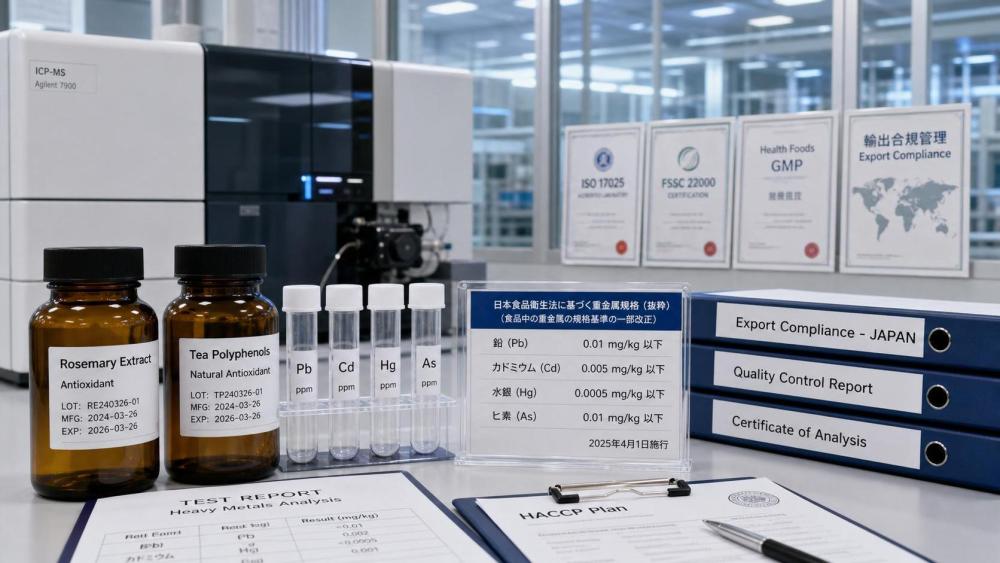
What the revision changes
According to the information provided, the revised standards lower the limits for lead, cadmium, and arsenic by 20% across natural antioxidants including rosemary extract and tea polyphenols. The revision also adds mercury as a new testing item. The change was issued by MHLW on June 27, 2026, and is scheduled to take effect on October 1, 2026.
The same information indicates that this adjustment will affect JQA recertification reviews for major Chinese antioxidant exporters, as well as raw material access reviews conducted by downstream brand owners.
Where the pressure is likely to appear first
Export-facing ingredient suppliers
From an industry perspective, exporters of natural antioxidants may feel the impact first because the revised limits directly affect whether existing products continue to meet Japanese compliance expectations. The immediate pressure is likely to center on specification matching, test coverage, and documentation prepared for recertification or customer review.
Procurement and supplier approval teams
For procurement functions and raw material approval teams, the revision may affect supplier qualification and onboarding decisions. What deserves closer attention is whether existing supplier files, test reports, and compliance statements remain sufficient once the lower thresholds and added mercury testing requirement begin to apply.
Brand owners and end-use product manufacturers
Observably, end-use brands and manufacturers using these antioxidant ingredients may need to reassess raw material access criteria in their Japanese supply chain. The impact is less about headline policy language and more about whether current approved materials still pass internal review, especially where imported ingredient compliance is tied to launch timing or continuity of supply.
Service providers involved in certification and compliance
Certification-related and compliance support providers may also see a practical effect, because the reported change is expected to influence JQA recertification reviews. In business terms, that means more attention to testing scope, review timing, and the completeness of supporting compliance materials.
What companies should watch now
The gap between publication and enforcement
Analysis shows that the period between the June 27 publication date and the October 1 effective date is a key operational window. Companies with exposure to the Japanese market should pay close attention to how the revised requirements are reflected in customer review processes, certification scheduling, and shipment planning.
Products already traded into Japan
What deserves closer attention is not only new business, but also products already supplied or under review. For companies selling rosemary extract, tea polyphenols, or related natural antioxidants, the practical question is whether current compliance materials align with the lower lead, cadmium, and arsenic limits and the added mercury test item.
Customer communication and approval materials
Observably, commercial risk may arise where technical compliance and customer approval timelines do not move in step. Firms may need to prepare clearer communication for Japanese customers and downstream review teams regarding updated specifications, test items, and recertification status.
Documentation readiness around certification review
From an industry perspective, the reported effect on JQA recertification means documentation readiness becomes a near-term issue. Companies should closely monitor whether current certificates, supporting test records, and supplier compliance files remain acceptable under the revised standard framework.
How this update is best understood at this stage
Analysis shows this is more than a routine wording adjustment, because it combines a lower unified limit for several heavy metals with an additional testing item and a defined implementation date. At the same time, it is more appropriate to understand the development as a compliance tightening signal with concrete operational consequences, rather than as a fully measurable market outcome already completed.
Observably, the most important point for the industry is not to overstate the eventual impact before downstream review practices are fully visible. The clearer near-term takeaway is that compliance thresholds, certification review, and raw material approval are moving closer together in this category.
A near-term rule change with longer-term compliance implications
In summary, the revision signals a stricter entry and review environment for natural antioxidants in Japan, especially for exporters and supply chain participants connected to rosemary extract, tea polyphenols, and similar ingredients. The immediate issue is the October 1, 2026 implementation of lower limits for lead, cadmium, and arsenic plus the addition of mercury testing; the broader industry meaning is a heightened need to track how regulatory text translates into certification review and raw material access decisions. At present, it is more appropriate to understand this as a near-term compliance change with follow-on effects that still require continued observation.
Basis of this article
This article is based on the user-provided news title, event date, and event summary concerning MHLW’s June 27, 2026 revision of Japan’s Food Additive Standards for natural antioxidants. For developments of this type, commonly relevant source categories may include official notices, company disclosures, industry association updates, authoritative media coverage, and standards-related documents.
A specific official source link was not provided in the input, so the underlying document path and any subsequent implementation details still require ongoing verification. Areas that merit further monitoring include any follow-up official wording, certification review practice, and downstream raw material access requirements in actual business execution.
Related News
- How to assess a food antioxidants distributor’s traceability practicesOct 11, 2026Food Preservation Scientist
- How natural antioxidants for oils can prevent rancidity in storageSep 25, 2026Food Preservation Scientist
- How to choose natural antioxidants for beverages with longer shelf lifeAug 23, 2026Food Preservation Scientist
- EU Tightens MRLs for Three Pesticides, Prompting Raw Material Checks for Natural Antioxidant ExportsAug 17, 2026Food Preservation Scientist
Related News
- 00
0000-00
2026 Osong Cosmetics and Beauty Expo Concludes in South Korea - 00
0000-00
How to compare cosmetic active compounds by their cost in use - 00
0000-00
HKBU Showcases DR2 Following NMPA Registration as a New Cosmetic Ingredient - 00
0000-00
How to use ingredient market insights to forecast sourcing costs - 00
0000-00
Galderma Marks 30 Years of Hyaluronic Acid Injectable Innovation
Food Preservation Scientist
Weekly Insights
Stay ahead with our curated technology reports delivered every Monday.