





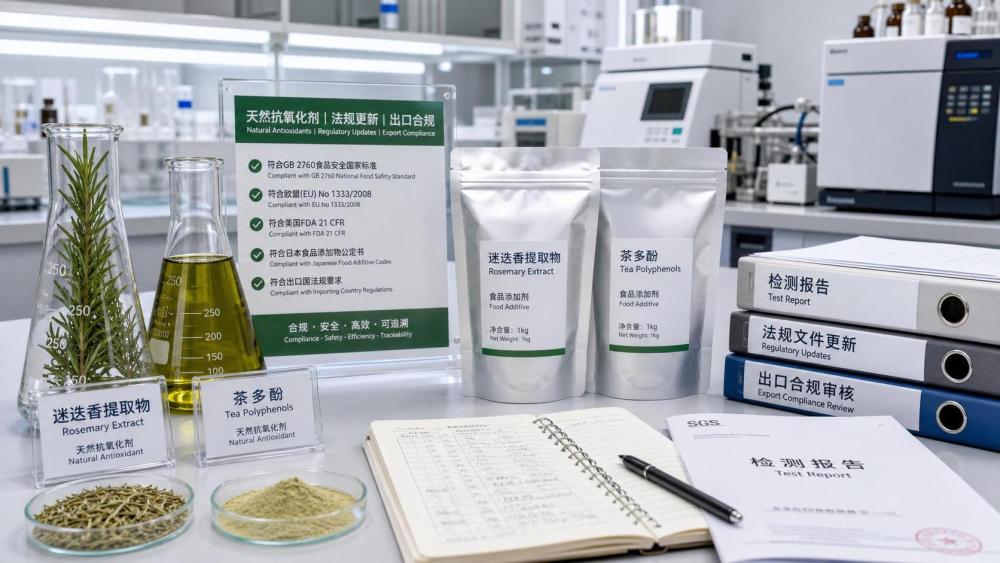
On June 22, 2026, the U.S. FDA released GRAS Notification Guidance Revision 2.1, introducing a new documentation requirement for food antioxidants based on natural plant extracts such as rosmarinic acid and tea polyphenols. For suppliers serving the U.S. and Canadian markets, especially Chinese exporters, the change matters because it affects how compliance files are prepared, how long registration may take, and how procurement and delivery schedules may need to be reassessed before the January 1, 2027 deadline.
What the updated guidance now requires
The confirmed change is that the FDA has updated the GRAS notification process through GRAS Notification Guidance Revision 2.1 issued on June 22, 2026. Under the update, all food antioxidants derived from natural plant extracts, including examples such as rosmarinic acid and tea polyphenols, are required to submit new toxicological data before January 1, 2027. The required new data must be based on OECD TG 422 and cover two-generation reproductive toxicity and skin sensitization. The information provided also confirms that this adjustment directly affects the compliance pathway and registration timeline for Chinese exporters supplying natural antioxidants to the U.S. and Canadian markets.
Where the pressure is likely to appear in the supply chain
Export programs tied to North American market access
From an industry perspective, exporters are the most directly exposed because the rule change is linked to market entry documentation rather than only to product marketing language. The likely impact is concentrated in compliance file completion, registration sequencing, and shipment planning for natural antioxidant products intended for the U.S. and Canadian markets. What deserves closer attention is whether existing dossiers, supporting reports, and customer-facing technical packages are still sufficient under the revised GRAS process.
Procurement and formulation decisions upstream
For companies purchasing plant-based antioxidant ingredients, the issue is not limited to regulatory teams. Procurement and product teams may need to confirm whether sourced materials fall within the affected category of natural plant extract-based antioxidants and whether suppliers can provide the newly required toxicology package within the stated timeline. Analysis shows that sourcing decisions, substitute evaluation, and supply continuity discussions may all become more sensitive where lead times depend on regulatory document readiness.
Testing, certification, and dossier support services
Testing service providers and compliance support organizations may also feel the effect because the updated requirement points directly to specific new toxicological evidence under OECD TG 422. The operational impact is likely to center on report preparation, document review, data completeness checks, and coordination with clients preparing GRAS-related submissions. Companies relying on third-party support should pay attention to whether service timelines align with product launch or delivery commitments.
Practical issues companies should review now
Check whether current files are still complete
Analysis shows that companies should first review whether existing GRAS-related materials for natural antioxidants already contain the newly required reproductive toxicity and skin sensitization data. If not, the core issue is not only missing studies but also whether current product documentation, customer submissions, and internal approval files remain usable without amendment.
Reassess timing against the 2027 deadline
What deserves closer attention is the gap between the formal deadline of January 1, 2027 and the practical time needed for data preparation, dossier integration, and downstream customer review. Where export contracts, replenishment cycles, or market launch plans rely on fixed dates, companies may need to review whether registration and delivery assumptions still hold.
Review supplier qualification and document flow
For manufacturers and traders working with multiple upstream partners, it is advisable to verify which suppliers can support the updated compliance pathway with complete and consistent technical materials. This includes checking how toxicology data, product specifications, and related compliance documents are transmitted and updated across procurement, quality, and sales functions.
Watch for further execution language
The information provided confirms the new requirement and deadline, but it does not include more detailed enforcement language or case-specific implementation criteria. It is therefore prudent to monitor how the revised guidance is referenced in compliance reviews, customer document requests, and related market access communications rather than assuming all execution details are already settled.
Why this looks like an execution signal, not just a headline
Observably, this development is more than a general policy message because it introduces a defined data requirement, a named guidance revision, a clear product scope, and a stated deadline. At the same time, it is more appropriate to understand this as an execution signal that still requires close follow-up, rather than as a fully transparent rule environment with every operational detail already clarified. From an industry perspective, the immediate significance lies in document readiness and compliance scheduling, while the broader market response will depend on how buyers, service providers, and exporters adjust their workflows.
How the market should read this update
In practical terms, this FDA guidance revision should be read as a concrete compliance change for natural plant extract-based food antioxidants, especially for businesses supplying the U.S. and Canadian markets from China. The confirmed facts are limited but meaningful: the required toxicology package has changed, the submission expectation is time-bound, and the compliance pathway may become longer or more document-intensive. A neutral reading today is that companies should treat this as an active regulatory development with direct operational implications, while continuing to observe how implementation language and market practice evolve.
Basis of this article and points for continued verification
This article is generated from the user-provided news title, event date, and event summary. For developments of this kind, commonly relevant source types may include official notices, releases by regulatory authorities, customs or trade administration updates, industry association communications, standards organization documents, and reporting by authoritative media. No specific official source link was provided in the input, so the exact official link still needs to be verified on an ongoing basis. Continued attention should also be given to detailed policy wording, certification and compliance interpretation, tender or procurement document changes, market feedback, and how affected companies implement the new requirement in practice.
Related News
- How to choose natural antioxidants for beverages with longer shelf lifeAug 23, 2026Food Preservation Scientist
- EU Tightens MRLs for Three Pesticides, Prompting Raw Material Checks for Natural Antioxidant ExportsAug 17, 2026Food Preservation Scientist
- China Customs Tightens Export Filing for Food Ingredients, Raising Clearance RisksAug 16, 2026Food Preservation Scientist
- How food antioxidants for oils help prevent rancidityAug 16, 2026Food Preservation Scientist
Related News
- 00
0000-00
How scientific anti-aging skincare targets wrinkles at the cellular level - 00
0000-00
How to select aroma chemical ingredients for better fragrance stability - 00
0000-00
How natural food pigments for bakery hold color during baking - 00
0000-00
How to verify compliance documents for cosmetic active compounds - 00
0000-00
How to verify food grade flavor formulation ingredients for safety
Food Preservation Scientist
Weekly Insights
Stay ahead with our curated technology reports delivered every Monday.