





On August 2, 2026, the US FDA revised its GRAS notification guidance in a way that immediately changes compliance expectations for natural antioxidants used in formulations intended for the US market. The update introduces batch-level third-party testing requirements for NDMA and seven other nitrosamine impurities, with a stated detection limit of 0.05 ppb, affecting both new submissions and reviews of existing cases. For exporters, ingredient suppliers, buyers, and compliance teams, this is worth close attention because it touches not only dossier preparation, but also shipment timing, document readiness, and customs-facing execution.
What the revised guidance now requires
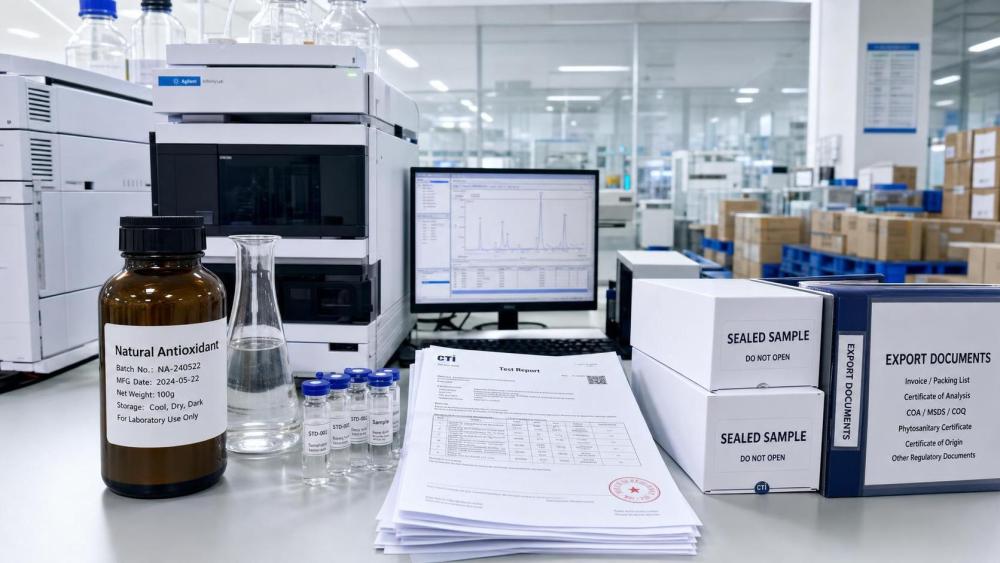
According to the provided event summary, the FDA issued the GRAS Notification Guidance Revision 2026 on August 2, 2026. The revision requires all newly submitted and existing natural antioxidant cases under review to include quantitative testing reports issued by third-party laboratories for N-nitrosodimethylamine (NDMA) and seven other nitrosamine impurities.
The requirement applies to natural antioxidants including rosemary extract, tea polyphenols, and ascorbyl palmitate as cited in the input. The required analytical reporting must cover every batch, and the detection limit is specified at 0.05 ppb. The requirement took effect immediately on the date of release.
The provided information also states that this change directly affects formula filing and customs clearance efficiency for Chinese exporters serving the US market.
Where the operational pressure is likely to appear
For exporters preparing US-bound filings
From an industry perspective, exporters are likely to feel the impact first because the rule change is tied directly to submission materials and review readiness. Where a product relies on natural antioxidants covered by the updated guidance, batch documentation and third-party analytical reports may become a practical prerequisite for moving dossiers forward. What deserves closer attention is whether existing document packages, supplier files, and shipment support materials are complete enough to match the revised expectation from the start.
For ingredient buyers and procurement teams
Procurement functions may be affected because the updated requirement shifts part of the compliance burden upstream into sourcing decisions. Buyers using rosemary extract, tea polyphenols, ascorbyl palmitate, or similar natural antioxidants may need to check whether suppliers can provide batch-by-batch nitrosamine testing from third-party laboratories at the required sensitivity. In practice, the issue is not only price or availability, but whether purchasing specifications and supporting documents remain aligned with filing and delivery needs.
For manufacturers managing formulation and release schedules
Manufacturers may be affected at the production planning stage because an immediate rule change can tighten the link between ingredient release, filing preparation, and export scheduling. Analysis shows that where antioxidant inputs are part of products intended for US submission or shipment, quality, regulatory, and operations teams may need closer coordination around test reports, lot traceability, and document turnover. The main pressure point is likely to be timing rather than product description alone.
For laboratories and compliance service providers
Testing institutions and compliance support providers are also implicated because the updated guidance explicitly refers to third-party laboratory reports and a defined detection limit. Observably, this places greater emphasis on analytical capability, reporting format, and the practical ability to support batch-level evidence. For service providers involved in GRAS-related documentation, the change may also alter how technical files are assembled and reviewed before submission or shipment.
What companies should watch in the near term
Check whether current files are still submission-ready
Analysis shows that companies with pending or planned GRAS-related work involving covered natural antioxidants should review whether existing files include batch-level third-party quantitative reports for NDMA and the other seven nitrosamine impurities. The immediate effective date makes document completeness a near-term issue rather than a later follow-up item.
Review supplier qualification against the new testing threshold
What deserves closer attention is whether current suppliers can consistently provide third-party reports that meet the stated 0.05 ppb detection limit. Even where supply itself is stable, the compliance value of that supply may change if supporting laboratory evidence cannot be produced in the required form or at the required batch level.
Reassess lead times tied to filing and clearance
Observably, the reported effect on formula filing and customs clearance efficiency means companies should pay attention to timeline risk. This should be understood as a practical warning to revisit submission sequencing, lot release planning, and document handoff between suppliers, exporters, and internal regulatory teams, rather than as proof of a fixed market outcome.
Track how the requirement is reflected in working documents
Because the input does not provide further execution detail, it would be premature to state a settled enforcement pattern. Even so, companies should closely monitor how the revised requirement appears in compliance checklists, technical documents, purchasing terms, and customer-facing specification requests linked to US-bound business.
Why this reads as an execution signal
From an industry perspective, this development is more appropriate to understand as an implemented compliance change rather than a distant policy discussion, because the requirement is described as taking effect immediately and applies to both new submissions and existing reviews. At the same time, analysis shows that the market still needs to observe how uniformly the requirement is interpreted in day-to-day filing, documentation review, and trade execution.
That distinction matters. The confirmed fact is the guidance revision and its stated testing requirement. The open question is how quickly business processes across sourcing, testing, submission, and customs-facing workflows adjust to the new baseline.
How to read the change at this stage
In practical terms, this FDA update signals a higher evidentiary threshold for natural antioxidants in the GRAS context, with immediate relevance to companies shipping into the US market. It should not be overstated as a full market conclusion, but it also should not be treated as a routine wording change. At the current stage, it is more appropriate to understand this event as a live compliance requirement accompanied by an execution signal that may affect documentation quality, review efficiency, and delivery planning.
Basis of this article and points still to verify
This article is generated on the basis of the user-provided news title, event date, and event summary. For events of this kind, commonly relevant source types may include official regulatory notices, releases from supervisory agencies, customs or trade authority information, industry association updates, standards documents, and reporting by established professional media.
No specific official source link was provided in the input, so the underlying official publication path still needs to be verified on an ongoing basis. Further observation is also needed on detailed implementation language, certification and review practice, changes in customer or tender documentation, market feedback, and how companies execute the requirement in actual export and compliance workflows.
Related News
- How to choose natural antioxidants for beverages with longer shelf lifeAug 23, 2026Food Preservation Scientist
- EU Tightens MRLs for Three Pesticides, Prompting Raw Material Checks for Natural Antioxidant ExportsAug 17, 2026Food Preservation Scientist
- China Customs Tightens Export Filing for Food Ingredients, Raising Clearance RisksAug 16, 2026Food Preservation Scientist
- How food antioxidants for oils help prevent rancidityAug 16, 2026Food Preservation Scientist
Related News
- 00
0000-00
How to verify food grade flavor formulation ingredients for safety - 00
0000-00
How to assess an anti-aging ingredients manufacturer’s batch consistency - 00
0000-00
How formulation tips prevent flavor separation in beverage applications - 00
0000-00
How biodegradable surfactants for laundry affect cold-water cleaning - 00
0000-00
How food hydrocolloids prevent ice crystals in frozen desserts
Food Preservation Scientist
Weekly Insights
Stay ahead with our curated technology reports delivered every Monday.