





On July 1, 2026, India moved water-soluble flavor exports into a stricter pre-shipment control framework, adding mandatory certification before customs clearance. The change matters not only for exporters, but also for buyers, procurement teams, testing partners, and supply-chain coordinators because it ties shipment release to lab verification of product characteristics and extends delivery lead times. For companies trading in flavor ingredients or finished formulations linked to these exports, the practical issue is no longer just price or supply availability, but whether documentation, testing, and shipment scheduling can still align under the new rule.
What the new export requirement now covers
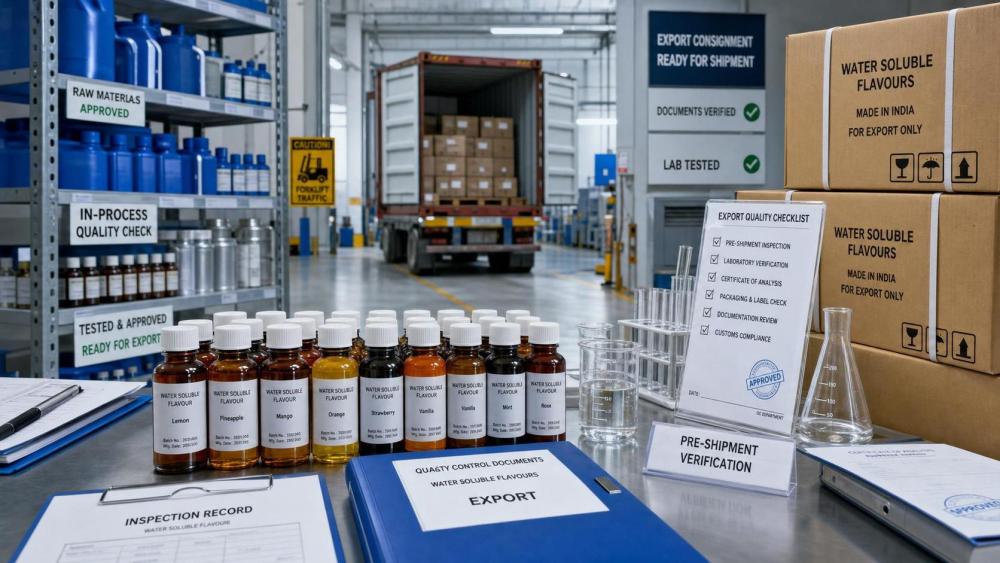
According to the provided information, India’s Directorate General of Foreign Trade (DGFT) made pre-shipment certification mandatory for all water-soluble flavor exports with effect from July 1, 2026. The stated reasons were volatile raw material supply, including vanilla and citrus oils, and growing concerns over adulteration.
Before customs clearance, exporters must obtain verification from a DGFT-authorized laboratory. The required checks cover the solubility profile, residual solvent limits with ethanol capped at no more than 50 ppm, and heavy metal content. The same information also states that lead times have been extended by 5 to 7 working days.
Where the pressure is likely to appear first in the trade chain
Export shipments now depend on test-backed release
From an industry perspective, exporters are the first group directly affected because shipment release now depends on pre-shipment certification rather than only commercial readiness. The immediate impact is likely to fall on export documentation, sample submission, coordination with authorized labs, and customs timing. What deserves closer attention is whether existing shipping plans, customer delivery windows, and contract schedules can absorb the additional 5 to 7 working days already referenced in the disclosed information.
Procurement teams face a tighter link between sourcing and compliance
For procurement functions handling water-soluble flavors or related inputs, the rule change matters because volatile supply in vanilla and citrus oils was explicitly cited in the policy context. Analysis shows that sourcing decisions may now need closer alignment with compliance readiness, especially where raw material variability could affect laboratory verification outcomes. In practice, buyers and sourcing teams should pay attention to whether suppliers can support the required testing and provide documents that match export clearance expectations.
Manufacturing and formulation planning may need earlier locking of batches
Processors and manufacturers connected to export orders may be affected at the batch planning stage. Because solubility profile, residual solvent limits, and heavy metal content must be verified before clearance, production lots intended for export may require earlier specification review and more disciplined release preparation. Observably, the operational issue is not only laboratory testing itself, but whether production, quality, and export teams can keep the same batch data consistent across technical files and shipment records.
Testing and compliance service providers become more central to delivery timing
DGFT-authorized laboratory verification is now a formal gate in the export process, which raises the importance of testing partners and compliance support providers. For companies relying on external labs or documentation service firms, the key issue is turnaround coordination. Analysis shows that any delay in testing slots, report issuance, or document correction could feed directly into customs clearance timing and downstream delivery commitments.
What companies should monitor in day-to-day execution
Check whether export files are ready for pre-shipment certification
Companies should review whether their current export files, test references, and product specifications are sufficient for DGFT-authorized lab verification. This is especially relevant where internal quality documents were previously designed for customer acceptance rather than a pre-clearance control step tied to customs release.
Rework shipment calendars around the added lead time
The provided information already indicates a 5 to 7 working day extension in lead times. Analysis shows that businesses should treat this as an immediate planning variable in booking, customer communication, and purchase scheduling. For firms operating on narrow delivery windows, the practical risk is timing misalignment rather than a purely technical compliance failure.
Watch for execution details beyond the headline rule
The disclosed summary confirms the new certification requirement and testing scope, but it does not provide fuller execution detail. For that reason, companies should continue monitoring how the rule is expressed in operational practice, including any further clarification on document handling, verification workflow, or interpretation standards applied during clearance.
Focus on traceability where quality concerns could trigger scrutiny
Because adulteration concerns were cited as a reason for the change, businesses should pay closer attention to product traceability, supporting test records, and consistency between technical claims and shipment materials. It is more appropriate to understand this as a compliance-management issue as much as a trade issue, particularly for firms serving customers that are sensitive to specification integrity.
How this change is best understood at this stage
Analysis shows that this is better understood as an implemented control measure rather than a tentative policy signal, because the requirement is stated as effective from July 1, 2026 and tied directly to customs clearance. At the same time, observably, the market still lacks broader execution texture in the information provided here. That means the rule itself appears landed, while its operational rhythm, industry adjustment costs, and possible interpretation differences still need continued observation.
Why the market should treat this as an execution signal
For the industry, the significance of this development is not limited to one additional certificate. It shows that export readiness for water-soluble flavors is now more closely connected to verifiable product attributes and pre-clearance compliance controls. A neutral reading is that the change should currently be viewed as a live execution requirement with immediate scheduling and documentation consequences, while broader effects on trade behavior and supplier response still need to be tracked through follow-up implementation and market feedback.
Basis of this article and points that still require verification
This article is based on the user-provided news title, event date, and event summary. For developments of this kind, relevant source categories typically include official notices, releases from regulatory or trade authorities, customs or foreign trade administration information, industry association updates, standards-related documents, and reporting by authoritative media.
A specific official source link was not provided in the input, so the exact source document still requires continued verification. Analysis also suggests that the market should keep watching for any further policy detail, certification interpretation, tender or specification document changes, industry feedback, and how companies are handling implementation in actual export operations.
Related News
- When heat stable flavor formulations are needed for UHT beveragesOct 04, 2026Aromatics & Perfumery Fellow
- How heat stable flavor formulations prevent aroma loss in baked goodsOct 03, 2026Aromatics & Perfumery Fellow
- Using 4-vinyl guaiacol flavour standard to calibrate sensory panelsOct 02, 2026Aromatics & Perfumery Fellow
- Garlic Powder Flavor Profiles and Their Role in Seasoning BlendsSep 28, 2026Aromatics & Perfumery Fellow
Related News
- 00
0000-00
2026 Osong Cosmetics and Beauty Expo Concludes in South Korea - 00
0000-00
How to compare cosmetic active compounds by their cost in use - 00
0000-00
HKBU Showcases DR2 Following NMPA Registration as a New Cosmetic Ingredient - 00
0000-00
How to use ingredient market insights to forecast sourcing costs - 00
0000-00
Galderma Marks 30 Years of Hyaluronic Acid Injectable Innovation
Aromatics & Perfumery Fellow
Weekly Insights
Stay ahead with our curated technology reports delivered every Monday.