





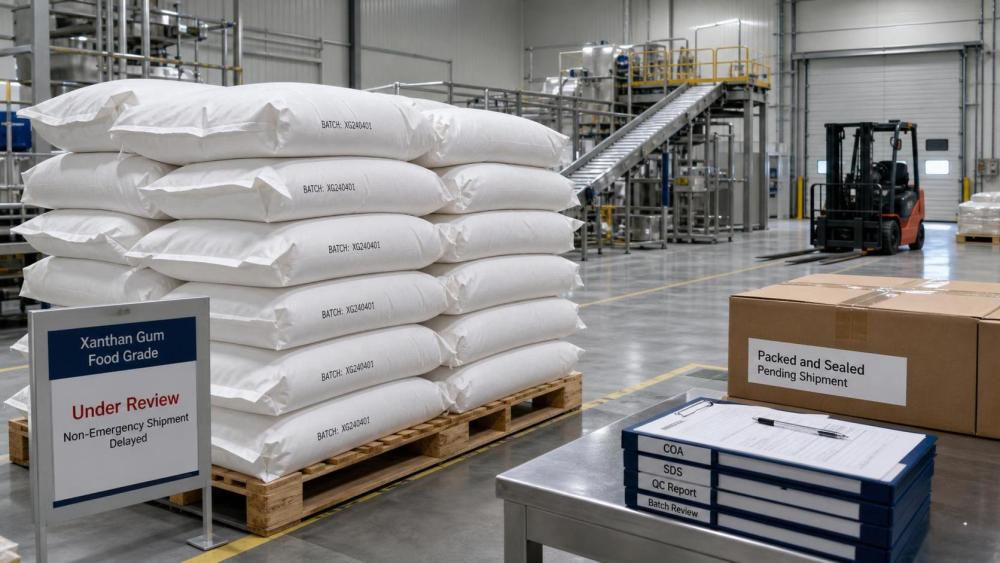
On July 5, 2026, the xanthan gum market drew attention after a Tier-1 producer in Shandong temporarily halted non-urgent shipments from July 5 to July 12 during an unplanned ISO 22000 surveillance audit. The facility did not fully shut down, but standard-grade lead times reportedly moved out to 8-10 weeks, making this a relevant development for buyers and formulators that depend on steady hydrocolloid supply, especially in EU bakery and plant-based beverage production.
What has been confirmed so far
The confirmed information is limited but commercially meaningful. A Tier-1 xanthan gum producer in Shandong paused non-urgent shipments for the period of July 5-12, 2026. The pause followed an unplanned ISO 22000 surveillance audit, which was triggered by a minor deviation recorded in fermentation pH control logs.
The event was not described as a full production shutdown. However, standard grades were pushed to lead times of 8-10 weeks. The reported impact is especially relevant to EU bakery and plant-based beverage formulators that rely on just-in-time hydrocolloid supply chains.
Where the pressure may be felt first
Procurement teams facing longer replenishment windows
From an industry perspective, procurement functions may be among the first to feel the effect because an 8-10 week lead time changes purchasing rhythm even when supply has not stopped entirely. The main pressure point is timing: buyers that normally rely on standard replenishment cycles may need to review open orders, shipment priority, and available safety stock.
Formulators with narrow inventory buffers
EU bakery and plant-based beverage formulators are specifically mentioned in the event summary, so these application segments deserve close attention. Analysis shows the risk is less about a dramatic supply break and more about operational disruption where formulations depend on predictable hydrocolloid arrivals and just-in-time inventory models.
Traders and supply chain intermediaries managing allocation risk
For trading companies and supply chain service providers, the issue may center on allocation and delivery sequencing. What deserves closer attention is whether non-urgent shipments remain deferred while urgent demand is prioritized, as that can affect customer commitments, shipment planning, and short-term contract execution.
What companies should watch now
Status updates tied to the audit window
Companies should closely track any operational update linked to the July 5-12 audit period. The key practical question is whether shipment normalization follows quickly after recertification activity or whether lead times for standard grades remain extended beyond the stated window.
Exposure by grade and application
Businesses using standard grades should review where those materials sit in their product portfolio and customer commitments. Analysis shows that the immediate concern is not every xanthan gum application equally, but the segments already identified as sensitive to just-in-time hydrocolloid flows.
Supplier documentation and compliance communication
Because the trigger involved a minor deviation in fermentation pH control logs during an ISO 22000 surveillance context, procurement and quality teams may need clearer supplier communication on documentation status, shipment timing, and any compliance-related customer questions. This is especially relevant where buyers must support internal quality review or downstream customer assurance.
Delivery planning and customer messaging
Observably, the near-term task for many companies is not strategic repositioning but disciplined delivery management. Order confirmation dates, substitution feasibility, and customer communication cadence may become more important than usual while lead times remain extended.
Why this matters beyond a single shipment pause
Analysis shows this development should currently be read as a supply-chain stress signal rather than as proof of a broad structural shortage. The event combines two issues that matter commercially: concentration around major producers and the sensitivity of food-grade ingredient flows to quality-system interruptions, even when the underlying deviation is described as minor.
It is more appropriate to understand this as a situation that still requires observation. The shipment suspension was limited to non-urgent orders and was not presented as a full shutdown, but the extension of lead times to 8-10 weeks indicates that even partial disruption at a key facility can quickly affect downstream planning.
How to read the situation at this stage
The industry significance of this update lies in its immediate operational implications. It does not yet confirm a long-term supply reset, but it does show how quickly audit-related interruptions can tighten availability for standard xanthan gum grades. For now, the most balanced interpretation is that this is a short-term disruption with broader relevance if delays persist or spread into additional supply nodes.
About the basis of this article
This article is based on the user-provided news title, event date, and event summary. For this type of development, commonly relevant source categories may include official company notices, regulatory or audit-related statements, industry association updates, authoritative media reporting, and standard-system documentation.
No specific official source link was provided in the input, so the underlying details still require ongoing verification. The main follow-up points to watch are whether shipment timing normalizes after the audit window, whether standard-grade lead times improve, and whether downstream buyers report continued pressure in bakery and plant-based beverage supply chains.
Related News
- How to assess a bio-based thickener manufacturer's batch consistencyOct 16, 2026Food Rheology Expert
- Verifying halal status of hydrocolloid ingredients in the Middle EastOct 15, 2026Food Rheology Expert
- Why Can Xanthan Gum Lose Viscosity After Adding Electrolytes?Oct 18, 2026Food Rheology Expert
- How Do You Test Hydrocolloid Viscosity After Changing a Thickener?Oct 17, 2026Food Rheology Expert
Related News
- 00
0000-00
2026 Osong Cosmetics and Beauty Expo Concludes in South Korea - 00
0000-00
How to compare cosmetic active compounds by their cost in use - 00
0000-00
HKBU Showcases DR2 Following NMPA Registration as a New Cosmetic Ingredient - 00
0000-00
How to use ingredient market insights to forecast sourcing costs - 00
0000-00
Galderma Marks 30 Years of Hyaluronic Acid Injectable Innovation
Food Rheology Expert
Weekly Insights
Stay ahead with our curated technology reports delivered every Monday.