





Micelles help detergent remove grease by providing a way for oily material to disperse in water. They form when enough surfactant molecules gather in a washing solution: their water-attracting heads face the surrounding water, while their oil-compatible tails cluster toward the interior. Grease can enter these structures or be broken into small droplets whose surfaces are coated with surfactant, allowing the oil to be carried away during rinsing.
Cleaning involves more than enclosing grease. Surfactants first reach the boundary between water, oil, and the dirty surface. Agitation, temperature, water chemistry, and the nature of the stain all influence whether the grease detaches and stays dispersed long enough to leave with the wash water.
Why grease resists plain water
Water molecules attract one another strongly, while most oils and fats interact poorly with water. As a result, grease tends to remain as a separate layer or as droplets rather than dissolve throughout the water. On fabric or a hard surface, it can also cling within pores, around fibers, or beneath particles of dirt.
Rinsing with plain water can remove loose material, especially with rubbing, but water has difficulty spreading across an oily surface and lifting it away. Detergents address this problem through surfactants, molecules with two different affinities: a hydrophilic, or water-attracting, head and a hydrophobic tail that interacts favorably with oils.
At an oil–water boundary, surfactant molecules arrange themselves so that their heads face the water and their tails associate with the oil. This lowers the interfacial tension, making it easier for water to wet the greasy surface and for mechanical action to deform and divide the oil.
How micelles form and carry oily material
When surfactant is added to water, some molecules occupy interfaces, including the water’s surface and the boundaries around grease. Others remain dispersed as individual molecules. Once the concentration of dissolved surfactant reaches the critical micelle concentration, or CMC, additional molecules increasingly assemble into micelles.
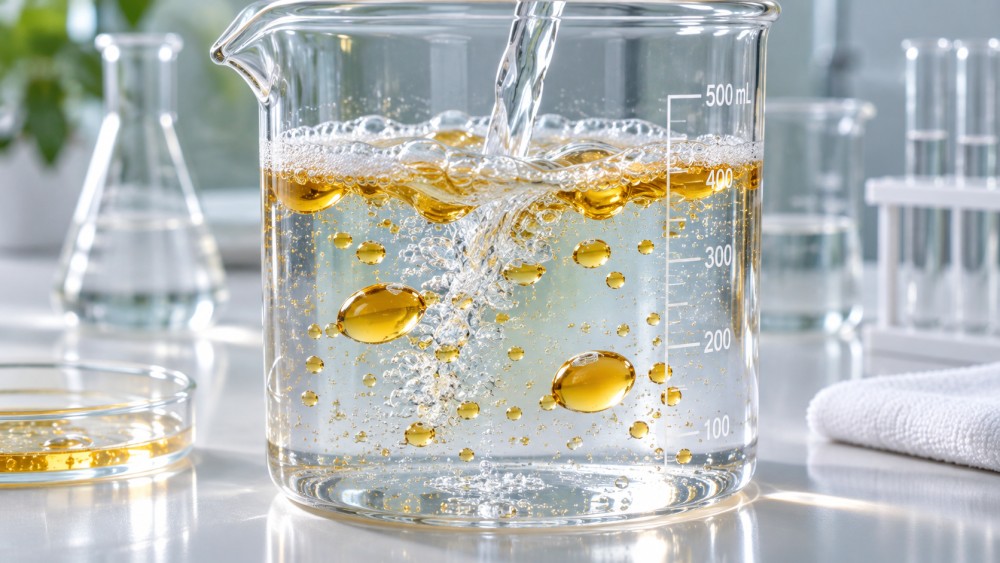
A simple micelle is often pictured as a sphere, with hydrophobic tails gathered inside and hydrophilic heads exposed to water. The interior provides a favorable environment for small amounts of oil-compatible material. Micelles are dynamic: surfactant molecules move in and out rather than remaining permanently locked in place. Their shape and size also vary with the surfactant and the conditions in the solution.
For larger amounts of grease, the familiar image of one micelle swallowing an entire stain is an oversimplification. Washing can produce small oil droplets coated with surfactant, known as an emulsion. The droplets are generally much larger than individual micelles. Both micellar solubilization and droplet formation can help transport oily material, but their relative importance changes with the oil, formulation, and washing conditions.
From a greasy surface to the rinse water
- Wetting: The detergent solution spreads over the soiled surface and reaches the oil–water boundary. This contact can be slower when grease is trapped inside dense fabric or coated with dry particles.
- Detachment: Surfactants reduce interfacial tension. Water flow, rubbing, or machine movement then helps loosen the grease and break it into smaller portions.
- Dispersion: Some oily molecules enter micelles; larger amounts can form surfactant-coated droplets. The coating helps keep droplets apart in the water.
- Removal: Draining and rinsing carry dispersed oil and detached particles away. If the wash solution cannot keep the soil suspended, some can settle back onto the surface.
The sequence is useful for understanding the process, although these steps overlap during washing. Surfactant is continually redistributing among the water, the grease, the surface being cleaned, and any droplets already formed.
What changes the cleaning result?
Surfactant concentration and the CMC
Below the CMC, surfactant molecules can still adsorb at interfaces and help loosen grease. Micelles become abundant above that threshold, increasing the solution’s capacity to accommodate certain oily substances. The CMC is therefore a useful reference point, not a universal minimum concentration for all cleaning.
A lower CMC alone does not prove that one detergent will remove a particular stain better than another. Cleaning also depends on how quickly the surfactant reaches the grease, how effectively it reduces interfacial tension, and how well the formulation keeps detached soil dispersed. Mixed surfactants have their own behavior, so the CMC of one ingredient cannot automatically describe the finished detergent.
Adding detergent beyond the amount needed does not guarantee a proportionate improvement. A heavy soil load can use up cleaning capacity, while excess product can leave residue if rinsing is inadequate. Dilution, water volume, and the amount of grease all affect the concentration available during the wash.
Temperature and the physical state of grease
Heat often makes solid or viscous fats softer and easier to dislodge. Warmer water can also help a detergent solution penetrate an oily deposit. The effect depends on the soil: a liquid cooking oil and a waxy fat do not respond in the same way, even when they look similarly greasy.
Temperature also changes surfactant behavior and the stability of the resulting dispersion. More heat is not always appropriate for delicate fabrics, skin, or heat-sensitive surfaces. Follow the care instructions for the item being washed; select a temperature that the material can tolerate.
Agitation and contact time
Rubbing, brushing, spraying, or the movement of a washing machine helps fresh solution reach the grease and supplies force to detach it. Agitation can also break detached oil into smaller droplets. Without enough movement, detergent can sit on a stain without fully reaching grease embedded between fibers.
Time matters because wetting and soil release are not instantaneous. A short soak can help solution penetrate a dried deposit, but leaving a detergent in contact for longer does not compensate for every problem. If grease is trapped under a solid layer, gentle mechanical action or a suitable pretreatment can be more effective than additional soaking alone.
Water hardness and formulation
Hard water contains calcium and magnesium ions. These can interfere with some surfactants, particularly soap, which can form insoluble deposits with hardness minerals. Those deposits reduce the soap available for cleaning and can leave a film on surfaces or fabric.
Synthetic detergent formulations can respond differently to hardness. They often include ingredients that bind hardness ions or otherwise support cleaning in hard water. The surfactant type and the rest of the formula matter together; the presence of micelles by itself does not reveal how the product will perform in a particular water supply.
Surfactant types and their role in grease removal
Surfactants are often grouped by the electrical character of their hydrophilic heads. This classification helps explain differences in behavior, although individual ingredients within each group can vary substantially.
A detergent can contain more than one surfactant. A blend can be designed to balance grease removal, rinsing, foam, and compatibility with the surface being cleaned. Other ingredients have separate jobs: builders address water hardness, while polymers or other dispersing agents can help prevent detached soil from depositing again.
Why grease sometimes returns or leaves a film
A surface that still feels greasy after washing does not identify a single cause. The grease may never have detached, or it may have dispersed briefly and then deposited again. A residue can also come from detergent or minerals rather than from the original oil. Looking at when the film appears helps narrow down the explanation.
- Grease remains in the original spot: The solution may not have penetrated the deposit, the contact time may have been too short, or the fat may have been too solid for the washing conditions.
- Soil spreads across a wider area: Oil may have detached without staying sufficiently dispersed, particularly when the wash water carries a heavy soil load.
- A film appears after drying: Incomplete rinsing can leave detergent behind; hard-water deposits are another possible source, especially when soap is used.
- Foam disappears while grease remains: Foam is a poor stand-alone measure of cleaning. Oils and other conditions can suppress bubbles without directly revealing how much active surfactant remains.
For a heavily soiled item, removing excess grease first reduces the amount the wash solution must handle. A fresh detergent solution and a thorough rinse can then carry away loosened material. If a residue persists, changing one condition at a time—such as water volume, agitation, or rinse quality—makes the cause easier to identify.
Micelles in laundry detergents and shampoos
In laundry, surfactants must reach oils held on and between fibers while also dealing with particulate dirt. The fabric’s weave and the age of the stain affect access to the soil. A pretreatment can place surfactant directly on a greasy spot before the main wash, but the fabric’s care instructions still govern temperature and mechanical treatment.
In shampoo, surfactants help disperse sebum and residues from the hair and scalp into rinse water. The desired result includes both cleansing and an acceptable feel after rinsing, so shampoos often combine surfactants with conditioning or viscosity-adjusting ingredients. A rich lather can make a shampoo pleasant to use, but lather volume alone does not measure how much oil it removes.
In both settings, micelles contribute to the movement of oil through water, while the full cleaning result depends on contact, detachment, dispersion, and rinsing. The same visible grease can behave differently on a smooth dish, a woven fabric, or a hair fiber because each surface holds soil and admits water differently.
Related News
- How do micelles help detergents remove grease?Nov 21, 2026Surfactant Chemistry Architect
- Buying SLES: The Hidden Costs Behind a Cheap QuoteNov 18, 2026Surfactant Chemistry Architect
- 67 Food and Related Standards Take Effect in November, Including Surfactant Test StandardNov 02, 2026Surfactant Chemistry Architect
- How do anionic surfactant ingredients perform in hard water?Nov 02, 2026Surfactant Chemistry Architect
Related News
- 00
0000-00
A cosmetic compliance checklist for US product labeling - 00
0000-00
New York Governor Vetoes Food Disclosure Bill; IDFA Cites Affordability - 00
0000-00
How do micelles help detergents remove grease? - 00
0000-00
AAFCO Urges FDA to Recognize Third-Party Reviews in Proposed GRAS Rule - 00
0000-00
How to choose synthetic flavors for biscuits that withstand baking
Surfactant Chemistry Architect
Weekly Insights
Stay ahead with our curated technology reports delivered every Monday.