





The cheapest surfactant quotation can become an expensive production decision. A detergent plant does not buy foam in a photograph; it buys an ingredient that must unload, disperse, meet a formulation specification, and behave consistently across batches. A lower price per delivered tonne may conceal additional water, a different impurity profile, more difficult handling, or a documentation gap that delays release. Those costs appear in the factory rather than on the first quotation sheet.
For buyers comparing Sodium Lauryl Ether Sulfate (SLES), the useful question is whether each offer supplies the same measurable function under the same purchasing conditions. The supplier page identifies the material as an anionic surfactant used in detergent and personal-care formulations. That establishes a product lead, not an approved purchasing specification. The following review turns that lead into a structured buying decision without assuming a particular concentration, certification, or production outcome.
Start the inquiry with the detergent, not the drum
A dishwashing liquid, a laundry liquid, and an industrial cleaner can require different balances of cleaning performance, foam, viscosity, and compatibility. State the intended product family and the role of the surfactant before requesting a price. Include the other ingredient families that materially affect performance, such as amphoteric surfactants, salts, builders, fragrances, and preservatives. Confidential percentages need not be disclosed in an initial inquiry, but the technical team needs enough context to evaluate a proposed grade.
The purchase request should distinguish mandatory requirements from preferences. Mandatory items may include active matter, limits for specified impurities, appearance, packaging compatibility, and the documentation needed in the destination market. Preferences might include pack size or a preferred delivery window. This separation lets suppliers identify a genuine exception rather than respond with an attractive price for a different product. It also prevents purchasing staff from accepting an unreviewed substitute simply because the trade name sounds familiar.
Make concentration a commercial comparison point
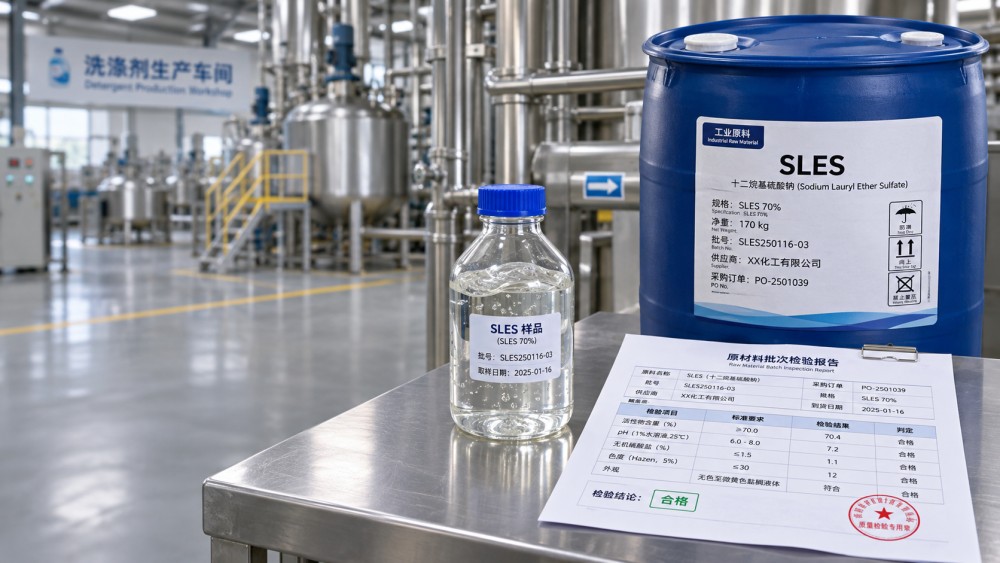
Active matter is central to comparing offers. A tonne of a more dilute product does not contain the same amount of surfactant active as a tonne of a more concentrated product. Request the declared active-matter range, test method, reporting basis, and batch results. Do not assume the concentration from the abbreviation SLES or from a common market grade. Any stated concentration should be confirmed for the actual material offered, including its permitted variation.
For an initial comparison, divide the delivered price per unit mass by the active-matter fraction expressed as a decimal. This produces an indicative delivered cost per unit mass of active ingredient. It is a comparison tool, not the final manufacturing cost: unloading losses, dilution requirements, energy, testing, and rejected material still matter. Compare prices using the same currency, freight boundary, tax treatment, and packaging basis so that the calculation does not disguise another difference.
Build a quotation sheet that exposes differences
Treat impurity limits as specifications, not adjectives
Descriptions such as high quality or premium grade do not establish an impurity limit. Depending on the grade, application, and market, the technical review may need to address unsulfated matter, inorganic salts, residual processing substances, color, odor, and microbiological suitability. Ethoxylated surfactants can also require attention to residual ethylene oxide and 1,4-dioxane. The appropriate limits and analytical methods must come from the applicable requirements and the formulation risk assessment, rather than a universal number copied from a sales page.
Ask whether each result is a routinely tested batch value, a periodic verification result, or a typical descriptive value. These are different types of evidence. A certificate that lists only typical values cannot demonstrate that the delivered batch meets every contractual limit. Where a required test is outsourced, establish the laboratory route, sample identity, reporting time, and responsibility for discrepancies. Resolve these questions before production depends on the material.
Approve a sample through the real production route
A laboratory sample should be identified by batch or source, supplied in representative packaging, and accompanied by the proposed specification and safety documentation. Evaluate it against a retained reference using the intended formulation and the water available at the plant. Record the mixing sequence, temperature, addition rate, equipment, and measurement conditions. Without those controls, a difference attributed to the raw material may actually come from the trial method.
The trial should examine more than initial foam. Useful observations include dissolution or dispersion behavior, viscosity development, clarity where relevant, odor, color, cleaning performance under a defined test, and compatibility with the rest of the formula. Finished-product stability needs its own suitable program. A successful bench test does not automatically establish performance in a larger vessel, so define the scale-up review and approval conditions before placing a full production order.
Check whether handling will consume the price advantage
Concentrated surfactants can behave very differently from dilute liquids during unloading and dilution. Viscosity and phase behavior depend on concentration, temperature, and composition. Ask for guidance specific to the offered grade and confirm the plant has compatible transfer equipment and an approved procedure. Do not prescribe a universal heating temperature or mixing sequence from a general article. The supplier guidance, safety review, and controlled trial should establish the working conditions.
Packaging also influences yield. Review the container material, closure, tamper evidence, net mass, pallet arrangement, and ability to empty the pack with the available equipment. Consider residue left in the container, cleaning requirements, and disposal or return arrangements. If a proposed pack reduces freight cost but requires extra manual handling or leaves more product behind, include those effects in the comparison. The relevant cost is the accepted usable ingredient reaching the process.
Read the COA as a batch record
A certificate of analysis should connect an identifiable shipment to the tests used for acceptance. Review product name, grade, batch number, manufacturing or relevant dating information, specification limits, actual results, units, and analytical references. Match those details to the packing list and container labels. Where the supplier is a distributor, clarify how the commercial identity connects to the manufacturing source and which party controls the batch documentation.
A COA and a safety data sheet answer different questions. The COA supports quality assessment of an identified batch; the SDS communicates hazards and safe handling for the supplied product. Neither document alone proves that every destination-market obligation has been met. The importer and responsible regulatory personnel should determine the applicable chemical registration, labeling, and end-use requirements. A website claim is not a substitute for documents covering the actual offered grade and supply chain.
Separate supplier capability from delivery promises
A short advertised lead time may refer to stock availability, not the date when material clears the buyer's receiving process. Ask what is physically available, whether it is already allocated, which batches would ship, and what documents will be ready before dispatch. Then distinguish production completion, loading, export clearance, transit, import clearance, and delivery to the plant. Each milestone has different dependencies and should have a named owner.
For repeat purchasing, agree how changes will be communicated. Manufacturing source, formulation-related characteristics, specification, packaging, and test methods can all affect the buyer even if the commercial product name remains unchanged. A change-notification clause gives the technical team time to decide whether another trial is needed. It is particularly useful when a distributor has several possible sources and the initial sample represents only one of them.
Write acceptance and disagreement into the order
Define receiving checks, sampling arrangements, acceptance methods, and the period allowed for reporting a discrepancy. Establish how retained samples are sealed and identified, and how a disputed result will be reviewed. If an independent laboratory may be used, agree its role and method basis in advance. These provisions turn a vague quality promise into a procedure that both parties can actually follow.
Receiving staff should know which findings require quarantine. A broken seal, inconsistent batch number, missing required document, damaged package, or failed agreed test should trigger the defined hold process rather than an improvised production decision. The commercial agreement should also address replacement, return, rework authorization where appropriate, and responsibility for related costs. Do not blend questionable material into a working batch merely to avoid a delivery delay.
Choose the offer with the clearest route to release
Sodium Lauryl Ether Sulfate (SLES) purchasing works best when technical approval and commercial approval share the same evidence. First eliminate offers that cannot meet mandatory requirements. Next compare accepted active matter and realistic handling costs. Finally assess documentation, delivery confidence, and the supplier's response to deviations. This sequence prevents a low headline price from outweighing a missing condition that production cannot tolerate.
The final recommendation should state what is approved, for which application, under which specification, and with which unresolved conditions. Keep the sample report, approved specification, correspondence, and purchase terms together. If a second source is needed, qualify it through the same process rather than assuming equivalence. A purchasing decision becomes repeatable when the next buyer can understand why the chosen material was accepted and what would require another review.
Before issuing the purchase order
- Confirm the exact grade, application, active-matter range, and agreed test methods.
- Obtain the required batch documentation and a current SDS for the supplied material.
- Complete a representative formulation trial and record the conditions and approval scope.
- Compare delivered active cost, transfer losses, handling work, and packaging obligations.
- Agree source-change notification, receiving checks, retained samples, and dispute resolution.
- Record the approved quantity, freight boundary, payment basis, and realistic delivery milestones.
FAQ
Is a higher concentration always the better purchase?
No. It may reduce the amount of water transported, but the plant must be able to unload, meter, and dilute the grade efficiently. Compare usable active cost and the approved process requirements together.
Can SLES be replaced directly by sodium lauryl sulfate?
No direct substitution should be assumed. SLES is ethoxylated, while sodium lauryl sulfate is a different surfactant. Performance, handling, and formulation requirements need a separate technical evaluation.
Does strong foam prove cleaning performance?
Foam and cleaning are related formulation observations, not interchangeable acceptance measures. Use a defined cleaning test suited to the intended soils and use conditions, alongside the other finished-product requirements.
Should the lowest quotation be rejected automatically?
No. A low quotation can be competitive when specification, evidence, handling, and delivery conditions match. The aim is to expose missing costs and unsupported assumptions before comparing otherwise acceptable offers.
Related News
- How do micelles help detergents remove grease?Nov 21, 2026Surfactant Chemistry Architect
- Buying SLES: The Hidden Costs Behind a Cheap QuoteNov 18, 2026Surfactant Chemistry Architect
- 67 Food and Related Standards Take Effect in November, Including Surfactant Test StandardNov 02, 2026Surfactant Chemistry Architect
- How do anionic surfactant ingredients perform in hard water?Nov 02, 2026Surfactant Chemistry Architect
Related News
- 00
0000-00
A cosmetic compliance checklist for US product labeling - 00
0000-00
New York Governor Vetoes Food Disclosure Bill; IDFA Cites Affordability - 00
0000-00
How do micelles help detergents remove grease? - 00
0000-00
AAFCO Urges FDA to Recognize Third-Party Reviews in Proposed GRAS Rule - 00
0000-00
How to choose synthetic flavors for biscuits that withstand baking
Surfactant Chemistry Architect
Weekly Insights
Stay ahead with our curated technology reports delivered every Monday.