





On 15 July 2026, IFRA’s update to Annex I introduced a new compliance threshold for microencapsulated fragrance systems sold in the EU: mandatory accelerated stability testing at 40°C/75% RH for 90 days. For exporters, formulation developers, FMCG supply partners, and compliance teams handling encapsulated scent technologies, this is not just a technical revision; it directly affects dossier maintenance, certificate renewal, and the continued marketability of affected products before the Q4 2026 deadline.
What the Annex I revision now requires
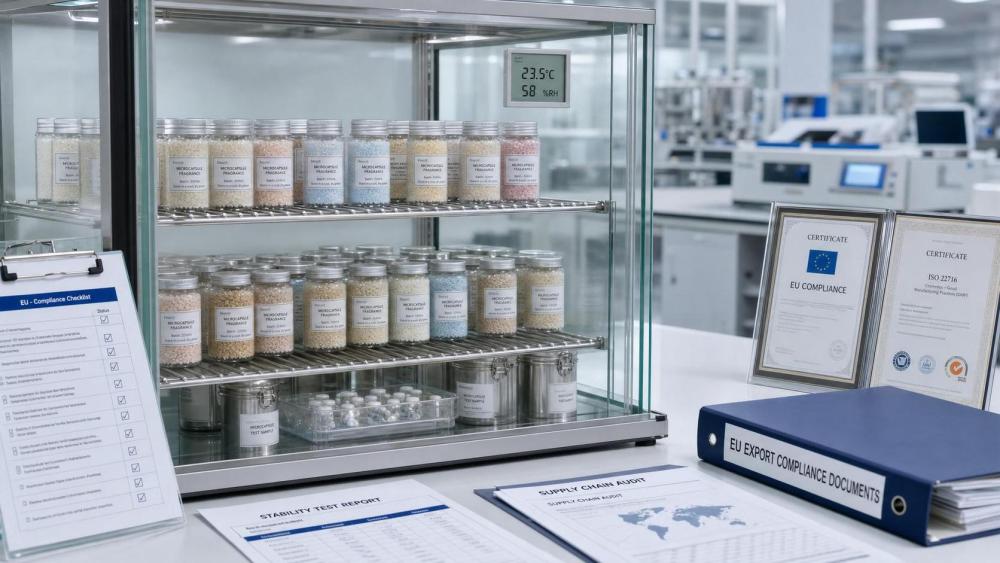
The confirmed change is that IFRA revised Annex I with effect from 15 July 2026. Under the revision, all microencapsulated fragrance systems sold in the EU must undergo accelerated stability testing conducted at 40°C/75% RH for 90 days.
The event summary also states that formulations failing to meet this requirement must either be reformulated or withdrawn by Q4 2026. The change directly affects overseas suppliers exporting encapsulated scent technologies to EU FMCG brands, with particular relevance for systems using gelatin-chitosan or PLGA carriers.
Another confirmed consequence is the need for updated technical dossiers and renewal of the IFRA Certificate of Compliance for affected products.
Where the pressure will show up across the supply chain
Export programs tied to EU FMCG customers
From an industry perspective, exporters supplying microencapsulated fragrance systems into EU-facing FMCG programs are likely to feel the impact first because continued supply now depends on demonstrating compliance with the new testing condition. The immediate pressure points are product qualification status, customer documentation, and whether existing formulations can remain in sale without interruption through the Q4 2026 transition window.
What deserves closer attention is the interaction between shipment planning and compliance readiness. Where dossiers or certificates are not updated in time, supply continuity risks may move from the laboratory stage into contract execution and delivery scheduling.
Formulation and carrier system review
Suppliers using gelatin-chitosan or PLGA carriers are specifically identified in the event summary, so these material systems are likely to receive closer internal review. Analysis shows that the main operational impact here is not only testing itself, but also whether the current encapsulation approach can continue without reformulation.
For product development and technical teams, the relevant business changes center on stability evidence, formulation assessment, and the readiness of supporting records needed for customer and compliance review.
Documentation and certification workflows
Certification-related functions and regulatory support providers may also see additional workload because the revision explicitly requires updated technical dossiers and IFRA Certificate of Compliance renewal. This means documentation is no longer a secondary follow-up item; it becomes part of the market access path for affected products.
For procurement teams and brand-side buyers, the practical implication is that supplier qualification may increasingly depend on whether updated test records and compliance documents are available within purchasing and approval cycles.
What companies should review now
Check whether existing dossiers still match the new rule
Companies handling relevant products should review whether current technical dossiers reflect the Annex I revision and whether existing compliance files remain usable under the new testing mandate. If documentation was prepared under earlier assumptions, it may no longer support uninterrupted EU sales.
Map products exposed to reformulation or withdrawal risk
Analysis shows that the most immediate internal task is to identify which microencapsulated fragrance systems could face reformulation or withdrawal if they do not satisfy the accelerated stability requirement. This is especially relevant for portfolios involving gelatin-chitosan or PLGA carriers, since those systems are specifically noted in the event summary.
Reconfirm certificate renewal timing with commercial commitments
Because IFRA Certificate of Compliance renewal is identified as part of the required response, companies should align renewal timing with active sales programs, customer qualification milestones, and planned deliveries. The event summary does not provide a detailed administrative process, so this remains an area where execution timing should be monitored closely rather than assumed.
Watch for changes in customer-side submission requirements
Observably, buyers and brand owners may adjust their document requests, technical review expectations, or approval sequencing as they absorb the Annex I change. Since no detailed downstream implementation guidance is provided in the input, it is more appropriate to treat this as a likely compliance follow-up area that still needs confirmation in practice.
How this should be read at this stage
Analysis shows that this development is best understood as an implemented rule change with immediate compliance consequences, not as a preliminary policy discussion. The effective date is stated, the testing condition is specified, and the event summary sets out a Q4 2026 consequence for non-compliant formulations.
At the same time, it is also a rule change whose practical execution still deserves observation. What remains worth monitoring is how consistently the new requirement is reflected in customer technical files, certificate renewal handling, procurement documentation, and market-side acceptance of reformulated systems.
Why the change matters beyond the lab
This update matters because it connects a defined testing obligation to market continuity in the EU for a specific class of fragrance systems. The issue is therefore broader than product performance alone; it reaches into export readiness, approval documents, and delivery planning.
Current observation suggests that the development should be read as a concrete compliance signal already in effect, while the downstream business response such as dossier handling, customer enforcement rhythm, and formulation transition still requires close tracking.
Basis of this article
This article is generated from the user-provided news title, event date, and event summary. For developments of this type, commonly relevant source categories may include official notices, regulatory publications, trade or customs authority updates, industry association releases, standards organization documents, and reporting by established professional media.
No specific official source link was provided in the input, so the exact official publication path still needs to be verified on an ongoing basis. Follow-up attention should remain on implementing details, certification interpretation, tender or procurement document changes, industry feedback, and how affected companies carry out compliance adjustments in practice.
Related News
- How to Choose Fragrance Ingredients for Diffusers That Stay Stable in Oil BasesAug 04, 2026Aromatics & Perfumery Fellow
- How to Choose Aroma Ingredients for Candles Based on Scent Throw and Wax CompatibilityAug 03, 2026Aromatics & Perfumery Fellow
- Home Diffuser Series Technical Guide for Fragrance BuyersJul 21, 2026Aromatics & Perfumery Fellow
- EU Bans More Microencapsulated Fragrance AllergensJul 16, 2026Aromatics & Perfumery Fellow
Related News
- 00
0000-00
2026 Osong Cosmetics and Beauty Expo Concludes in South Korea - 00
0000-00
How to compare cosmetic active compounds by their cost in use - 00
0000-00
HKBU Showcases DR2 Following NMPA Registration as a New Cosmetic Ingredient - 00
0000-00
How to use ingredient market insights to forecast sourcing costs - 00
0000-00
Galderma Marks 30 Years of Hyaluronic Acid Injectable Innovation
Aromatics & Perfumery Fellow
Weekly Insights
Stay ahead with our curated technology reports delivered every Monday.