





On 10 July 2026, China Customs began requiring full blockchain-enabled traceability for exports of hyaluronic acid with purity of 95% or above when shipments are bound for the EU, the US, and South Korea. For exporters, ingredient suppliers, compliance teams, and overseas buyers, the change deserves close attention because it ties customs clearance more directly to documentation quality, laboratory records, and digital filing readiness rather than to product movement alone.
What the new customs requirement covers
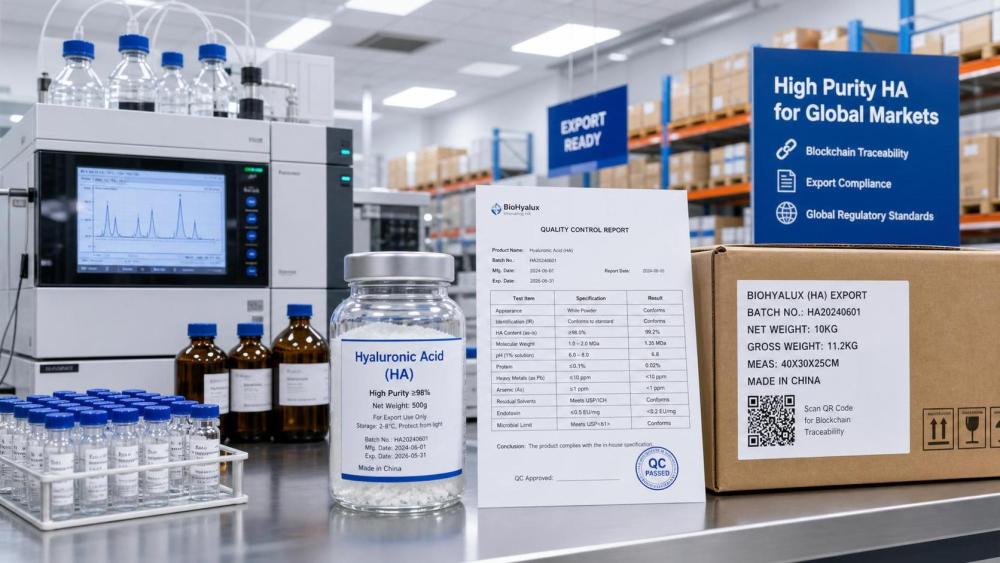
According to the information provided, the requirement applies to all hyaluronic acid exports at or above 95% purity destined for the EU, the US, and South Korea. China Customs requires blockchain-enabled traceability through the China Ingredient Trace Platform.
The required dossier includes fermentation batch logs, chromatographic purity certificates using HPLC-UV, and endotoxin test reports showing a limit of no more than 0.1 EU/mg. Shipments that do not carry a QR-coded digital dossier will be subject to 100% physical inspection, which can add 5 to 7 working days to customs clearance.
Where the impact is likely to be felt first
Export operations may face a tighter documentation gate
From an industry perspective, direct trading companies are likely to feel the change at the shipment preparation stage. The issue is not only whether goods are ready to move, but whether the export file can support traceability in the exact format now required. What deserves closer attention is the risk that a shipment may be commercially ready while still being non-compliant at the customs documentation level.
Upstream manufacturers will be judged on record integrity
For fermentation-based HA producers and processing manufacturers, the new rule points to a more detailed review of production and testing records. Analysis shows that batch logs, purity certificates, and endotoxin reports are no longer supporting papers in the background; they become part of the customs-facing compliance package. That can affect internal release timing, document consistency, and coordination between production, QA, and export teams.
Overseas buyers and procurement teams may need to reassess lead times
Buyers in the EU, the US, and South Korea may be affected through delivery planning and supplier verification. Observably, the 5 to 7 working day delay tied to missing QR-coded dossiers creates a direct scheduling issue. Procurement teams therefore need to pay closer attention to whether suppliers can provide complete digital traceability before shipment, especially for time-sensitive orders.
Supply chain service providers may see more compliance coordination work
Logistics coordinators, customs agents, and related service providers may be drawn more deeply into pre-clearance checks. The practical effect is that shipment readiness now depends more heavily on whether digital records, lab documentation, and customs submission steps are aligned before cargo is dispatched.
What companies should review now
Check whether product scope and destination match the rule
Companies should first identify whether their HA exports meet the stated purity threshold and whether the destination market is the EU, the US, or South Korea. This is a practical scoping step, because the rule described in the provided information is not framed as a general requirement for all destinations.
Validate the completeness of the digital dossier
The immediate operational focus should be on whether fermentation batch logs, HPLC-UV purity certificates, and endotoxin test reports are complete, consistent, and ready to be linked to a QR-coded digital dossier. Analysis shows that missing information is not a minor paperwork issue here; it can trigger full physical inspection at customs.
Separate policy wording from shipment execution
What deserves closer attention is the difference between understanding the requirement in principle and meeting it in day-to-day export execution. A company may understand that blockchain traceability is required, yet still face disruption if internal data collection, document review, or platform submission is not completed before dispatch.
Prepare customer communication around lead-time risk
For exporters and account teams, buyer communication becomes part of compliance management. Where documentation readiness is still being standardized, companies may need to build extra time into delivery commitments and explain the customs inspection risk linked to incomplete QR-coded digital dossiers.
Why this looks like more than a filing update
Analysis shows that this development is better understood as a compliance signal with operational consequences, rather than as a routine paperwork adjustment. The rule connects traceability, lab evidence, and customs processing in a more explicit way for high-purity HA exports to three major destination markets named in the provided information.
At the same time, it is still more appropriate to understand this as a rule that requires continued observation rather than as a basis for broad market conclusions. The confirmed facts show a higher documentation threshold and a defined clearance penalty for incomplete dossiers, but they do not by themselves prove wider trade outcomes beyond that.
How to read the development at this stage
At this stage, the most balanced reading is that China Customs has raised the execution standard for high-purity hyaluronic acid exports in specific markets by tying customs efficiency to traceability completeness. For the industry, the immediate significance lies in GMP documentation rigor, digital compliance readiness, and shipment planning discipline. It is more appropriate to understand this as a concrete short-term operational change and a longer-term signal that documentation quality is becoming a more visible trade control factor.
Basis of this article and points to keep tracking
This article is based on the user-provided news title, event date, and event summary. For developments of this kind, commonly relevant source types may include official customs notices, company disclosures, industry association updates, authoritative media reporting, and standard-setting documents.
No specific official source link was provided in the input, so the exact source document still needs ongoing verification. What deserves continued attention is whether subsequent official wording adds implementation details, clarifies submission procedures on the China Ingredient Trace Platform, or further defines documentation expectations for affected exports.
Related News
- Galderma Marks 30 Years of Hyaluronic Acid Injectable InnovationOct 24, 2026Cosmeceutical Formulator
- Sihuan Pharmaceutical’s Two Self-Developed Aesthetic Products Approved in Hong KongOct 21, 2026Cosmeceutical Formulator
- Does Low-Molecular-Weight Hyaluronic Acid Work Better in Leave-Ons?Oct 23, 2026Cosmeceutical Formulator
- How high purity actives for serums reduce formula instability riskSep 30, 2026Cosmeceutical Formulator
Related News
- 00
0000-00
Bairun Nine-Month Profit Up 20.4% to RMB 662m; Flavors and Fragrances Also Grow - 00
0000-00
How biomimetic peptides work in anti-aging skincare formulations - 00
0000-00
2026 Osong Cosmetics and Beauty Expo Concludes in South Korea - 00
0000-00
How to compare cosmetic active compounds by their cost in use - 00
0000-00
HKBU Showcases DR2 Following NMPA Registration as a New Cosmetic Ingredient
Cosmeceutical Formulator
Weekly Insights
Stay ahead with our curated technology reports delivered every Monday.