





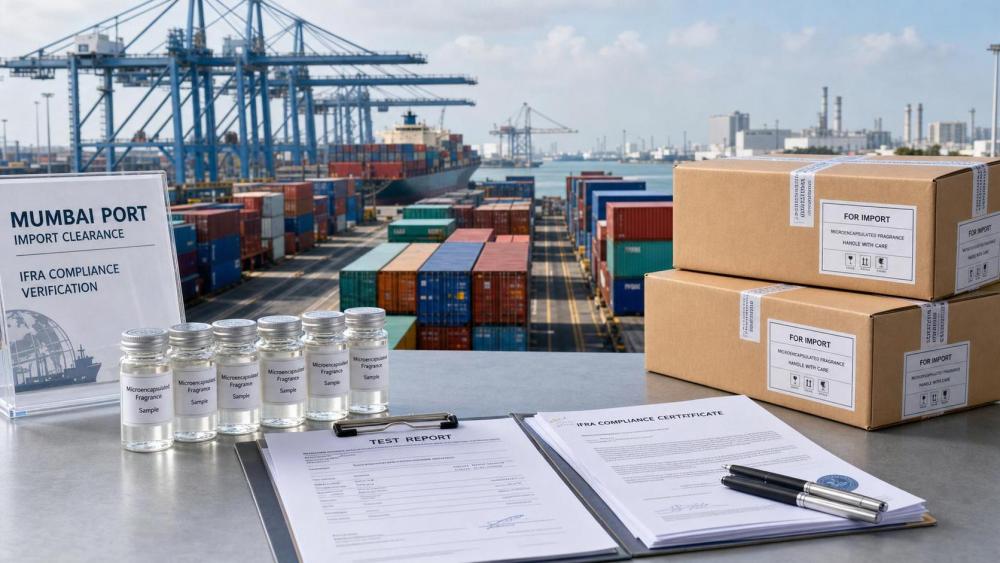
From 1 July 2026, India’s import control for microencapsulated fragrances entering via Mumbai port moves from document presence to verified IFRA compliance. Under the new DGFT requirement, importers must provide a third-party IFRA Certificate of Conformance validated by an IFRA-recognized lab, and the change is especially relevant for fragrance houses supplying Indian FMCG brands and contract manufacturers because it directly affects customs handling, release timing, testing exposure, and delivery planning.
A narrower entry path for microencapsulated fragrance imports
The confirmed change takes effect on 1 July 2026. India’s Directorate General of Foreign Trade (DGFT) requires all imports of microencapsulated fragrances to carry a third-party IFRA Certificate of Conformance (CoC) verified by an IFRA-recognized lab. For shipments that do not have a valid CoC, a mandatory 14-day quarantine applies, and retesting is to be conducted at the importer’s cost. The stated impact extends to fragrance houses supplying Indian FMCG brands and contract manufacturers.
Where the pressure is likely to appear first
For importers handling customs clearance
From an industry perspective, the most immediate pressure point is border entry. Importers are the party directly exposed to quarantine and retesting costs when a shipment does not present a valid CoC. In practical terms, this raises the importance of pre-shipment document readiness, verification status, and alignment between cargo and compliance paperwork before goods arrive at Mumbai port.
For fragrance houses supplying Indian brand owners
Analysis shows that suppliers serving Indian FMCG brands and contract manufacturers may need to treat IFRA documentation as a shipment-critical requirement rather than a supporting compliance file. The rule change can affect order release timing, shipment acceptance, and customer confidence where delivery commitments depend on uninterrupted port clearance.
For procurement and manufacturing schedules downstream
Observably, procurement teams and contract manufacturing operations may need to pay closer attention to certificate validity and testing readiness because a 14-day quarantine can alter inbound material timing. Even without additional policy detail, the confirmed rule introduces a clearer link between compliance paperwork and production scheduling risk.
For testing and compliance service workflows
What deserves closer attention is the role of third-party verification by an IFRA-recognized lab. This means the issue is not only whether a CoC exists, but whether the certificate meets the specified verification condition. Companies relying on external compliance support may therefore need to review how testing, certification, and document handover are organized before shipment.
What companies should monitor now
Check whether existing CoC workflows match the new requirement
Analysis shows that businesses should first confirm whether their current IFRA documentation process already includes third-party certification and verification by an IFRA-recognized lab. Where current practice falls short of that threshold, shipment preparation may need adjustment before cargo is dispatched.
Review contract and purchase document language
From an operational perspective, procurement teams may need to revisit purchase orders, supply agreements, and shipment checklists to ensure the required CoC is clearly treated as a mandatory pre-delivery or pre-dispatch document. The input does not provide detailed enforcement templates, so this remains a practical point to monitor rather than a confirmed uniform market practice.
Reassess lead times and contingency planning
Observably, the confirmed 14-day quarantine for non-compliant shipments creates a specific timing risk. Companies supplying time-sensitive production programs may need to build more room into dispatch plans and inbound scheduling, especially where substitute supply is limited or delivery windows are tight.
Follow later clarification in execution language
What deserves closer attention is whether later official communication further clarifies document review standards, validity expectations, or handling procedures for retesting. The current information confirms the rule and the consequence for missing valid CoC, but it does not provide the full operational detail companies would usually want for internal compliance execution.
How this change is best understood at this stage
As an editorial observation, this development is more appropriate to understand as an implemented compliance control rather than a tentative policy signal, because an effective date, a documentary requirement, and a stated consequence for non-compliance have all been identified. At the same time, it should not yet be read as a complete picture of port execution practice, since the available information does not describe detailed review procedures, documentary formatting expectations, or how consistently follow-up measures may be applied in day-to-day clearance.
A compliance signal with direct supply implications
Taking the confirmed facts together, the significance of this change lies in how directly it ties verified IFRA documentation to import release conditions for microencapsulated fragrances entering via Mumbai port. For the industry, the most reasonable reading at present is that this is a live execution signal with immediate relevance for compliance preparation, shipment planning, and supplier qualification, while the finer points of implementation still warrant continued observation.
Basis of this report and points for continued verification
This article is based on the user-provided news title, event date, and event summary. For developments of this kind, commonly relevant source types may include official notices, publications from trade regulators, customs or foreign trade authorities, industry association updates, standards-related documents, and reporting by established trade media. A specific official source link was not provided in the input, so the precise official text still needs ongoing verification. Further observation should focus on any later policy detail, certification execution guidance, tender or procurement document changes, market feedback, and how companies implement the requirement in actual trade operations.
Related News
- How to Choose Fragrance Ingredients for Diffusers That Stay Stable in Oil BasesAug 04, 2026Aromatics & Perfumery Fellow
- How to Choose Aroma Ingredients for Candles Based on Scent Throw and Wax CompatibilityAug 03, 2026Aromatics & Perfumery Fellow
- Home Diffuser Series Technical Guide for Fragrance BuyersJul 21, 2026Aromatics & Perfumery Fellow
- EU Bans More Microencapsulated Fragrance AllergensJul 16, 2026Aromatics & Perfumery Fellow
Related News
- 00
0000-00
2026 Osong Cosmetics and Beauty Expo Concludes in South Korea - 00
0000-00
How to compare cosmetic active compounds by their cost in use - 00
0000-00
HKBU Showcases DR2 Following NMPA Registration as a New Cosmetic Ingredient - 00
0000-00
How to use ingredient market insights to forecast sourcing costs - 00
0000-00
Galderma Marks 30 Years of Hyaluronic Acid Injectable Innovation
Aromatics & Perfumery Fellow
Weekly Insights
Stay ahead with our curated technology reports delivered every Monday.