





On 25 May 2026, the European Union’s Rapid Alert System for Food and Feed (RASFF) issued an alert regarding a non-compliant batch of dietary supplements exported from China. The product contained high-purity hyaluronic acid (HA) but lacked complete safety dossiers required under EU Novel Food Regulation (EU) 2015/2283 — specifically, either EFSA evaluation reports or validated GRAS notifications. This incident directly affects exporters of HA-based dietary supplements, functional beverages, and oral beauty ingredients targeting the EU market.
Event Overview
On 25 May 2026, the EU RASFF published notification #2026.2487 concerning one consignment of food supplements originating from China. The notified product included high-purity hyaluronic acid as an active ingredient. Authorities confirmed that the importer failed to submit evidence of either a valid EFSA scientific assessment or a GRAS determination accepted by EU competent authorities. As a result, the shipment was refused entry into the EU.
Industries Affected
Direct Exporters & Trading Companies
These entities face immediate customs delays and potential rejection of shipments destined for EU member states. The alert triggers heightened scrutiny not only for HA-containing products but also for other novel bioactive ingredients without pre-authorized status under EU regulation.
Raw Material Suppliers (e.g., HA Producers)
Suppliers of high-purity hyaluronic acid must now ensure their technical documentation aligns with EU requirements — including purity specifications, manufacturing process descriptions, and traceable safety data. Buyers increasingly request EFSA-aligned dossiers at the procurement stage, shifting compliance responsibility upstream.
Contract Manufacturers & Formulators
Companies producing finished supplements or functional drinks for EU-bound brands are exposed to liability if formulations include unauthorised novel ingredients. Batch-level compliance verification — especially for HA sourced from third-party suppliers — has become a critical quality gate before release.
Distribution & Brand Owners in EU Markets
EU-based importers and brand owners may encounter supply chain disruption, reputational risk, and contractual penalties if products fail border control. They are now expected to validate supplier compliance claims prior to placing orders — beyond standard COA or ISO certifications.
Key Compliance Focus Areas & Recommended Actions
Monitor Official Updates on HA Status Under EU Novel Food Regulation
While hyaluronic acid is permitted in cosmetics and topical applications, its use in foods and supplements remains subject to case-by-case authorisation. Check EFSA’s database and national food safety authority portals regularly for any new opinions or pending applications related to HA purity grades or dosage forms.
Verify Documentation Requirements for Specific HA Grades and Intended Uses
Not all HA sources qualify equally under EU law. High-purity, low-molecular-weight, or enzymatically modified HA may trigger stricter review. Confirm whether your HA grade falls within existing authorised uses — e.g., via Commission Implementing Regulation (EU) 2023/1091 — or requires a full Novel Food application.
Distinguish Between Policy Signals and Enforceable Obligations
This RASFF alert reflects enforcement practice, not a regulatory amendment. However, observably, customs authorities are applying tighter checks on supporting documentation — particularly where purity exceeds typical food-grade benchmarks. Treat this as an operational signal, not merely an isolated incident.
Prepare Documentation Packages Ahead of Shipment
Assemble EFSA-referenced safety summaries, GRAS letters (if applicable), full specifications, and process flowcharts for each HA-containing SKU. Maintain version-controlled records accessible to EU importers and customs brokers. Pre-submission review by EU regulatory consultants is advisable for high-value consignments.
Editorial Perspective / Industry Observation
Analysis shows this alert signals a broader tightening of enforcement around ingredient-level Novel Food compliance — especially for bioactives previously assumed ‘low-risk’ due to cosmetic or pharmaceutical use history. It does not indicate a ban on HA per se, but rather confirms that marketing HA in food supplements in the EU requires demonstrable, dossier-backed authorisation. From an industry perspective, this is less a sudden policy shift and more a calibration of existing rules toward stricter implementation. Current enforcement appears focused on transparency of origin, purity thresholds, and alignment between declared function and approved use cases.
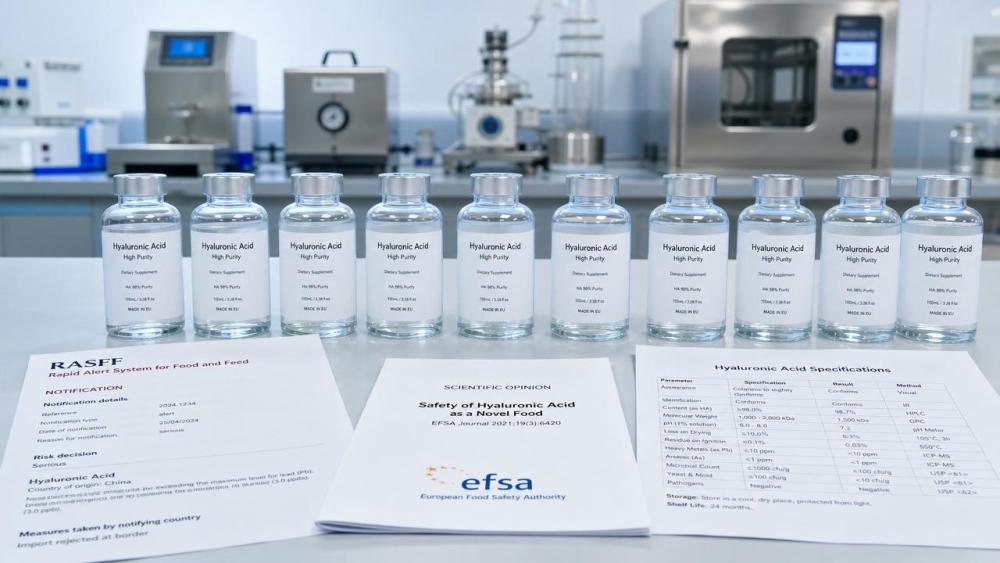
Conclusion: This RASFF notification underscores that EU market access for functional food ingredients hinges increasingly on granular, product-specific regulatory readiness — not just broad category approvals. It is best understood not as an outlier event, but as a reinforcement of long-standing Novel Food obligations now being applied with greater consistency across borders and supply tiers.
Source: European Commission RASFF Notification #2026.2487 (published 25 May 2026).
Note: Ongoing observation is recommended for EFSA’s evaluation status of hyaluronic acid dossiers submitted under Regulation (EU) 2015/2283 — no formal opinion has yet been published.
Related News
- Bairun Nine-Month Profit Up 20.4% to RMB 662m; Flavors and Fragrances Also GrowOct 27, 2026Prof. Elian Thorne
- How biomimetic peptides work in anti-aging skincare formulationsOct 27, 2026Cosmeceutical Formulator
- 2026 Osong Cosmetics and Beauty Expo Concludes in South KoreaOct 26, 2026Prof. Elian Thorne
- How to compare cosmetic active compounds by their cost in useOct 26, 2026Prof. Elian Thorne
Related News
- 00
0000-00
Bairun Nine-Month Profit Up 20.4% to RMB 662m; Flavors and Fragrances Also Grow - 00
0000-00
How biomimetic peptides work in anti-aging skincare formulations - 00
0000-00
2026 Osong Cosmetics and Beauty Expo Concludes in South Korea - 00
0000-00
How to compare cosmetic active compounds by their cost in use - 00
0000-00
HKBU Showcases DR2 Following NMPA Registration as a New Cosmetic Ingredient
Industry Global
Weekly Insights
Stay ahead with our curated technology reports delivered every Monday.