





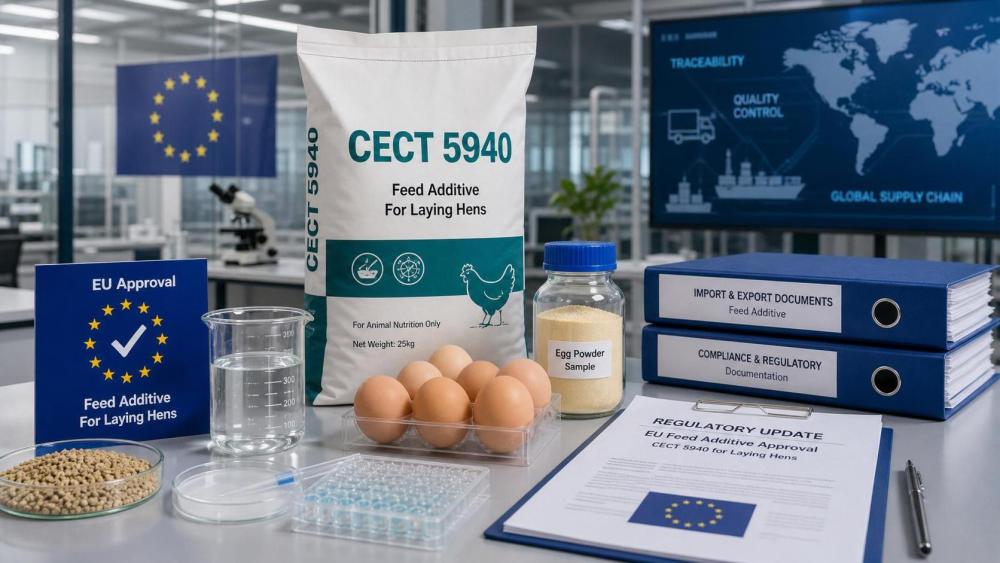
On May 11, 2026, the European Commission approved the use of Bacillus velezensis CECT5940 as a feed additive for laying poultry, signaling a concrete regulatory change for feed formulation and downstream compliance. For feed suppliers, ingredient buyers, egg product processors, and import-export operators, the development matters less as a product story than as a rule-based market signal: approved probiotic use may reshape how supporting preservatives, natural antioxidants, raw material declarations, and customs documentation are prepared across animal-derived food supply chains.
What the approval confirms
The confirmed facts are limited but commercially relevant. The approval was issued by the European Commission on May 11, 2026, and covers a preparation of Bacillus velezensis CECT5940 for laying poultry feed. According to the provided event summary, the strain has antibacterial and absorption-promoting functions and may replace part of the role currently played by some chemical preservatives and antibiotic growth promoters. The same summary also indicates that the approval is expected to stimulate coordinated demand for natural antioxidants such as rosemary extract and food preservatives such as natamycin within animal-source food supply chains, while affecting raw material compliance declarations and import customs clearance for end products including probiotic eggs and functional egg powder.
Where the rule change may be felt first
Feed formulation and ingredient purchasing are likely to face earlier review
From an industry perspective, feed manufacturers and raw material procurement teams are among the first to feel the impact because the approval changes the compliance status of one feed-use ingredient for laying poultry. That can affect how buyers assess formulation options, supplier qualification materials, and supporting technical documents when combining probiotics with related preservatives or antioxidant inputs. What deserves closer attention is whether procurement files, specifications, and compliance statements remain internally consistent once CECT5940 is introduced into commercial feed programs.
Egg and egg-product processors may need tighter raw material declarations
Processors handling products such as probiotic eggs or functional egg powder may be affected at the declaration and traceability level. Analysis shows that once an approved feed additive becomes part of the upstream feeding regime, downstream operators may need to review how raw material compliance statements, product descriptions, and supporting dossiers are presented in customer, audit, or import settings. The immediate issue is not a confirmed new filing obligation, but a higher likelihood that document alignment will matter more in cross-border transactions.
Trade and customs teams may see closer scrutiny of supporting paperwork
For exporters, importers, and supply chain service providers, the event matters because the provided summary explicitly links the approval to import clearance implications. Observably, shipments involving probiotic-positioned eggs, egg powder, or related animal-derived products may require more careful preparation of ingredient descriptions, supplier declarations, and technical support files. The practical risk is not necessarily rejection, but mismatch between product positioning, upstream additive use, and the supporting compliance language submitted during customs or commercial review.
Testing, certification, and document support services may see new demand
Certification-related service providers and testing support institutions may also be drawn in as clients seek clearer substantiation for ingredient status, supporting documentation, and traceability claims. It is more appropriate to understand this as a documentation and interpretation issue rather than a confirmed new certification regime, but service demand may still rise where companies need to reconcile feed-use approvals with downstream customer requirements.
What companies should review now
Check whether compliance wording matches actual ingredient use
Analysis shows that companies should first examine whether existing declarations, specifications, and sales descriptions accurately reflect the use of approved probiotic inputs in laying poultry feed. This is especially relevant where finished products are marketed with functional, probiotic, or quality-linked positioning.
Revisit supplier files for related preservatives and antioxidants
The event summary points to likely coordinated demand for inputs such as rosemary extract and natamycin. That makes it sensible for procurement and quality teams to review supplier qualifications, technical documents, and consistency of compliance files for these related ingredients, particularly where they are used within the same supply chain narrative.
Prepare for document-level questions in import and delivery processes
What deserves closer attention is the readiness of import-export documentation. Companies involved in cross-border trade should review whether product dossiers, raw material statements, and shipment documents can clearly support the relationship between upstream feed additive use and downstream product claims or descriptions. The input does not provide detailed enforcement rules, so this remains a precautionary review point rather than a confirmed procedural change.
Keep watching for execution language rather than assume full market uniformity
Observably, the approval itself is a confirmed development, but the market effect will depend on how official wording, customer requirements, and transaction documents evolve in practice. Businesses should therefore monitor follow-up interpretations, tender language, customer specifications, and any shifts in compliance review expectations before treating the change as fully standardized across all channels.
Why this looks like an execution signal, not a closed chapter
Analysis shows that this development is best read as a real regulatory milestone with practical downstream implications, but not as the end of the compliance discussion. The approval establishes a clearer basis for the use of Bacillus velezensis CECT5940 in laying poultry feed, yet the more consequential industry question is how that approval will be translated into procurement standards, declaration language, import review, and product positioning for eggs and egg-derived ingredients. In that sense, it functions both as an implemented rule change and as a signal that supporting commercial documents may now receive closer attention.
How the market may best interpret this development
A measured reading is that the approval does not automatically rewrite every trade or certification practice, but it does create a more concrete compliance reference point for companies operating around laying poultry feed and egg-derived products. From an industry perspective, the event is most useful as a prompt to review upstream-downstream document consistency, supplier support materials, and customs-facing product descriptions. It is more appropriate to understand this as a landed regulatory change with follow-on execution questions still worth monitoring.
Basis of this article and what still needs verification
This article is based on the user-provided news title, event date, and event summary. For developments of this type, relevant source categories typically include official regulatory notices, releases from competent authorities, customs or trade administration updates, industry association communications, standard-setting documents, and reporting by authoritative trade media. A specific official source link was not provided in the input, so the exact primary publication should still be verified. Ongoing attention should also be given to any later policy detail, compliance interpretation, tender-document changes, industry feedback, and evidence of how companies implement the approval in practice.
Related News
- Flavour preservation failures caused by oxygen exposure in beveragesOct 01, 2026Food Preservation Scientist
- Which flavour preservation method best protects citrus top notes?Sep 30, 2026Food Preservation Scientist
- How functional additives for beverages affect shelf-life stabilitySep 11, 2026Food Preservation Scientist
- Ingredient selection for preservatives when pH limits antimicrobial efficacySep 07, 2026Food Preservation Scientist
Related News
- 00
0000-00
2026 Osong Cosmetics and Beauty Expo Concludes in South Korea - 00
0000-00
How to compare cosmetic active compounds by their cost in use - 00
0000-00
HKBU Showcases DR2 Following NMPA Registration as a New Cosmetic Ingredient - 00
0000-00
How to use ingredient market insights to forecast sourcing costs - 00
0000-00
Galderma Marks 30 Years of Hyaluronic Acid Injectable Innovation
Food Preservation Scientist
Weekly Insights
Stay ahead with our curated technology reports delivered every Monday.