





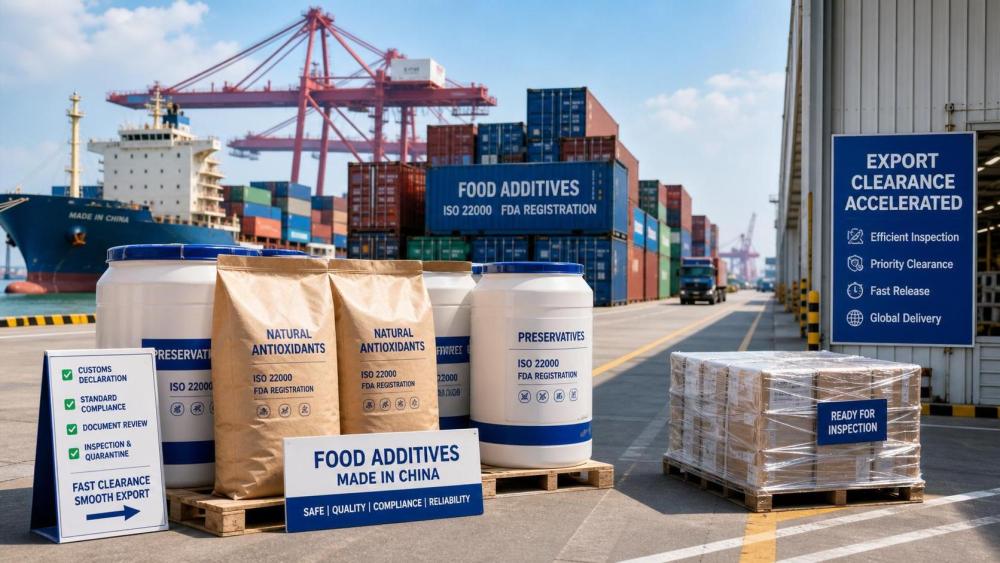
On June 25, 2026, China began implementing trial export facilitation measures for selected food additives after the General Administration of Customs and the market regulation authority issued the policy on June 20. The change introduces a whitelist and fast-inspection release channel for 37 ingredients in the Food Preservatives & Natural Antioxidants category, drawing attention from exporters, overseas buyers, procurement teams, and supply chain operators because it directly affects customs handling speed and how supplier delivery reliability may be assessed.
What the new customs arrangement confirms
According to the information provided, the trial measures apply from June 25 and cover 37 ingredients included in the export whitelist for Food Preservatives & Natural Antioxidants. Examples named in the summary include potassium sorbate, tea polyphenols, and rosemary extract.
The measures were jointly released on June 20, 2026 by the General Administration of Customs of China and the market regulation authority under the title Trial Measures for Facilitating Food Additive Exports. For whitelist products, port processing will use fast inspection and release procedures, and the average customs clearance time is stated as 1.2 working days.
The information also confirms that the first group of whitelist companies must hold both ISO 22000 certification and FDA registration. Overseas customers may use that requirement as one reference point when evaluating the delivery stability of Chinese suppliers.
Where the immediate impact is likely to be felt
Exporters handling listed ingredients
From an industry perspective, companies exporting the 37 listed ingredients are the most directly affected because the policy is tied to port inspection and release efficiency. The practical impact is likely to center on shipment scheduling, customs processing expectations, and communication with overseas customers on lead times.
Overseas buyers and procurement teams
Analysis shows that buyers sourcing preservatives and natural antioxidants from China may pay closer attention to whether a supplier is part of the whitelist framework and whether it meets the stated dual qualification threshold of ISO 22000 plus FDA registration. The main business relevance is supplier screening, order planning, and delivery-risk assessment rather than price or demand assumptions, which are not confirmed by the available information.
Supply chain and trade service participants
Observably, customs brokers, logistics coordinators, and other trade service providers may need to adjust document review and shipment coordination around listed ingredients and eligible exporters. What deserves closer attention is whether cargo, certificates, and customer communications are aligned with the new fast-track treatment so that expected clearance gains are not lost in execution.
What companies should watch now
Check whether products fall within the named scope
Businesses should first distinguish between general food additive exports and the specific scope covered by the whitelist for Food Preservatives & Natural Antioxidants. The current information confirms 37 ingredients, but it does not provide the full list here, so firms should avoid assuming that all related additives automatically qualify for faster release.
Review qualification readiness against the stated threshold
For companies aiming to be viewed as stable export suppliers, the stated requirement for the first batch of whitelist companies is a practical checkpoint. ISO 22000 certification and FDA registration are not just compliance labels in this context; they are part of how overseas customers may judge supply continuity and execution reliability.
Separate policy signal from operational delivery
Analysis shows that a shorter average customs clearance time does not by itself guarantee every shipment will move at the same speed. Companies should pay attention to how the fast-inspection channel translates into actual order fulfillment, internal documentation workflows, and customer-facing delivery commitments.
Prepare customer communication and shipment planning
Export, sales, and supply chain teams should be ready to explain whether a shipment involves listed ingredients, whether the supplier meets the stated qualification conditions, and how the new arrangement may affect delivery timing. This matters especially for customers using supplier stability as part of their procurement decision process.
Why this looks like more than a simple clearance update
As an editorial observation, this development appears to be both a short-term operational change and a longer-term policy signal, but it is not yet appropriate to treat it as a fully settled market outcome. The confirmed facts are clear on faster release for listed ingredients and on the qualification threshold for the first whitelist companies.
What deserves closer attention is the combination of customs efficiency and supplier screening logic. The policy does not only shorten a port process on paper; it also links export convenience with recognizable compliance credentials that overseas buyers can use in evaluating Chinese suppliers. That makes the update relevant beyond customs teams alone.
At the same time, it is more appropriate to understand this as a development that still requires observation. The measures are described as trial measures, and the available information does not confirm how broadly the mechanism may expand, whether the whitelist will change, or how consistently the stated average clearance time will be reflected across different transactions.
How this news is best understood for now
On the basis of the confirmed information, the most grounded reading is that China has introduced a more structured export facilitation mechanism for a defined group of food preservatives and natural antioxidants, with faster customs handling and a visible qualification bar for the first batch of participating companies.
For the industry, the significance lies less in headline speed alone and more in the way customs efficiency, supplier credentials, and delivery reliability are being connected. It is more appropriate to understand this as an important operational signal with wider commercial implications, while still keeping expectations tied to the trial nature of the measures and the need for continued verification in practice.
Basis of this article and points for continued verification
This article is based on the user-provided news title, event date, and event summary. The summary states that the policy was issued on June 20, 2026, took effect on June 25, covers 37 whitelist ingredients in Food Preservatives & Natural Antioxidants, provides fast inspection and release with an average customs clearance time of 1.2 working days, and requires ISO 22000 plus FDA registration for the first batch of whitelist companies.
For this type of update, typical reference categories may include official notices, company disclosures, industry association updates, authoritative media coverage, and standard-related documentation. A specific official source link was not provided in the input, so further verification remains necessary. Areas worth continued attention include any official clarification of the whitelist scope, any later adjustment to implementation rules, and how the trial measures translate into actual export operations.
Related News
- Flavour preservation failures caused by oxygen exposure in beveragesOct 01, 2026Food Preservation Scientist
- Which flavour preservation method best protects citrus top notes?Sep 30, 2026Food Preservation Scientist
- How functional additives for beverages affect shelf-life stabilitySep 11, 2026Food Preservation Scientist
- Ingredient selection for preservatives when pH limits antimicrobial efficacySep 07, 2026Food Preservation Scientist
Related News
- 00
0000-00
2026 Osong Cosmetics and Beauty Expo Concludes in South Korea - 00
0000-00
How to compare cosmetic active compounds by their cost in use - 00
0000-00
HKBU Showcases DR2 Following NMPA Registration as a New Cosmetic Ingredient - 00
0000-00
How to use ingredient market insights to forecast sourcing costs - 00
0000-00
Galderma Marks 30 Years of Hyaluronic Acid Injectable Innovation
Food Preservation Scientist
Weekly Insights
Stay ahead with our curated technology reports delivered every Monday.