





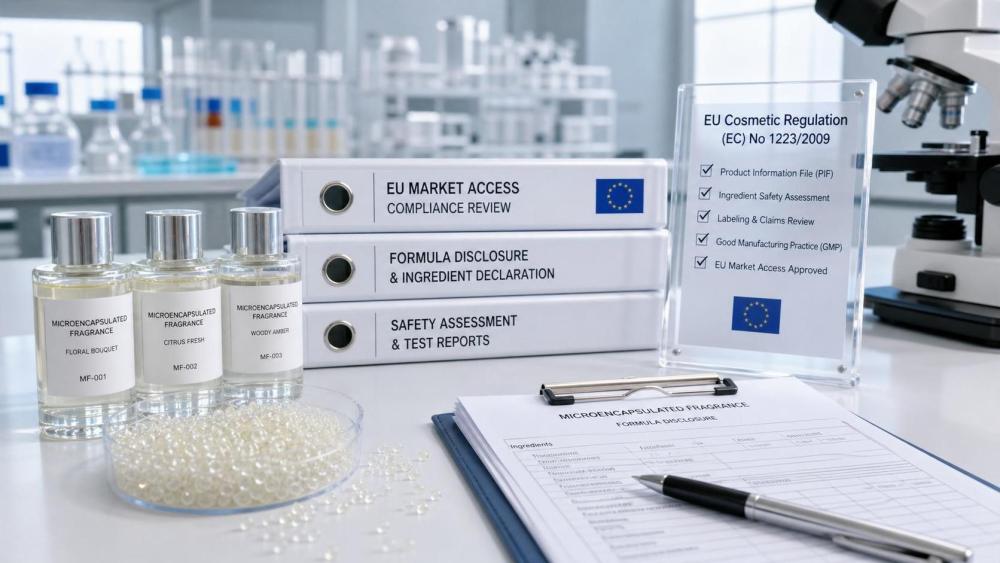
On June 24, 2026, a new CPNP filing requirement took effect for cosmetic products containing microencapsulated fragrances. The change is not just a technical update in submission materials; it directly affects formula compliance, labeling documentation, and EU market access for exporters, especially suppliers whose fragrance systems rely on encapsulation technology and whose product files must now present more detailed disclosure.
What the new CPNP filing requirement now demands
From June 24, 2026, the EU Cosmetic Products Notification Portal (CPNP) requires all marketed products containing microencapsulated fragrances to fully disclose two categories of information in their notification files. The first is the release trigger mechanism of the microcapsules, such as pH response, heat sensitivity, or enzymatic degradation. The second is the composition of the capsule carrier material, with examples including gelatin, gum arabic, and hydrogenated castor oil derivatives.
The information provided also makes clear that products failing to meet this requirement cannot complete CPNP notification. Without a completed notification, those products lose access to the EU market.
Where the pressure is likely to appear across the business chain
Export documentation moves closer to formulation detail
For export-oriented fragrance suppliers, the immediate pressure point is the connection between technical formulation information and market-entry documentation. If the release mechanism and carrier composition are not clearly prepared for submission, the issue is no longer limited to internal formulation records; it becomes a filing barrier that can interrupt access to the destination market.
Procurement teams may need deeper upstream material visibility
Companies purchasing fragrance ingredients or encapsulated fragrance systems may be affected because filing readiness now depends on knowing not only the fragrance function but also how the microcapsule works and what the shell or carrier contains. In practice, this means procurement review may need to pay closer attention to supplier-provided technical documents and whether those documents are sufficient for CPNP submission.
Manufacturing and labeling functions face a documentation linkage issue
For manufacturers using microencapsulated fragrances in finished products, the impact is likely to concentrate in product file preparation, specification alignment, and labeling-related document consistency. Analysis shows that even where a product formula is commercially ready, the inability to align formulation details with notification materials can delay or block compliant market placement.
Compliance service and support roles may see higher verification demands
Certification-related service providers, documentation support teams, and other compliance-facing roles may need to respond to more detailed requests around ingredient disclosure and technical substantiation. From an industry perspective, the change raises the standard for completeness in submission materials rather than simply adding another routine checkbox.
What companies should review now
Check whether product files identify the release pathway clearly
Companies dealing with affected products should review whether current technical files explicitly describe the release trigger mechanism used by the microencapsulated fragrance system. Where existing records are broad or incomplete, that gap may become a direct obstacle in notification preparation.
Confirm whether carrier composition can be disclosed in usable form
What deserves closer attention is whether the capsule material information held internally or provided by suppliers is detailed enough for filing purposes. If the relevant composition is not available in a usable format, companies may face delays in documentation completion even before any commercial shipment question arises.
Reassess supplier coordination and submission readiness
For businesses relying on external fragrance developers or ingredient suppliers, this rule change makes supplier communication more operationally important. The practical focus is not only on whether a material is available, but also on whether its supporting documentation can be translated into a complete CPNP notification package.
Monitor how the requirement is reflected in downstream paperwork
The input information does not provide detailed enforcement wording beyond the new disclosure obligation and the filing consequence. For that reason, companies should continue to watch how this requirement is reflected in compliance checklists, technical documentation requests, and related product submission workflows.
Why this reads as an execution signal rather than a distant policy discussion
Observably, this development is better understood as an implemented compliance requirement rather than a general policy direction. The reason is straightforward: the change is tied to CPNP notification completion, and the consequence of non-compliance is loss of EU market access for affected products.
At the same time, analysis shows that the market still needs to observe how businesses, suppliers, and compliance teams interpret the depth of disclosure in practice. The current information confirms the requirement itself, but continued attention is still needed on documentation standards, filing expectations, and industry feedback during implementation.
How to read the significance of this change
This update should be viewed as a concrete market-entry requirement affecting products with microencapsulated fragrances, not merely as a labeling nuance. Its significance lies in bringing formulation transparency, documentation completeness, and filing readiness into the same compliance checkpoint. It is more appropriate to understand this as a rule already in force, while still recognizing that its detailed execution in day-to-day compliance work deserves close observation.
Basis of this article and points that still require verification
This article is based on the user-provided news title, event date, and event summary. For developments of this kind, commonly relevant source types may include official regulatory notices, releases from supervisory authorities, trade or customs information, industry association updates, standards documents, and reporting by authoritative media.
No specific official source link was provided in the input, so the exact official publication path still requires ongoing verification. It remains necessary to continue tracking any later clarification on implementation details, compliance interpretation, documentation practices, market feedback, and how affected companies adjust their filing and delivery processes.
Related News
- How to Choose Fragrance Ingredients for Diffusers That Stay Stable in Oil BasesAug 04, 2026Aromatics & Perfumery Fellow
- How to Choose Aroma Ingredients for Candles Based on Scent Throw and Wax CompatibilityAug 03, 2026Aromatics & Perfumery Fellow
- Home Diffuser Series Technical Guide for Fragrance BuyersJul 21, 2026Aromatics & Perfumery Fellow
- EU Bans More Microencapsulated Fragrance AllergensJul 16, 2026Aromatics & Perfumery Fellow
Related News
- 00
0000-00
2026 Osong Cosmetics and Beauty Expo Concludes in South Korea - 00
0000-00
How to compare cosmetic active compounds by their cost in use - 00
0000-00
HKBU Showcases DR2 Following NMPA Registration as a New Cosmetic Ingredient - 00
0000-00
How to use ingredient market insights to forecast sourcing costs - 00
0000-00
Galderma Marks 30 Years of Hyaluronic Acid Injectable Innovation
Aromatics & Perfumery Fellow
Weekly Insights
Stay ahead with our curated technology reports delivered every Monday.