





Food preservatives USA rules sit at the intersection of food safety, formulation stability, and market trust. For companies moving products across long supply chains, preservatives are not simply technical additives. They shape shelf life, label claims, audit exposure, and the credibility of every finished batch.
That makes the topic especially relevant now. Regulatory expectations remain strict, consumer scrutiny is higher, and reformulation pressure continues to grow. In practice, understanding what is allowed, what is effective, and what carries avoidable risk is now part of everyday product governance.
Why food preservatives USA rules deserve close attention
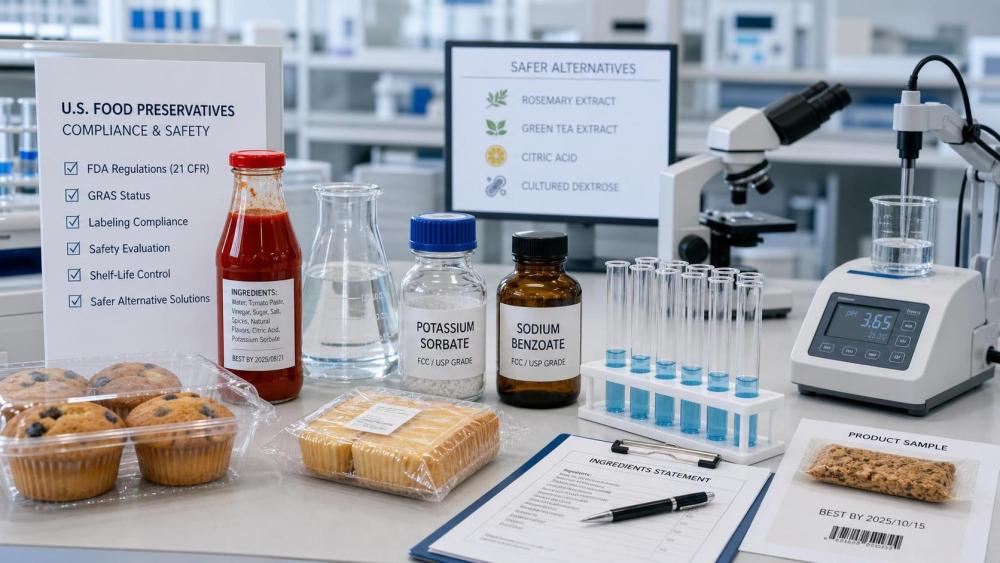
In the US, preservatives are governed through FDA frameworks, ingredient approvals, usage conditions, and labeling requirements. The basic principle is straightforward: a preservative must be lawful for its intended use, used at an appropriate level, and declared correctly on the label.
The challenge is that food preservatives USA compliance is rarely just a legal checkbox. A compliant preservative can still create business problems if it performs poorly in a specific matrix, conflicts with a clean label strategy, or raises retailer concerns.
This is where a broader FMCG perspective matters. FFAI tracks preservatives alongside antioxidants, thickeners, flavors, and other functional ingredients because product stability is never isolated. Preservative performance is influenced by pH, water activity, heat treatment, texture systems, oxygen exposure, and packaging choices.
What counts as a preservative in practical terms
In simple terms, preservatives slow spoilage caused by microorganisms, oxidation, or other degradation pathways. They help foods survive transport, storage, retail display, and consumer handling without unacceptable quality loss.
Not every shelf-life tool works the same way. Some preservatives target molds and yeasts. Others reduce bacterial growth. Antioxidants protect fats, colors, and flavors from oxidation, which is why they often sit close to preservative strategy in formulation decisions.
In food preservatives USA discussions, common examples include sorbates, benzoates, propionates, nitrites, sulfites, and certain antioxidant systems. Their suitability depends on product category, processing conditions, and legal use limitations.
A useful way to group them
This classification is useful because it keeps teams focused on function rather than marketing language alone.
Where the main regulatory pressure sits
Food preservatives USA oversight typically turns on three questions. Is the ingredient approved or GRAS for the intended use? Is the inclusion level technically justified? Is the label accurate and non-misleading?
These questions sound basic, but failures usually happen in the details. A preservative may be acceptable in one food category and restricted in another. A supplier specification may differ from actual plant use. A label may omit function language or fail to reflect the ingredient correctly.
Imported ingredients add another layer. Documentation quality, traceability, and specification alignment can become just as important as the chemistry itself. That is why intelligence-led review matters, especially for exporters serving US channels.
FFAI’s compliance perspective is useful here because ingredient decisions often need both regulatory reading and formulation context. A paper-compliant system may still collapse under baking temperatures, emulsion changes, or long distribution cycles.
Risk is not only toxicology
Public debate around preservatives usually focuses on health fears, but operational risk is broader. Toxicological concern matters, of course, yet many commercial failures come from mismatch rather than illegality.
One common issue is under-preservation. Teams reduce or replace a familiar preservative for label reasons, but do not fully compensate for microbiological pressure. Shelf life then weakens under real distribution conditions, not ideal laboratory storage.
Another issue is overconfidence in “natural” claims. Cleaner-sounding ingredients can help brand positioning, but they are not automatically safer, stronger, or simpler to validate. Fermented systems, cultured dextrose, vinegar derivatives, and plant extracts still require robust challenge testing.
There is also reputational risk. Certain preservatives remain legal, but trigger retailer restrictions or consumer concern. In food preservatives USA strategy, the practical question is often not “Can we use it?” but “Can we defend it across audits, claims review, and customer perception?”
High-attention points in current reviews
- Label-friendly alternatives that still maintain microbial control.
- Nitrite, sulfite, and benzoate scrutiny in sensitive categories.
- Interaction between preservatives and flavor, color, or texture systems.
- Stability after thermal processing, freeze-thaw cycles, and long transport.
- Supplier consistency, impurity profile, and specification discipline.
Safer options usually mean smarter systems
Safer options in food preservatives USA do not always mean a single substitute ingredient. Often they mean building a more resilient preservation system with lower dependence on one additive.
For many products, the strongest approach combines several controls. That may include pH reduction, lower water activity, tighter sanitation, oxygen management, packaging improvement, and a preservative chosen for the exact microbial threat profile.
This hurdle-based view is especially useful in baked goods, sauces, dairy alternatives, refrigerated meals, and beverages. Each matrix behaves differently, and preservative success depends on the whole system, not a single line on the specification sheet.
Cleaner-label options are gaining ground, but they need disciplined evaluation. Some work best in acidic applications. Others affect flavor, color, or viscosity. Because FFAI also covers hydrocolloids, antioxidants, and sensory systems, it is easier to judge tradeoffs across the full formulation.
Common directions for safer formulation
- Use the lowest effective level supported by testing, not habit.
- Pair preservatives with process and packaging controls.
- Review whether antioxidants can reduce secondary quality loss.
- Check sensory effects early, especially in premium products.
- Validate alternatives under real abuse conditions, not only ideal storage.
How to judge a preservative choice in real operations
A useful review starts with the product’s actual failure mode. Is the main threat mold growth, oxidative rancidity, pathogenic risk, or simple flavor drift? Without that answer, preservative decisions become reactive and inconsistent.
The next step is to match the ingredient to the matrix. pH, moisture, fat phase, salt level, heating profile, and packaging atmosphere all change preservative behavior. A system that works in a beverage may fail in a filled bakery item.
Documentation should then confirm four things: legal status, use range, supplier specification, and label declaration. In food preservatives USA programs, these records are often the difference between smooth audits and avoidable nonconformance.
Finally, test the finished product as sold. Challenge studies, shelf-life trials, and sensory checks should reflect realistic storage and distribution. Paper reviews are necessary, but they do not replace evidence from the actual formulation.
A practical next step for better decisions
The most reliable path is to build a short decision framework around food preservatives USA requirements. Map each preservative by legal status, microbial target, process tolerance, label impact, and customer acceptability.
That framework becomes more valuable when it includes adjacent ingredient effects. Texture modifiers, flavor systems, and antioxidants can either support or weaken preservation goals. Looking at them together creates a more stable basis for reformulation.
For teams reviewing current formulas or planning cleaner alternatives, the next move is not to chase the newest claim. It is to compare real product risks, verify the legal pathway, and test whether a safer option still protects quality through the full commercial journey.
In a market where compliance, sensory quality, and trust are increasingly linked, food preservatives USA decisions are best made with both regulatory discipline and formulation intelligence in view.
Related News
- Flavour preservation failures caused by oxygen exposure in beveragesOct 01, 2026Food Preservation Scientist
- Which flavour preservation method best protects citrus top notes?Sep 30, 2026Food Preservation Scientist
- How functional additives for beverages affect shelf-life stabilitySep 11, 2026Food Preservation Scientist
- Ingredient selection for preservatives when pH limits antimicrobial efficacySep 07, 2026Food Preservation Scientist
Related News
- 00
0000-00
2026 Osong Cosmetics and Beauty Expo Concludes in South Korea - 00
0000-00
How to compare cosmetic active compounds by their cost in use - 00
0000-00
HKBU Showcases DR2 Following NMPA Registration as a New Cosmetic Ingredient - 00
0000-00
How to use ingredient market insights to forecast sourcing costs - 00
0000-00
Galderma Marks 30 Years of Hyaluronic Acid Injectable Innovation
Food Preservation Scientist
Weekly Insights
Stay ahead with our curated technology reports delivered every Monday.