





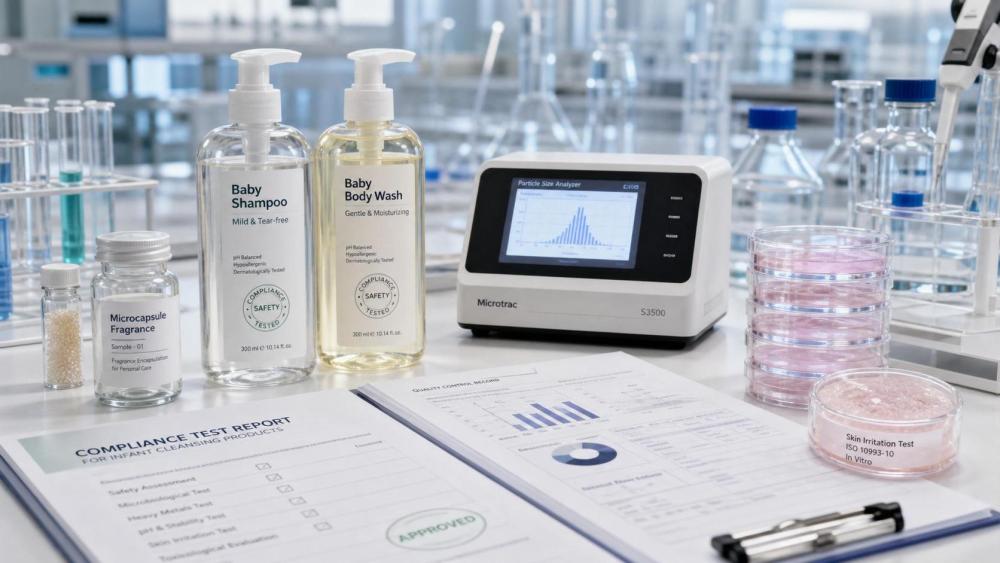
On June 26, 2026, Brazil’s ANVISA approved the use of microencapsulated fragrances in shampoos and bath products for infants and toddlers aged 0-3, while attaching specific technical and safety documentation requirements to market access. For fragrance suppliers, exporters, infant-care product manufacturers, procurement teams, and compliance service providers, this is worth close attention because the approval is tied not only to product use permission, but also to clearly defined evidence on particle size, release behavior, and skin irritation testing.
What the approval explicitly requires
According to the information provided, ANVISA approved microencapsulated fragrances for use in shampoos and body wash products intended for children aged 0-3 on June 26, 2026. The approval requires suppliers to provide particle size distribution data showing Dv90 ≤ 8.5 μm, an in vitro simulated release curve under pH 5.5, 32°C, and 60-minute conditions, and a double-blind clinical skin irritation report validated under OECD TG 439. The same information indicates that this approval opens an access window for Chinese fragrance microcapsule exports into higher-end infant and child channels in South America.
Why this matters across the supply chain
For fragrance microcapsule exporters, access now depends on dossier readiness
Analysis shows the change is relevant first to exporters and suppliers of encapsulated fragrance systems. The main effect is that commercial opportunity is now linked to the ability to present a usable compliance package, rather than relying only on product performance claims. What deserves closer attention is whether export-facing documentation can already support the required Dv90 threshold, the specified release curve conditions, and the requested skin irritation evidence in a form that downstream buyers can review.
For infant wash product manufacturers, formulation approval and supplier selection become more document-driven
From an industry perspective, manufacturers of baby shampoos and body wash products may be affected at the formulation approval, raw material qualification, and product development stages. The rule change suggests that selecting a fragrance supplier is no longer only a sensory or cost decision for this category. Procurement and regulatory teams will likely need to align more closely on technical files, test reports, and the suitability of supplier evidence for infant-use applications.
For procurement and channel-facing teams, the standard may shift into commercial specifications
Observably, buyers serving higher-end infant-care channels may begin treating these technical conditions as practical entry requirements in sourcing discussions, tender documents, or supplier onboarding reviews. Even where detailed execution language is not yet visible, companies involved in distribution and channel supply should monitor whether product briefs, technical specifications, or vendor qualification checklists start reflecting the ANVISA-linked data points.
For testing and compliance service providers, the demand is likely to center on evidence format and comparability
Analysis shows laboratories, documentation support firms, and certification-related service providers may see demand not simply for testing, but for reports that match the required conditions and can be used consistently across buyer and regulatory review contexts. The business impact is therefore likely to appear in report structure, parameter consistency, and traceability of supporting documents.
Practical priorities companies should review now
Check whether existing technical files match the required conditions
What deserves closer attention is whether current supplier files actually contain particle size distribution data expressed in a way that supports the Dv90 ≤ 8.5 μm requirement, and whether release testing has been performed under the stated pH 5.5, 32°C, 60-minute conditions. Where files exist but use different parameters or formats, companies should treat that as a documentation gap rather than assume equivalence.
Review the usability of irritation evidence for infant-care submissions and buyer audits
Analysis shows the skin irritation component may become a practical checkpoint in both regulatory and commercial review. Companies should therefore examine whether their available reports clearly correspond to the required double-blind clinical format and OECD TG 439 validation reference described in the provided information. If not, the issue may affect approval timing, supplier qualification, or customer acceptance.
Prepare for longer coordination cycles between R&D, regulatory, and sales teams
From an industry perspective, the main operational challenge may be internal alignment. Product development teams may focus on fragrance performance, while sales teams pursue channel entry and regulatory teams review evidence completeness. This approval suggests those functions may need earlier coordination, especially for export projects targeting infant and toddler wash categories.
Track whether buyer documents begin to mirror the regulatory language
Observably, one of the most practical signals to watch next is whether purchasing specifications, channel entry requirements, or technical review templates start repeating the same testing conditions and thresholds. The provided information does not establish a uniform execution pathway across the market, so companies should monitor document changes rather than assume immediate standardization.
How this development is best understood at this stage
Analysis shows this is more than a simple ingredient-use update, because the approval is tied to defined evidence requirements that can influence trade readiness, supplier qualification, and the pace of product launch. At the same time, it is more appropriate to understand this as both a landed rule change and an execution signal: the permission is explicit, but the way it will be translated into procurement practice, file review standards, and channel-level acceptance still needs observation.
A measured reading for the market
From an industry perspective, the clearest takeaway is that access to Brazil’s infant wash segment for microencapsulated fragrance solutions now appears more structured and more documentation-dependent. For Chinese suppliers in particular, the information provided points to a real opening into higher-end South American infant-care channels, but not to automatic market conversion. The practical outcome will depend on whether companies can present the required technical and safety evidence in a form that supports compliance, sourcing, and delivery decisions.
Basis of this article and what still needs verification
This article is based on the user-provided news title, event date, and event summary. For developments of this kind, relevant source types typically include official regulatory notices, releases from supervisory authorities, trade or customs updates, industry association communications, standards documentation, and reporting by authoritative sector media. No specific official source link was provided in the input, so the underlying official publication link still needs to be verified on an ongoing basis. Further observation is also needed on detailed implementation language, certification and testing interpretation, procurement document changes, market feedback, and how companies execute against these requirements in practice.
Related News
- How to Choose Fragrance Ingredients for Diffusers That Stay Stable in Oil BasesAug 04, 2026Aromatics & Perfumery Fellow
- How to Choose Aroma Ingredients for Candles Based on Scent Throw and Wax CompatibilityAug 03, 2026Aromatics & Perfumery Fellow
- Home Diffuser Series Technical Guide for Fragrance BuyersJul 21, 2026Aromatics & Perfumery Fellow
- EU Bans More Microencapsulated Fragrance AllergensJul 16, 2026Aromatics & Perfumery Fellow
Related News
- 00
0000-00
2026 Osong Cosmetics and Beauty Expo Concludes in South Korea - 00
0000-00
How to compare cosmetic active compounds by their cost in use - 00
0000-00
HKBU Showcases DR2 Following NMPA Registration as a New Cosmetic Ingredient - 00
0000-00
How to use ingredient market insights to forecast sourcing costs - 00
0000-00
Galderma Marks 30 Years of Hyaluronic Acid Injectable Innovation
Aromatics & Perfumery Fellow
Weekly Insights
Stay ahead with our curated technology reports delivered every Monday.