





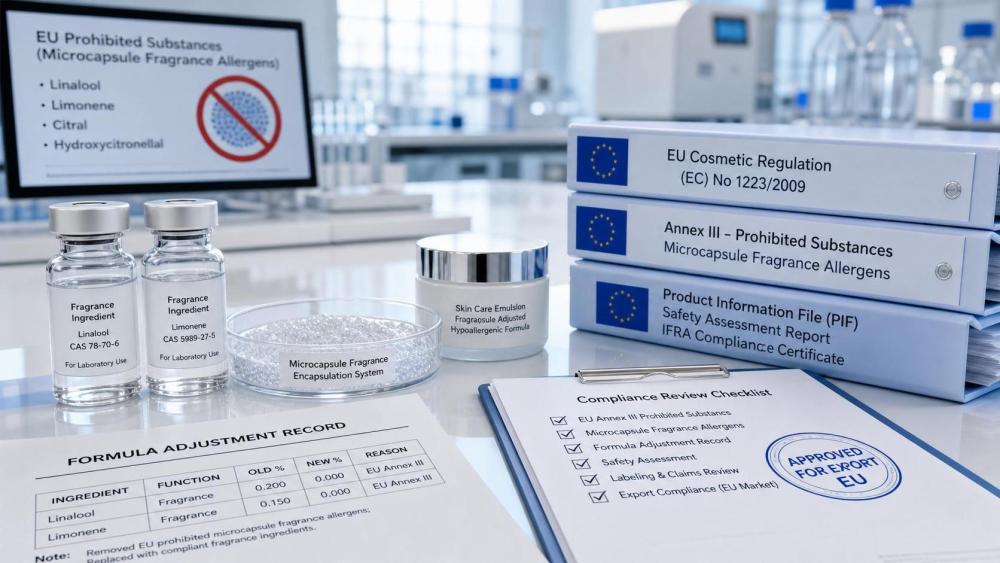
On July 15, 2026, the European Commission updated Annex II of the EU Cosmetics Regulation (EC) No 1223/2009 to prohibit seven newly identified microencapsulated fragrance allergens. The change is especially relevant for suppliers of microencapsulated fragrances serving the EU market, as well as manufacturers and regulatory teams handling formulation, product notification, and compliance documentation. The development merits close attention because it links encapsulated fragrance forms to higher dermal bioavailability and sensitization risk, and it sets a clear compliance workload that must be addressed by Q4 2026.
What the Annex II update confirms
The confirmed facts are limited but commercially significant. The European Commission published the updated Annex II on 2026-07-15 and added seven microencapsulated fragrance allergens to the prohibited list. The summary provided identifies encapsulated forms of hydroxycitronellal and hexyl cinnamal among them. The stated reason for the restriction is enhanced dermal bioavailability and sensitization risk. The update directly affects suppliers of microencapsulated fragrances exporting to the EU and requires reformulation, updated CPNP notifications, and revised IFRA Certificate documentation by Q4 2026.
Where the impact is likely to be felt first
Export-oriented fragrance suppliers face immediate formulation pressure
From an industry perspective, suppliers shipping microencapsulated fragrance materials into the EU are the first group likely to feel the impact. The reason is straightforward: the restriction applies to specific encapsulated allergens now placed on the prohibited list. The main pressure points are product review, reformulation planning, and the preparation of updated compliance files for affected items.
Cosmetics manufacturers will need to revisit product dossiers
Manufacturers using microencapsulated fragrance systems may be affected through downstream formulation and product registration work. Analysis shows that the practical burden is not limited to ingredient substitution. It also extends to checking whether existing cosmetic products require updated CPNP notifications and whether current supporting documents remain aligned with the revised Annex II position.
Regulatory and documentation functions become a central control point
What deserves closer attention is the documentation side of compliance. Teams responsible for IFRA Certificate management, product information flow, and market access coordination may need to verify whether affected materials and related files still support EU placement. In practice, the issue reaches beyond technical R&D and into document control, customer communication, and shipment readiness.
What companies should prioritize now
Check whether affected encapsulated substances are present
Companies dealing with microencapsulated fragrance ingredients should first determine whether any of the seven newly prohibited allergens appear in their EU-bound product scope. This is the threshold question that will shape reformulation, documentation updates, and delivery planning.
Separate reformulation work from notification work
Analysis shows that regulatory response here has at least two tracks: changing the formulation itself and updating the compliance records tied to that formulation. Businesses should avoid treating these as a single administrative task, because the summary explicitly points to both reformulation and updated CPNP notifications.
Review IFRA Certificate documentation early
The requirement to revise IFRA Certificate documentation by Q4 2026 means companies should not leave document review until late in the transition window. For firms working through distributors, contract manufacturers, or multiple documentation owners, this may become a timing issue as much as a technical one.
Prepare for customer and supplier alignment
Observably, this type of restriction can create friction at handoff points across the supply chain. Companies should pay attention to how ingredient status, revised specifications, notification updates, and certificate changes are communicated between suppliers, manufacturers, and EU-facing customers, especially where delivery commitments depend on documentation being current.
Why this reads as more than a one-off update
This section is an editorial observation rather than a statement of fact. It is more appropriate to understand this development as both an immediate compliance change and a longer-term regulatory signal around how encapsulated fragrance forms may be assessed in the EU. The key point is not only that seven substances were added to the prohibited list, but that the stated rationale focuses on enhanced dermal bioavailability and sensitization risk in microencapsulated form. From an industry perspective, that makes this relevant beyond a narrow substance list and worth continued monitoring for how similar materials may be viewed in future updates.
How the market should frame this development
At this stage, the most grounded interpretation is that the market is dealing with a defined regulatory action that already has practical consequences, while the broader direction still requires observation. The immediate result is clear for affected EU export business: formulation review, CPNP updates, and IFRA document revision now move higher on the priority list. The wider industry meaning should be treated cautiously, as a compliance signal with possible longer-term implications rather than a basis for sweeping conclusions.
Basis of this article and what still needs verification
This article is based on the user-provided news title, event date, and event summary. For developments of this kind, relevant source types typically include official regulatory notices, company compliance updates, industry association information, authoritative media reporting, and standard or documentation-related materials. A specific official source link was not provided in the input, so the underlying publication text and any subsequent implementation details still need ongoing verification. Follow-up attention should remain on any official clarifications, related compliance guidance, and further detail on documentation or transition expectations tied to the Q4 2026 deadline.
Related News
- How to Choose Fragrance Ingredients for Diffusers That Stay Stable in Oil BasesAug 04, 2026Aromatics & Perfumery Fellow
- How to Choose Aroma Ingredients for Candles Based on Scent Throw and Wax CompatibilityAug 03, 2026Aromatics & Perfumery Fellow
- Home Diffuser Series Technical Guide for Fragrance BuyersJul 21, 2026Aromatics & Perfumery Fellow
- EU Bans More Microencapsulated Fragrance AllergensJul 16, 2026Aromatics & Perfumery Fellow
Related News
- 00
0000-00
Bairun Nine-Month Profit Up 20.4% to RMB 662m; Flavors and Fragrances Also Grow - 00
0000-00
How biomimetic peptides work in anti-aging skincare formulations - 00
0000-00
2026 Osong Cosmetics and Beauty Expo Concludes in South Korea - 00
0000-00
How to compare cosmetic active compounds by their cost in use - 00
0000-00
HKBU Showcases DR2 Following NMPA Registration as a New Cosmetic Ingredient
Aromatics & Perfumery Fellow
Weekly Insights
Stay ahead with our curated technology reports delivered every Monday.