





On July 3, 2026, India moved to tighten export licensing for water-soluble vanilla flavor solutions, a step that immediately puts exporters, overseas buyers, procurement teams, and supply chain operators on alert. The change matters because it combines a supply-side disruption tied to monsoon-driven vanilla crop failure in Madagascar with new shipment-level compliance requirements in India, creating a direct risk of longer lead times for affected trade flows.
What changed on July 3
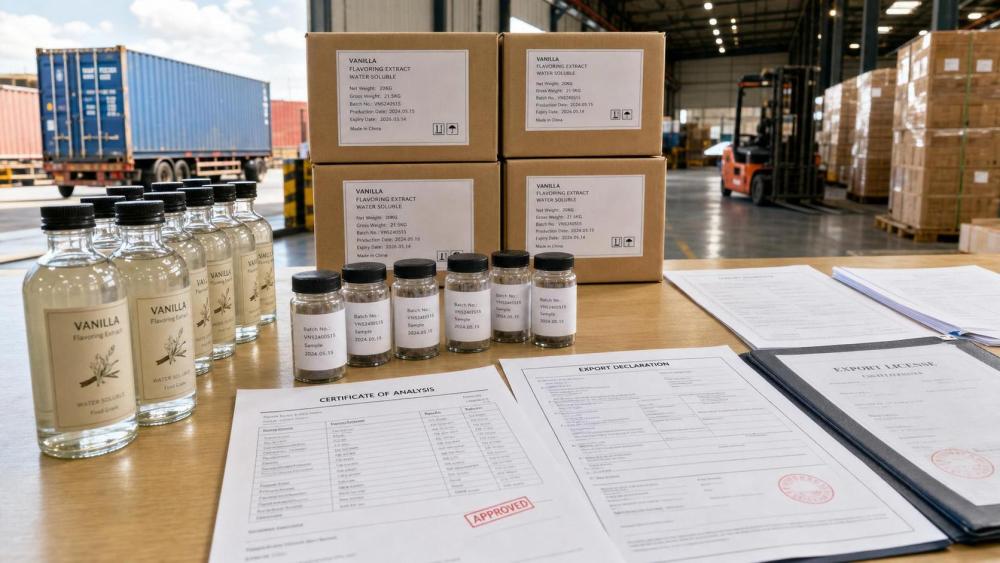
India’s Directorate General of Foreign Trade (DGFT) introduced immediate export restrictions on water-soluble vanilla flavor solutions classified under HS 3302.90.90 on July 3. Under the new arrangement, each consignment now requires pre-approval before export.
The measure was introduced in the context of severe monsoon-related crop failure in Madagascar, identified in the provided information as India’s primary source of vanilla beans. Exporters are also now required to submit batch-specific quality certificates and end-user declarations. According to the provided summary, these added procedures are expected to extend lead times by 10 to 14 days.
Where the pressure is likely to appear first
Export transactions face a more document-heavy cycle
From an industry perspective, direct trade companies are likely to feel the impact first because the rule change applies at the consignment level. The practical effect is likely to show up in export documentation, approval sequencing, and shipment scheduling. What deserves closer attention is whether internal export processes are ready for batch-level paperwork rather than broader product-level documentation.
Procurement teams may need to reassess timing assumptions
For buyers and raw material procurement functions, the stated 10 to 14 day delay is the most immediate operational issue. Analysis shows that even without any confirmed change in underlying demand, planning assumptions around replenishment, contract timing, and delivery windows may need review where water-soluble vanilla flavor solutions are part of active sourcing programs.
Manufacturing and downstream users may see delivery coordination risk
Processors, manufacturers, and end-use businesses that rely on imported vanilla flavor solutions may be affected through scheduling rather than through any confirmed volume outcome at this stage. Observably, the main exposure is in inbound timing, order confirmation, and customer communication if shipments are delayed by added approval and certification steps.
Logistics and service providers need closer shipment visibility
Supply chain service providers, including those handling export coordination and trade documentation, may need to track approvals and supporting paperwork more closely for each batch. The immediate issue is less about transport capacity and more about whether shipment readiness now depends on document completion and pre-clearance milestones.
What companies should monitor now
Whether implementation details become more specific
Companies involved in the affected trade should monitor any further official wording around how pre-approval is administered in practice. Analysis shows that the difference between a formal restriction and day-to-day clearance procedures can materially affect shipment predictability.
How batch documents are prepared and validated
The new requirement for batch-specific quality certificates and end-user declarations makes document readiness a near-term priority. Exporters and their customers should pay attention to whether product records, batch traceability, and consignee information are complete before cargo booking or dispatch planning.
How delivery commitments are communicated
Because the provided summary points to a 10 to 14 day lead-time extension, businesses should review customer-facing delivery commitments, internal planning buffers, and purchase order timelines. What deserves closer attention is the risk of treating the delay as exceptional when it may instead become the working assumption for current shipments.
Which transactions are most exposed to timing friction
Not every business relationship will face the same level of disruption. From an industry perspective, the most exposed transactions are likely to be those with tighter delivery windows, more frequent shipment cycles, or limited tolerance for document-related delays. That is a planning observation rather than a confirmed market-wide outcome.
How this should be read at this stage
Analysis shows that this development is best understood first as an operational trade-control event rather than as a fully defined long-term market shift. The confirmed facts point to tighter export oversight, additional compliance paperwork, and slower shipment processing for a specific flavor category. At the same time, the underlying trigger described in the input, severe crop failure in Madagascar, gives the measure broader relevance for businesses tracking vanilla-linked supply exposure.
Observably, this is also a signal worth following beyond the first announcement. It does not yet confirm a durable restructuring of the market, but it does show how upstream supply disruption can translate quickly into administrative controls and shipment delays in downstream trade.
The current industry takeaway
The immediate significance of this update lies in execution risk: approvals, batch documentation, and lead-time extension now matter as much as product availability for the affected export category. For industry participants, it is more appropriate to understand this as a short-term operational change with wider implications that still need to be monitored, rather than as a settled long-term outcome.
Basis of this report and points for verification
This article is based on the user-provided news title, event date, and event summary regarding India’s tighter export licensing for water-soluble vanilla flavor solutions on July 3, 2026. For this type of development, relevant source categories typically include official trade notices, company disclosures, industry association updates, authoritative media reporting, and related regulatory or standards documentation.
No specific official source link was provided in the input, so the exact underlying notice and any subsequent clarifications still need to be verified on an ongoing basis. Further attention should be given to whether India issues additional procedural guidance, whether documentation requirements are interpreted consistently in practice, and whether the reported lead-time impact remains stable over time.
Related News
- When heat stable flavor formulations are needed for UHT beveragesOct 04, 2026Aromatics & Perfumery Fellow
- How heat stable flavor formulations prevent aroma loss in baked goodsOct 03, 2026Aromatics & Perfumery Fellow
- Using 4-vinyl guaiacol flavour standard to calibrate sensory panelsOct 02, 2026Aromatics & Perfumery Fellow
- Garlic Powder Flavor Profiles and Their Role in Seasoning BlendsSep 28, 2026Aromatics & Perfumery Fellow
Related News
- 00
0000-00
Bairun Nine-Month Profit Up 20.4% to RMB 662m; Flavors and Fragrances Also Grow - 00
0000-00
How biomimetic peptides work in anti-aging skincare formulations - 00
0000-00
2026 Osong Cosmetics and Beauty Expo Concludes in South Korea - 00
0000-00
How to compare cosmetic active compounds by their cost in use - 00
0000-00
HKBU Showcases DR2 Following NMPA Registration as a New Cosmetic Ingredient
Aromatics & Perfumery Fellow
Weekly Insights
Stay ahead with our curated technology reports delivered every Monday.