





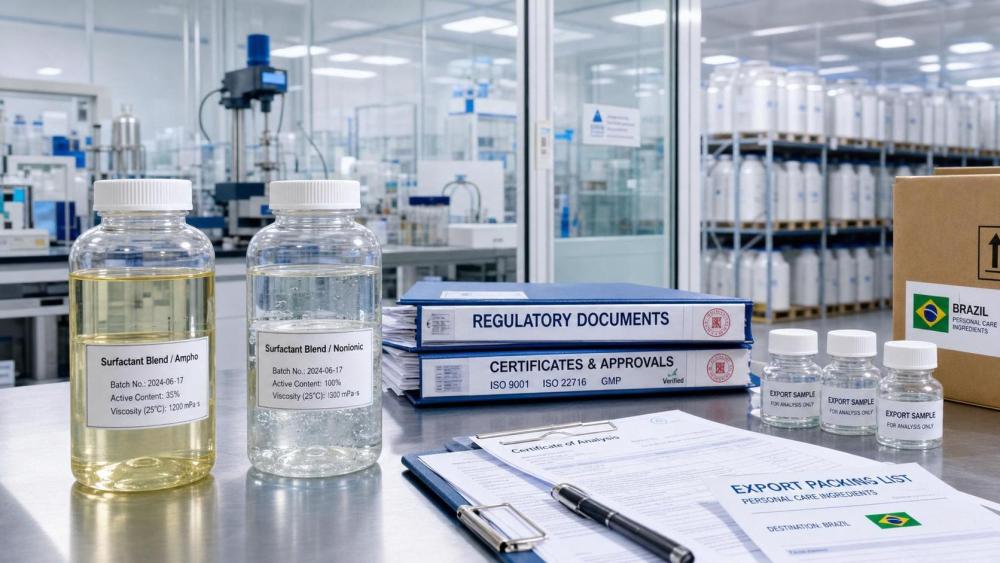
On July 3, Brazil's ANVISA introduced a fast-track registration route for two surfactants, sodium lauroyl sarcosinate and cocamidopropyl betaine, cutting the review period from 90 business days to 8 business days for applicants that hold valid WHO-GMP certification issued by Brazilian-recognized authorities. For exporters, import-facing suppliers, procurement teams, and compliance functions tied to Brazil's personal care supply chain, the change matters because it links registration speed directly to certification status and may alter how market entry timing is planned.
What the July 3 announcement confirms
The confirmed facts are limited but commercially relevant. ANVISA announced a fast-track registration pathway on July 3 for sodium lauroyl sarcosinate and cocamidopropyl betaine. Under this pathway, the review time is reduced from 90 business days to 8 business days for applicants holding valid WHO-GMP certification issued by authorities recognized by Brazil, with examples including China NMPA, the US FDA, and the EU EMA. The summary also indicates that this change accelerates market entry for Chinese surfactant producers targeting Brazil's $1.2B personal care import market.
Where the operational impact is likely to appear first
Exporters with recognized WHO-GMP credentials
From an industry perspective, the most immediate effect is likely to fall on exporters that already hold qualifying WHO-GMP certification. For these companies, the rule change may affect registration scheduling, customer onboarding timelines, and the sequencing of product launch preparations for Brazil. What deserves closer attention is whether certification validity, issuing authority recognition, and supporting registration documents are aligned before filing, because the shortened review window appears to be tied to that qualification threshold.
Procurement and sourcing teams buying for Brazil
Procurement teams may need to reassess supplier shortlists for the two named surfactants. Analysis shows that a faster regulatory route can shift purchasing preference toward suppliers able to demonstrate recognized WHO-GMP status and filing readiness. In practical terms, buyers may need to pay closer attention to supplier qualification files, certification currency, and document consistency when comparing sources intended for the Brazilian market.
Manufacturers and formulators managing launch timing
For manufacturers and formulators serving personal care demand connected to Brazil, the change may affect planning around ingredient approval lead times. Observably, a reduction from 90 to 8 business days can change assumptions used in formulation rollout, production scheduling, and delivery coordination. That said, companies should avoid treating the announcement as a blanket simplification of all compliance steps; the confirmed information speaks specifically to the two surfactants and to applicants meeting the stated certification condition.
Compliance and documentation service functions
Compliance teams, registration advisers, and documentation service providers may see greater pressure on document accuracy and timing. Because the accelerated route appears to depend on recognized WHO-GMP certification, the practical focus may move toward how certificates, technical files, and submission materials are prepared and presented. The current information does not define the full execution standard, so firms should treat documentation review as a live compliance task rather than an administrative formality.
What companies should watch before adjusting execution plans
Check whether certification status is submission-ready
Analysis shows that the central gatekeeping factor in this announcement is not product demand alone, but whether the applicant holds valid WHO-GMP certification from a Brazilian-recognized authority. Companies planning to use the fast-track route should closely verify certificate validity, issuing authority recognition, and internal consistency across submission materials.
Track official wording and implementation practice
What deserves closer attention is the practical interpretation of the new pathway. The summary confirms the fast-track route and the reduced review time, but it does not provide the full operating details. Companies should therefore continue monitoring official wording, implementation practice, and any clarifications that affect filing scope, document acceptance, or review conditions.
Revisit procurement and delivery assumptions
For commercial and supply teams, this development may justify a review of procurement timing, supplier qualification cadence, and delivery planning for the Brazilian market. It is more appropriate to understand this as a potential change in regulatory timing assumptions rather than as proof that every transaction or launch step will move faster in practice.
Prepare for downstream requests from customers and partners
Export-facing companies may also need to prepare for more detailed certification and traceability questions from importers, distributors, or downstream customers. Even where the announcement is favorable, counterparties may request clearer evidence that the supplier qualifies for the accelerated route and that the relevant registration file is complete.
How this should be read at this stage
Observably, this development looks less like a broad policy shift across all ingredients and more like a targeted execution signal tied to two specified surfactants and a defined certification condition. Analysis shows that the commercial importance comes from the compression of review time and from the fact that regulatory speed is being connected to recognized WHO-GMP credentials. At the same time, it remains necessary to watch how consistently the pathway is applied in practice and whether market participants begin reflecting it in qualification standards, bid documents, or supplier requirements.
A narrower rule change with practical trade value
In summary, the July 3 announcement is best understood as a concrete regulatory facilitation measure for sodium lauroyl sarcosinate and cocamidopropyl betaine applicants that meet the stated WHO-GMP condition. It may influence export planning, supplier selection, procurement timing, and registration preparation for companies targeting Brazil. A neutral reading is that this is an executed rule signal with immediate practical relevance, while the finer points of implementation and market response still warrant close observation.
Basis of this article and what still needs verification
This article is based on the user-provided news title, event date, and event summary. For developments of this type, relevant source categories typically include official regulatory announcements, notices from supervisory authorities, trade or customs-related information releases, industry association updates, standards documentation, and reporting by established media. A specific official source link was not provided in the input, so the exact official publication should still be independently verified. What still requires ongoing attention includes implementation details, certification interpretation, filing practice, possible changes in procurement or tender documents, market feedback, and how companies execute against the new pathway in practice.
Related News
- When does amino acid surfactant powder improve cleanser mildness?Oct 05, 2026Surfactant Chemistry Architect
- When to Seek Shampoo Formulation Support for Foam, Mildness, or Stability IssuesAug 07, 2026Surfactant Chemistry Architect
- FDA Tightens GRAS Data Requirements for Amino Acid SurfactantsJul 20, 2026Surfactant Chemistry Architect
- Amino Acid Surfactant Prices Rise on Coconut Oil TightnessJul 15, 2026Surfactant Chemistry Architect
Related News
- 00
0000-00
2026 Osong Cosmetics and Beauty Expo Concludes in South Korea - 00
0000-00
How to compare cosmetic active compounds by their cost in use - 00
0000-00
HKBU Showcases DR2 Following NMPA Registration as a New Cosmetic Ingredient - 00
0000-00
How to use ingredient market insights to forecast sourcing costs - 00
0000-00
Galderma Marks 30 Years of Hyaluronic Acid Injectable Innovation
Surfactant Chemistry Architect
Weekly Insights
Stay ahead with our curated technology reports delivered every Monday.