





On July 1, 2026, Brazil's ANVISA introduced a new fast-review route for imported amino acid surfactants that meet OECD 301D, shortening the registration timeline from 45 days to 8 working days and removing the need for local toxicology retesting. For importers, raw material buyers, formulators, compliance teams, and supply chain planners working with listed substances such as sodium cocoyl glycinate and disodium lauroyl glutamate, this is worth close attention because it changes the practical timing and documentation logic around market entry.
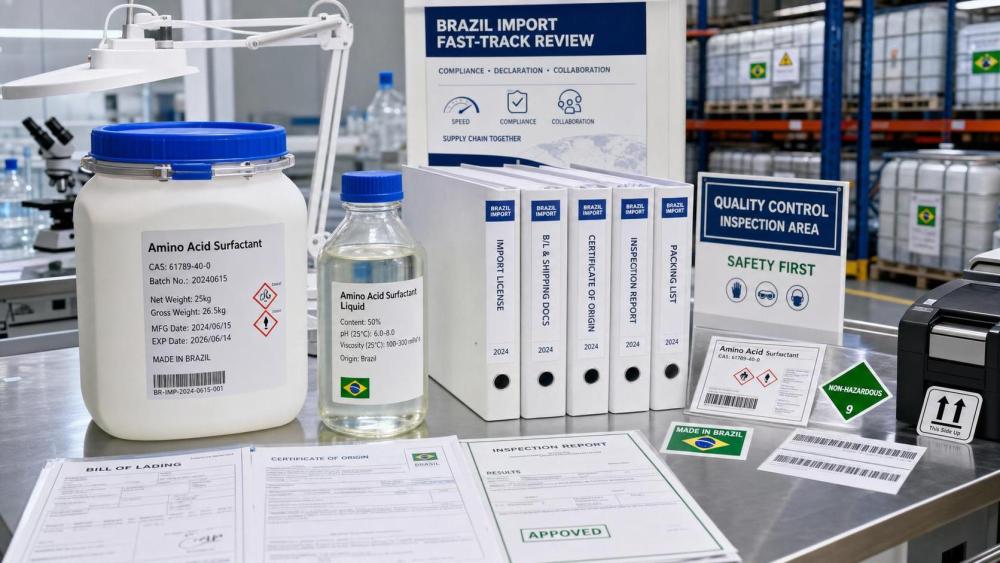
What the new review route confirms
According to the provided event summary, ANVISA launched Fast Review Mechanism No. 112 on July 1, 2026. The mechanism applies to amino acid surfactants that comply with OECD 301D.
The confirmed examples named in the summary include sodium cocoyl glycinate and disodium lauroyl glutamate. For eligible imported products, the registration review period has been reduced from 45 days to 8 working days.
The same summary also states that local toxicology retesting is waived under this mechanism. In addition, the first batch of applicable products has been published at the same time.
Where the operational impact is likely to appear first
Import registration teams may need to rework submission timing
From an industry perspective, import-oriented businesses are among the first to feel the effect because the review window is materially shorter for products that fall within the published scope. The main impact is likely to be on filing schedules, launch sequencing, and internal coordination between regulatory, commercial, and logistics functions. What deserves closer attention is whether dossiers clearly demonstrate OECD 301D alignment and whether the imported substance is included in the applicable list.
Raw material sourcing and purchasing may shift toward list-based planning
Buyers and procurement teams may also be affected because the change could alter how priority ingredients are selected for Brazil-facing supply plans. Analysis shows that once approval timing becomes shorter for qualifying substances, purchasing decisions may place greater weight on whether a surfactant sits within the first published scope and whether supporting technical documents are already prepared. In practice, document readiness may become as important as price or lead time for some transactions.
Formulators and manufacturers may revisit compliance handoffs
For processors and manufacturers using these surfactants in downstream products, the change matters mainly at the compliance interface. The shorter registration path and the waiver of local toxicology retesting may affect how technical, safety, and product stewardship teams prepare handoff materials for Brazil-related submissions. Observably, this does not remove the need for disciplined record control; instead, it raises the value of complete and consistent technical evidence at an earlier stage.
Testing and certification support functions may see a change in document demand
Service providers involved in testing, regulatory documentation, or certification support may need to watch how clients adjust their evidence packages. The practical change is not that compliance disappears, but that the emphasis may shift toward proving eligibility under the fast-review route and matching the published list and standard requirement. That can affect the type of reports and supporting files customers request first.
What companies should watch in the near term
Check eligibility against the published scope
Companies dealing with amino acid surfactants for Brazil should first verify whether their products fall within the initial applicable list referenced in the summary. If a product sits outside that scope, businesses should avoid assuming that the shortened review period applies automatically.
Prepare OECD 301D-related evidence carefully
Because the mechanism is tied to OECD 301D compliance, regulatory and technical teams should pay particular attention to the completeness and consistency of supporting documents. Analysis shows that where approval timing is compressed, documentation gaps can become more operationally visible, even if the policy itself is intended to accelerate review.
Reassess delivery and procurement calendars
Importers, purchasing teams, and supply planners should review whether existing lead-time assumptions still reflect the new registration timeline for eligible products. This does not confirm a uniform outcome across every transaction, but it does suggest that planning models based on the previous 45-day review period may need updating.
Track official wording and implementation signals
The summary confirms the launch of the mechanism and the publication of the first applicable list, but it does not provide further execution detail. For that reason, companies should continue to monitor official wording, any clarifications in regulatory practice, and any changes that appear in tender documents, customer requirements, or submission checklists.
Why this looks like both a live rule change and an execution signal
Analysis shows that this development is more than a general policy direction because the summary describes a mechanism that has already been launched, with a defined review timeline and a published first batch of applicable products. At the same time, it is more appropriate to understand this as an implemented change that still requires observation in practice, especially around how consistently eligibility, documentation standards, and review handling are applied in real transactions.
From an industry perspective, the most important point is not only that a review period has been shortened, but that ANVISA has linked faster access to a specific standard threshold and a defined product scope. That gives market participants a clearer compliance signal, while still leaving room for close monitoring of execution details and market response.
How the market is likely to read the announcement for now
At this stage, the announcement is best understood as a concrete procedural change with immediate relevance for Brazil-bound amino acid surfactant trade, especially where products can clearly meet OECD 301D and match the published scope. It should not yet be treated as proof of identical outcomes across all filings or supply arrangements.
A neutral reading is that the change may improve timing and reduce one layer of local testing burden for eligible imports, while shifting more practical importance onto scope confirmation, technical documentation, and ongoing monitoring of implementation language.
Basis of this article and points that still need verification
This article is based on the user-provided news title, event date, and event summary. For events of this kind, relevant source categories typically include official regulatory notices, publications from supervisory authorities, customs or trade-administration information, industry association updates, standard-setting documents, and reporting by established professional media.
No specific official source link was provided in the input, so the exact official publication path still needs to be verified on an ongoing basis. What still deserves continued attention includes detailed implementation wording, certification or registration interpretation in practice, any changes reflected in tender or procurement documents, market feedback from affected businesses, and how companies execute against the new requirements over time.
Related News
- When does amino acid surfactant powder improve cleanser mildness?Oct 05, 2026Surfactant Chemistry Architect
- When to Seek Shampoo Formulation Support for Foam, Mildness, or Stability IssuesAug 07, 2026Surfactant Chemistry Architect
- FDA Tightens GRAS Data Requirements for Amino Acid SurfactantsJul 20, 2026Surfactant Chemistry Architect
- Amino Acid Surfactant Prices Rise on Coconut Oil TightnessJul 15, 2026Surfactant Chemistry Architect
Related News
- 00
0000-00
2026 Osong Cosmetics and Beauty Expo Concludes in South Korea - 00
0000-00
How to compare cosmetic active compounds by their cost in use - 00
0000-00
HKBU Showcases DR2 Following NMPA Registration as a New Cosmetic Ingredient - 00
0000-00
How to use ingredient market insights to forecast sourcing costs - 00
0000-00
Galderma Marks 30 Years of Hyaluronic Acid Injectable Innovation
Surfactant Chemistry Architect
Weekly Insights
Stay ahead with our curated technology reports delivered every Monday.