





Fragrance can define a cosmetic product’s appeal, but controlling its safe use requires more than checking a supplier’s certificate. Finished-product category and concentration matter.
This cosmetic compliance guide helps quality control and safety professionals assess IFRA fragrance limits, interpret supplier documentation, and distinguish voluntary standards from applicable cosmetic regulations.
The practical conclusion is straightforward: verify the correct product category, calculate the fragrance concentration in the finished product, and document regulatory and safety checks separately.
What Do IFRA Fragrance Limits Mean for a Finished Cosmetic?
The International Fragrance Association, or IFRA, publishes Standards that restrict, prohibit, or set specification requirements for certain fragrance ingredients based on available safety information.
For a specific fragrance mixture, a supplier’s IFRA Certificate of Conformity commonly states the maximum concentration of that mixture for defined finished-product categories.
A certificate limit of 2% for a category generally means up to 2% of the specified fragrance mixture in the finished product, not 2% of each ingredient.
That limit is formulation-specific. A certificate for one fragrance, revision, or supplier does not automatically apply to a similar-smelling alternative or a reformulated batch.
Some Standards prohibit an ingredient or impose purity requirements rather than simply setting a concentration ceiling. A complete review therefore goes beyond comparing two numbers.
IFRA conformity also does not establish that the complete cosmetic is safe or legal everywhere. Other ingredients, exposure routes, labeling obligations, and local restrictions remain relevant.
How Do You Choose the Correct IFRA Product Category?
Start with the intended finished product: where it is applied, whether it is rinsed off, the likely exposure route, and the expected user population.
Use IFRA’s current category descriptions and guidance, together with the supplier’s certificate. Familiar product names alone can be misleading when application patterns differ.
For example, a leave-on body lotion and a rinse-off shampoo generally require different category assessments because their exposure conditions are not the same.
A fragrance intended for a lip product, an eye-area product, or a product used on babies may require a particularly careful category review.
Do not assume that a product marketed for sensitive skin automatically belongs in a separate IFRA category, or that a general body-product category covers every application.
When a product has multiple intended uses, assess each relevant use and seek supplier clarification. Apply the most restrictive relevant limit unless documented guidance supports another approach.
Record the selected category, the product description, the version of the classification guidance, and the rationale. This makes later audits and change reviews more reliable.
If the product sits between category descriptions, escalate the question to the fragrance supplier and the responsible safety assessor before approving the formula.
How Do You Calculate the Fragrance Use Level?
Calculate the fragrance concentration as supplied in the final, ready-to-use cosmetic, using consistent weight units and accounting for the complete finished-product batch.
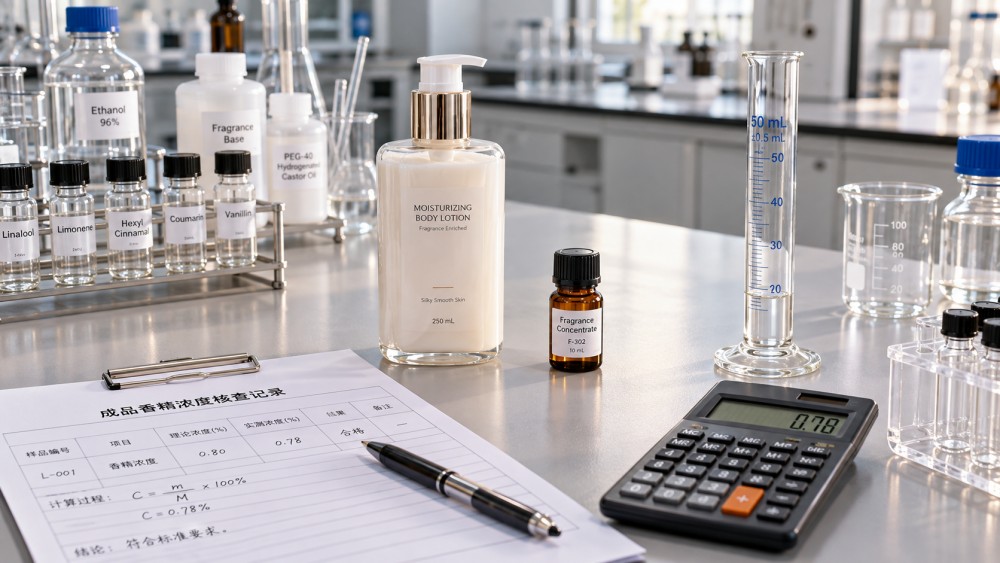
For a single fragrance addition, divide the weight of the supplied fragrance mixture by the finished batch weight, then multiply the result by 100.
For example, 0.8 kilograms of fragrance in 100 kilograms of finished lotion equals 0.8%. Compare that figure with the supplier’s limit for the applicable category.
If the certificate permits 1.0% in that category, the example has a margin of 0.2 percentage points. That margin is not a substitute for other safety checks.
If the formula contains a diluted fragrance preparation, confirm whether the certificate covers that preparation as supplied or the undiluted fragrance concentrate before calculating.
For instance, 2% of a preparation containing 50% fragrance concentrate contributes 1% concentrate. Use this conversion only when the certificate’s scope supports it.
When several fragrance mixtures or other ingredients contribute the same restricted substance, individual certificates may not establish combined compliance. Obtain composition data and assess the aggregate contribution.
Consider scented extracts, essential oils, masking fragrances, and fragranced premixes. Their contributions can be missed when teams review only the ingredient named “fragrance.”
For products diluted before consumer use, confirm which form the relevant Standard and supplier certificate address. Document any dilution assumptions and realistic consumer instructions.
Build in an appropriate operational margin when feasible. Manufacturing tolerances, weighing errors, and formula adjustments can otherwise push a borderline product beyond its approved limit.
What Should You Check on an IFRA Certificate?
An IFRA Certificate of Conformity is a supplier declaration for a defined fragrance mixture and specified uses. Its value depends on accurate identification and current information.
Check the fragrance name, supplier reference, formula or revision identifier, issue date, relevant IFRA Standards version, and the listed limit for the selected category.
Confirm that the document applies to the material actually purchased, including its concentration or carrier, and that the supplier has not issued a replacement.
A category listed as “not acceptable” or prohibited should not be treated as a numerical limit. Ask the supplier to explain any ambiguous entry.
Also confirm whether the certificate covers the intended geographical use and whether any additional supplier restrictions or conditions apply to the particular fragrance.
The certificate is normally not a full ingredient disclosure, a cosmetic safety assessment, or evidence that every labeling requirement has been met.
Request supporting information appropriate to the market and formula, such as relevant allergen concentrations, restricted-substance data, specifications, and a safety data sheet where applicable.
Ask suppliers to explain missing category limits, unusual concentration bases, or conflicts between the certificate and composition data before releasing the material for production.
Maintain a controlled link between the certificate, purchase specification, approved formula, and batch records. An untraceable certificate is difficult to defend during an investigation.
How Are IFRA Standards Different From Cosmetic Laws?
IFRA Standards are part of a voluntary industry framework. Their contractual or practical significance can be substantial, but they are not a universal substitute for law.
A cosmetic must meet the legal requirements of every market where it is placed. A product can conform to IFRA Standards and still fail local requirements.
Conversely, a legal assessment cannot be reduced to asking whether a fragrance has an IFRA certificate. Check restrictions, labeling, product classification, and responsible-party obligations separately.
In the European Union, Regulation (EC) No 1223/2009 establishes the cosmetics framework, including safety assessment and ingredient restrictions in its annexes, subject to amendments.
EU fragrance-allergen labeling requirements have expanded under Regulation (EU) 2023/1545, with transition periods. Check the applicable substance list, thresholds, and deadlines for each product.
For affected EU products, the transition dates include 31 July 2026 for placing noncompliant products on the market and 31 July 2028 for making them available.
In the United States, cosmetics are subject to applicable federal law, including the Federal Food, Drug, and Cosmetic Act and relevant provisions introduced by MoCRA.
US fragrance labeling and safety obligations differ from EU requirements. Product claims, ingredients, distribution, and applicable exemptions can affect the specific obligations to assess.
Do not assume that an FDA premarket approval or GRAS status applies to an ordinary cosmetic fragrance. Check the regulatory status of the actual product and use.
Maintain a market-specific legal register and verify current official requirements before launch. Regulatory provisions, transition periods, and ingredient classifications can change after supplier documents are issued.
How Should QC and Safety Teams Handle Common Risk Scenarios?
A supplier changes the fragrance formula. Treat the change as a potential impact on category limits, allergens, restricted substances, and the finished-product safety assessment.
Obtain the revised certificate and relevant composition data before implementation. Compare the approved formula against the new limit and update specifications and labeling as needed.
The fragrance level increases. Recalculate the finished-product concentration, assess all relevant intended uses, and obtain safety and regulatory approval before authorizing the change.
A new market is added. Review local ingredient restrictions, allergen disclosures, language requirements, and product notification or other obligations applicable to that market.
Two fragrances are blended. Do not assume that each mixture’s individual certificate proves the combination is acceptable. Evaluate shared restricted ingredients using supplier composition information.
An essential oil is added for a botanical claim. Assess its contribution to fragrance-related restricted substances and allergens, even when the formula lists it as an extract.
The product is sold in multiple formats. A spray, cream, and rinse-off wash can have different exposure characteristics and may require separate category and safety assessments.
The certificate appears outdated. Ask the supplier whether it remains valid, which Standards version it addresses, and whether a newer document or implementation deadline applies.
IFRA amendments can include different implementation dates for new and existing products. Verify the relevant Standard and current supplier documentation rather than assuming immediate or indefinite validity.
What Evidence Should Be Kept for Audit and Release?
Keep the approved formula and finished-product fragrance calculation alongside the category rationale, supplier certificate, supplier revision history, and applicable specifications.
Retain the safety assessor’s conclusions, relevant toxicological or composition data, allergen calculations, and the market-specific regulatory review in the appropriate controlled records.
For EU products, ensure the responsible person maintains the required product information file and cosmetic product safety report in accordance with applicable law.
Set clear ownership: procurement obtains current supplier documents, formulation confirms concentrations, quality controls specifications and changes, and safety or regulatory specialists approve the assessment.
Before batch release, verify that the manufactured formula matches the approved version and that any fragrance substitution or deviation has passed the established change-control process.
Schedule periodic reviews and supplier updates. A compliant launch decision can become outdated when a fragrance composition, IFRA Standard, regulation, or intended use changes.
Useful primary references include the IFRA Standards and category guidance at ifrafragrance.org, EU legislation on EUR-Lex, and US cosmetics guidance at FDA Cosmetics.
Conclusion: Make the Certificate Part of a Wider Decision
An IFRA certificate is an important input, but the decision depends on the right category, the actual finished-product concentration, and the exact supplied fragrance.
For dependable cosmetic compliance, combine that evidence with aggregate ingredient checks, a documented safety assessment, market-specific legal review, and controlled supplier and formula changes.
Related News
- Cosmetic compliance guide to IFRA fragrance limitsOct 31, 2026Dr. Chloe Vance
- HHS Draft Policy Eases Compounding Enforcement for Six PeptidesOct 30, 2026Dr. Chloe Vance
- NMPA Issues Implementation Details for Revised Banned and Restricted Cosmetic IngredientsOct 29, 2026Dr. Chloe Vance
- How to screen personal care flavor and fragrance ingredients for allergensOct 28, 2026Dr. Chloe Vance
Related News
- 00
0000-00
Indian FMCG Companies Plan Further Price Increases as Input Costs Rise - 00
0000-00
Cosmetic compliance guide to IFRA fragrance limits - 00
0000-00
HHS Draft Policy Eases Compounding Enforcement for Six Peptides - 00
0000-00
How to choose food-grade hydrocolloid ingredients for stable sauces - 00
0000-00
NMPA Issues Implementation Details for Revised Banned and Restricted Cosmetic Ingredients
Dr. Chloe Vance
Weekly Insights
Stay ahead with our curated technology reports delivered every Monday.