





Dressing quality is judged long before flavor reaches the palate. Flow pattern, emulsion integrity, particle suspension, and shelf-life consistency all shape product acceptance.
That is why rheology modifiers for dressings matter. They help formulators control how a dressing pours, clings, coats, and survives transport without separating or becoming pasty.
Across the wider FMCG ingredients landscape tracked by FFAI, rheology sits at the intersection of sensory design, process practicality, and compliance-driven formulation discipline.
Why flow behavior has become a formulation priority
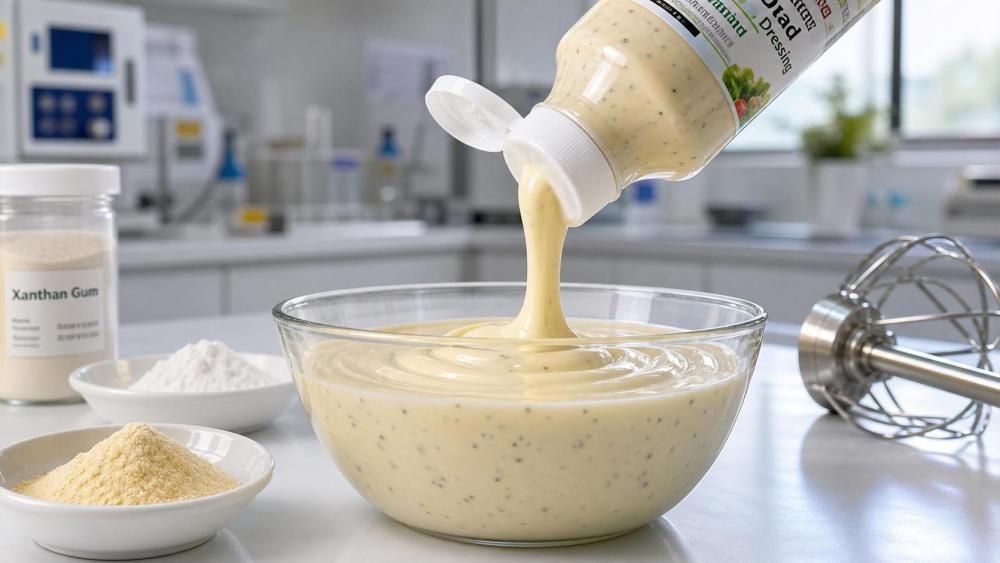
Dressings now face longer supply chains, cleaner labels, and tighter texture expectations. A product must remain stable in the plant, in distribution, on shelf, and during repeated consumer use.
A stable dressing is not simply thick. It must resist oil separation, keep herbs or spices suspended, and still pour smoothly from a bottle or sachet.
This is where rheology modifiers for dressings become commercially relevant. They do not only increase viscosity. They shape the entire mechanical behavior of the product.
For FFAI, this topic fits naturally within the broader study of natural thickeners, preservation systems, and sensory optimization. Rheology is one of the quiet tools behind perceived quality.
What rheology modifiers actually do in a dressing system
In simple terms, rheology modifiers for dressings adjust how a liquid deforms under stress. That stress may come from pumping, shaking, squeezing, pouring, or spreading.
A well-designed system often targets three outcomes at once:
- high enough viscosity at rest to support emulsion and particulates
- shear thinning under force so the dressing pours without excess resistance
- fast structure recovery after pouring to maintain cling and visual body
That balance is more useful than a single viscosity number. Two dressings may share the same Brookfield reading and still behave very differently in the bottle.
This is why evaluation usually extends beyond nominal thickness. Yield stress, flow curve shape, particle suspension, and temperature response all deserve attention.
The link between stability and pourability
Formulators often face an apparent contradiction. Increasing structure may improve physical stability, yet too much structure can make the dressing slow, gummy, or difficult to dispense.
Rheology modifiers for dressings solve that contradiction when they create a network that is strong at rest but weak enough under shear to release cleanly.
Xanthan gum is a classic example. At low use levels, it can support suspension and provide shear-thinning flow, which is why it remains common in pourable emulsified dressings.
Common material choices and why they differ
Not every thickener behaves like a true rheology modifier. Some mainly build bulk viscosity. Others create elastic structure, improve mouthfeel, or stabilize dispersed droplets more effectively.
Selection depends on oil level, acid load, target texture, particulate content, labeling constraints, and process sequence.
From an FFAI perspective, this is where intelligence matters. Ingredient names alone are not enough; performance depends on interaction at formulation and process level.
Where performance problems usually start
Many dressing defects are described as viscosity failures, but the root cause is often broader. The structure may be incompatible with acid, salt, oil phase, or thermal history.
Typical warning signs include:
- clear serum layer after storage
- spice settling at the bottle base
- clogging at the dispensing opening
- good initial pour, then rapid thinning over shelf life
- excessive ropiness that consumers read as artificial
Rheology modifiers for dressings must therefore be tested under realistic stress. Bench-top texture that looks fine on day one can fail after filling, transport vibration, or freeze-thaw exposure.
Processing changes the final texture
Hydration order, mixing intensity, homogenization pressure, and thermal treatment all influence final rheology. A strong ingredient can still underperform if the process damages its functional structure.
This matters in scaled production. Lab success should always be confirmed after pilot trials, especially when emulsification energy and residence time change.
How to evaluate rheology modifiers for dressings in practice
A practical review usually starts with the product target, not the ingredient brochure. The desired use moment defines the needed flow behavior.
A spoonable premium dressing, a squeeze-bottle ranch, and a low-oil vinaigrette need different structures, even when all three require shelf stability.
Useful evaluation criteria include the following:
- resting viscosity and yield stress for suspension
- shear-thinning behavior during pouring
- recovery after shear for cling and appearance
- compatibility with acid, salt, sweeteners, and preservatives
- tolerance to hot fill, cold chain variation, and storage time
- labeling fit with clean-label or regional compliance goals
This broader screen is consistent with FFAI’s intelligence model, where texture, preservation, regulation, and end-market positioning are evaluated together rather than in isolation.
Why market expectations are changing the decision framework
The discussion around rheology modifiers for dressings is no longer just technical. It now overlaps with clean-label demand, natural sourcing, ingredient cost pressure, and export compliance.
A hydrocolloid that performs well may still face resistance if it complicates label language or sourcing continuity. On the other hand, a familiar label may require more careful process control.
This is why cross-functional judgement has become more valuable. Rheology decisions influence sensory appeal, packaging behavior, line efficiency, and even premium product positioning.
In the broader FMCG context followed by FFAI, the same principle appears across categories: minor ingredient choices can determine whether a product feels engineered, natural, indulgent, or dependable.
A sensible next step for formulation decisions
When comparing rheology modifiers for dressings, start by defining the exact failure you need to prevent. Separation, poor pour, weak cling, and particle settling rarely share one perfect fix.
Then review the system as a whole: oil phase, pH, solids, thermal profile, packaging, and shelf-life target. The best modifier is the one that works inside that full context.
Shortlist a few materials or blends, test them under realistic process conditions, and compare not only viscosity but recovery, appearance, and storage resilience.
That approach creates a more reliable basis for selection, especially in categories where sensory quality and technical stability must hold together from factory to final use.
Related News
- How to assess a bio-based thickener manufacturer's batch consistencyOct 16, 2026Food Rheology Expert
- Verifying halal status of hydrocolloid ingredients in the Middle EastOct 15, 2026Food Rheology Expert
- Why Can Xanthan Gum Lose Viscosity After Adding Electrolytes?Oct 18, 2026Food Rheology Expert
- How Do You Test Hydrocolloid Viscosity After Changing a Thickener?Oct 17, 2026Food Rheology Expert
Related News
- 00
0000-00
2026 Osong Cosmetics and Beauty Expo Concludes in South Korea - 00
0000-00
How to compare cosmetic active compounds by their cost in use - 00
0000-00
HKBU Showcases DR2 Following NMPA Registration as a New Cosmetic Ingredient - 00
0000-00
How to use ingredient market insights to forecast sourcing costs - 00
0000-00
Galderma Marks 30 Years of Hyaluronic Acid Injectable Innovation
Food Rheology Expert
Weekly Insights
Stay ahead with our curated technology reports delivered every Monday.