





Hydrocolloid Ingredients Manufacturer: Key Quality Signals to Compare
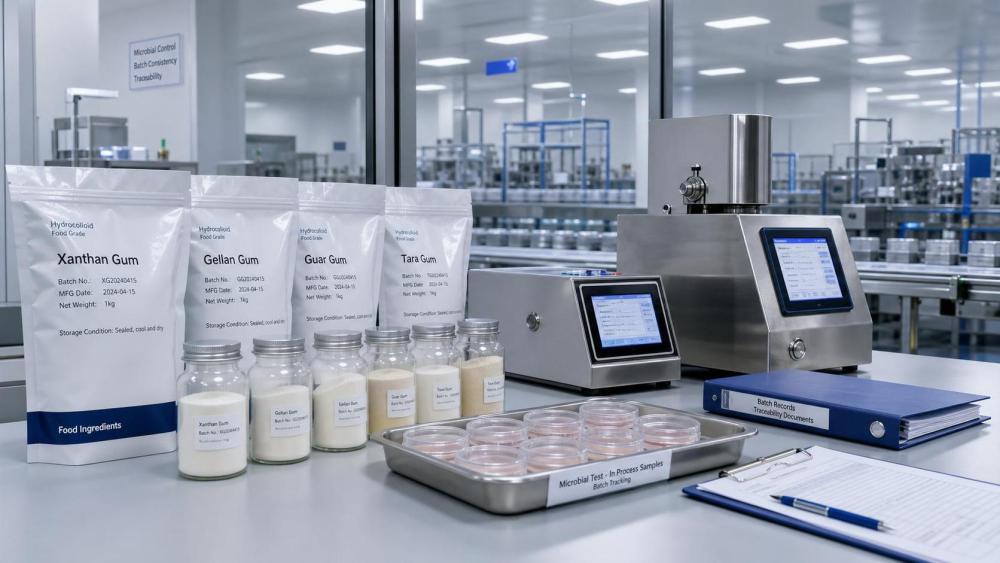
Choosing a hydrocolloid ingredients manufacturer often starts with price, viscosity, and lead time.
That is understandable, but it is rarely enough for a sound decision.
In real production, failures usually come from weaker signals.
A batch may pass a basic spec sheet, yet still create trouble.
The issue could be microbial load, poor lot consistency, or incomplete traceability.
For a quality-focused buyer, the better question is simple.
Which hydrocolloid ingredients manufacturer reduces operational risk after purchase?
That shift in perspective changes how suppliers should be compared.
It also leads to better supplier approval decisions.
Why Basic Specs Do Not Tell the Full Story
Most hydrocolloids look similar on a commercial datasheet.
You may see viscosity range, moisture, ash, pH, and particle size.
Those values matter, but they are only the surface.
A capable hydrocolloid ingredients manufacturer should prove control behind those numbers.
That includes raw material qualification, process hygiene, validated testing, and change management.
If those systems are weak, specification compliance becomes less meaningful.
This is especially true for xanthan gum, carrageenan, pectin, gellan gum, guar gum, and CMC.
Each material behaves differently across pH, salt, heat, shear, and storage conditions.
So supplier quality must be judged in context, not in isolation.
The First Signal: Traceability That Works Under Pressure
Traceability is one of the clearest ways to compare a hydrocolloid ingredients manufacturer.
Many suppliers claim full traceability.
The stronger signal is how quickly they can prove it.
During an audit or complaint, speed matters as much as completeness.
Look for these practical checks:
- Lot-to-lot linkage from incoming raw material to finished shipment
- Retention sample policy with defined storage periods
- Recall simulation records and documented response times
- Clear identification of production date, packing date, and release status
A mature hydrocolloid ingredients manufacturer can retrieve this information fast.
If the answer depends on manual searching across spreadsheets, risk is higher.
Microbiological Control Is Often the Real Divider
Hydrocolloids are frequently used in moisture-sensitive and high-risk applications.
That makes microbiological control a major comparison point.
A reliable hydrocolloid ingredients manufacturer should define both routine monitoring and escalation actions.
Ask beyond total plate count.
Check yeast, mold, coliforms, Salmonella, and pathogen control where relevant.
Also ask how the site prevents cross contamination.
Dry cleaning alone does not tell the whole story.
More useful signs include zoned traffic, air handling, sieving controls, and environmental monitoring.
In practical terms, low counts are good.
Stable counts over time are better.
Batch Consistency Must Be Proven in Application, Not Claimed
One common mistake is overrelying on certificate of analysis values.
A hydrocolloid ingredients manufacturer may meet viscosity limits and still perform unevenly.
Hydration rate, dispersion behavior, and gel strength can shift noticeably.
That is where application testing becomes important.
A stronger supplier usually offers application-specific data, not just generic specs.
Useful examples include:
- Viscosity stability after heat treatment
- Performance across pH ranges
- Tolerance to salt, sugar, and calcium systems
- Suspension or mouthfeel behavior in target formulas
This matters even more when reformulation windows are tight.
A hydrocolloid ingredients manufacturer with deep technical support can shorten validation time.
Regulatory Readiness Should Be Visible, Not Promotional
A supplier brochure may mention compliance in broad terms.
That is not enough for supplier selection.
A dependable hydrocolloid ingredients manufacturer should provide current, usable documentation.
This typically includes allergen statements, GMO status, residual solvent position, and contaminant limits.
Depending on market scope, it may also include halal, kosher, organic, or region-specific declarations.
The key signal is document control.
Are versions dated, signed, and easy to update?
Can the hydrocolloid ingredients manufacturer explain specification changes before they affect released products?
That level of readiness usually signals stronger internal discipline.
Audit Depth Reveals More Than Certifications Alone
Certifications are useful, but they should be a starting point.
A hydrocolloid ingredients manufacturer with FSSC 22000, BRCGS, or ISO systems may still vary in execution.
What matters is how those systems behave on the factory floor.
During supplier qualification, focus on evidence that shows discipline over time.
This kind of review gives a more realistic picture than certificates alone.
Supply Reliability and Packaging Control Also Affect Quality
Quality problems do not always begin in processing.
They can start with unstable sourcing or weak packing design.
A hydrocolloid ingredients manufacturer should show how it protects material through storage and transit.
Moisture uptake, odor pickup, and seal failure can all damage performance.
Look at packaging specifications, pallet practices, warehouse humidity control, and transport contingency plans.
This becomes more important for long international routes.
A good hydrocolloid ingredients manufacturer will also discuss backup capacity honestly.
That includes second-line production, alternate raw materials, and seasonal risk planning.
How to Compare Suppliers in a More Practical Way
A structured comparison usually works better than open-ended discussion.
When screening a hydrocolloid ingredients manufacturer, use a weighted scorecard.
That keeps decisions tied to business risk, not supplier presentation style.
- Define the most critical application risks first.
- Rank microbiology, traceability, consistency, and compliance by impact.
- Request supporting records, not summary claims.
- Run side-by-side trials with at least three production lots.
- Review response quality during technical questions and deviations.
This process often exposes differences that price comparisons miss.
It also helps justify supplier approval decisions internally.
Final Decision Signals That Deserve More Weight
When comparing a hydrocolloid ingredients manufacturer, the strongest signals are usually operational.
Can the supplier explain variability clearly?
Can it release reliable documents quickly?
Can it support application troubleshooting with data that fits real use conditions?
Those capabilities usually matter more than a small price gap.
The right hydrocolloid ingredients manufacturer should lower the chance of complaints, reformulation delays, and compliance surprises.
That is the benchmark worth using.
Start with the quality signals above, test them against your application, and let documented control drive the final choice.
Related News
- How to assess a bio-based thickener manufacturer's batch consistencyOct 16, 2026Food Rheology Expert
- Verifying halal status of hydrocolloid ingredients in the Middle EastOct 15, 2026Food Rheology Expert
- Why Can Xanthan Gum Lose Viscosity After Adding Electrolytes?Oct 18, 2026Food Rheology Expert
- How Do You Test Hydrocolloid Viscosity After Changing a Thickener?Oct 17, 2026Food Rheology Expert
Related News
- 00
0000-00
2026 Osong Cosmetics and Beauty Expo Concludes in South Korea - 00
0000-00
How to compare cosmetic active compounds by their cost in use - 00
0000-00
HKBU Showcases DR2 Following NMPA Registration as a New Cosmetic Ingredient - 00
0000-00
How to use ingredient market insights to forecast sourcing costs - 00
0000-00
Galderma Marks 30 Years of Hyaluronic Acid Injectable Innovation
Food Rheology Expert
Weekly Insights
Stay ahead with our curated technology reports delivered every Monday.