





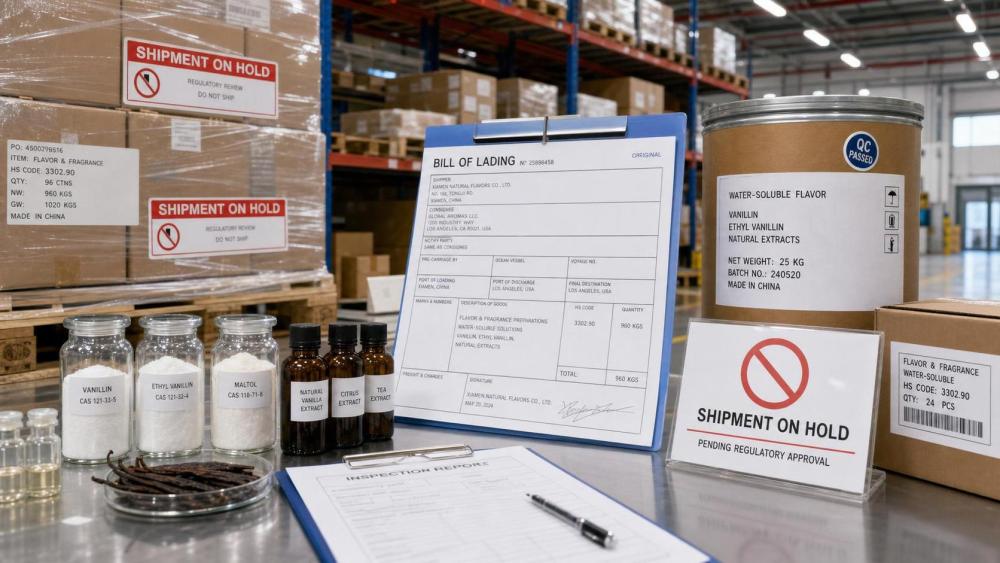
On July 5, 2026, India moved from market supply pressure to a formal trade control by temporarily restricting exports of water-soluble flavors under HS 3302.90. The change matters not only because it affects shipments of vanillin, ethyl vanillin, and natural extract blends sourced from India, but also because it immediately touches procurement planning, delivery schedules, trade documentation review, and substitution decisions across the flavor supply chain. For buyers, processors, and supply chain service providers, this is not merely a supply story; it is a rule change with direct commercial and compliance consequences.
What Has Formally Changed
India’s Directorate General of Foreign Trade (DGFT) imposed a temporary export restriction on all water-soluble flavors classified under HS 3302.90, effective July 5, 2026. The stated reason is a severe vanilla bean shortage linked to floods in Kerala. The event summary further indicates that global buyers dependent on Indian-origin vanillin, ethyl vanillin, and natural extract blends are facing immediate supply gaps and price volatility, leading to urgent sourcing shifts toward Vietnam, Madagascar, and encapsulated alternatives based in China.
Where the Pressure Moves Across the Chain
Import buyers now face a trade rule interruption, not just a sourcing delay
For companies that purchase Indian-sourced water-soluble flavors, the immediate issue is that export availability is now subject to a temporary restriction rather than normal shipment flow. The operational impact is likely to appear first in purchase order execution, shipment confirmation, and delivery planning. From an industry perspective, what deserves closer attention is whether existing procurement files, product classifications, and customs-facing documentation are aligned with the restricted HS category, because trade treatment now matters directly to whether supply can move.
Manufacturers using flavor inputs may need to reassess formulation continuity
Processors and manufacturers relying on vanillin, ethyl vanillin, or natural extract blends sourced from India may experience disruption at the input stage rather than only at final delivery. Analysis shows that the practical effect may extend into production scheduling, raw material substitution review, and customer delivery commitments. Where alternative origins or encapsulated replacements are being considered, companies should pay closer attention to product specifications, internal quality review, and any certification or technical document consistency needed for downstream acceptance.
Distributors and logistics participants will need clearer execution checks
Channel distributors and supply chain service providers are also exposed because the restriction changes the trade handling environment around affected products. The main pressure points may include shipment readiness, order reprioritization, and communication with customers about availability and lead times. Observably, even without additional official detail in the input, companies involved in forwarding, trade support, or inventory coordination should monitor whether transaction documents, declared product scope, and substitute-origin arrangements require adjustment before execution.
What Companies Should Watch Immediately
Review product scope and classification exposure
Companies should first identify whether the materials they buy, sell, process, or ship fall within water-soluble flavors under HS 3302.90 as referenced in the event summary. This matters because the current issue is tied to a defined export category, not to the flavor market in general. Where internal item descriptions are broad, a tighter mapping between commercial product names and trade classification becomes more important.
Track substitute sourcing with document consistency in mind
The summary points to sourcing shifts toward Vietnam, Madagascar, and China-based encapsulated alternatives. Analysis shows that changing origin or product form can create follow-on work in supplier qualification, technical file review, testing references, and buyer-side approval processes. Companies should therefore treat replacement sourcing not as a simple purchasing switch, but as a documentation and compliance review task tied to product acceptance and delivery reliability.
Recheck delivery commitments and procurement timing
Because the restriction is already effective from July 5, 2026, businesses with open demand exposure should closely review near-term delivery commitments, procurement timing, and inventory assumptions. What deserves closer attention is not only whether supply is delayed, but whether existing commercial commitments were built around Indian-origin availability that may no longer be executable under current trade conditions.
Watch for further official wording and market-side implementation signals
The input confirms the restriction and its effective date, but it does not provide detailed implementation mechanics. For that reason, companies should continue monitoring follow-up official language, execution practice, and buyer-side requirements rather than assuming a settled operating framework. This is especially relevant for teams handling trade compliance, procurement approval, and customer communication.
How This Signal Should Be Read
Observably, this development is best understood first as an implemented trade restriction with immediate operational consequences, because an effective date and restricted product scope are already identified. At the same time, analysis shows it should also be treated as a rule dynamic that still requires observation, since the input does not provide the full enforcement detail, duration framework, or downstream documentation expectations. That combination makes the event more than a temporary supply disruption: it is an execution signal for cross-border flavor trade participants.
A Practical Reading of the Market Impact
From an industry perspective, the key meaning of this event is that supply stress has translated into a formal export control affecting a defined product category. The near-term consequence is likely to center on trade execution, sourcing substitution, and delivery risk rather than on a fully settled new market structure. It is more appropriate to understand this as a live regulatory and procurement development that has already taken effect, while many details relevant to implementation and market response still need to be watched closely.
Basis of This Article and What Still Needs Verification
This article is based on the user-provided news title, event date, and event summary. For developments of this kind, relevant source types typically include official notices, releases from trade regulators, customs or foreign trade authorities, industry association updates, standard-setting bodies, and reporting by authoritative media. No specific official source link was provided in the input, so the exact official publication path remains subject to further verification. Follow-up attention should remain on any detailed policy wording, enforcement interpretation, certification or documentation expectations, tender document adjustments, market feedback, and how companies are implementing sourcing and delivery changes in practice.
Related News
- When heat stable flavor formulations are needed for UHT beveragesOct 04, 2026Aromatics & Perfumery Fellow
- How heat stable flavor formulations prevent aroma loss in baked goodsOct 03, 2026Aromatics & Perfumery Fellow
- Using 4-vinyl guaiacol flavour standard to calibrate sensory panelsOct 02, 2026Aromatics & Perfumery Fellow
- Garlic Powder Flavor Profiles and Their Role in Seasoning BlendsSep 28, 2026Aromatics & Perfumery Fellow
Related News
- 00
0000-00
2026 Osong Cosmetics and Beauty Expo Concludes in South Korea - 00
0000-00
How to compare cosmetic active compounds by their cost in use - 00
0000-00
HKBU Showcases DR2 Following NMPA Registration as a New Cosmetic Ingredient - 00
0000-00
How to use ingredient market insights to forecast sourcing costs - 00
0000-00
Galderma Marks 30 Years of Hyaluronic Acid Injectable Innovation
Aromatics & Perfumery Fellow
Weekly Insights
Stay ahead with our curated technology reports delivered every Monday.