





Texture is often the first thing people notice, even before flavor becomes clear.
That is why hydrocolloid molecular gastronomy ingredients matter in both kitchens and formulation labs.
They help control flow, suspension, gel strength, foam stability, and moisture release with surprising precision.
In practice, they are not just thickeners.
They are structure-building tools that shape mouthfeel, visual appeal, and product consistency across food applications.
For an intelligence platform like FFAI, hydrocolloids sit at the center of a wider conversation.
That conversation links sensory science, clean-label pressure, processing stability, and global compliance expectations.
The real question is not whether hydrocolloids work.
It is how different hydrocolloid molecular gastronomy ingredients create different textures, and how to choose them intelligently.
What exactly do hydrocolloid molecular gastronomy ingredients do at a molecular level?
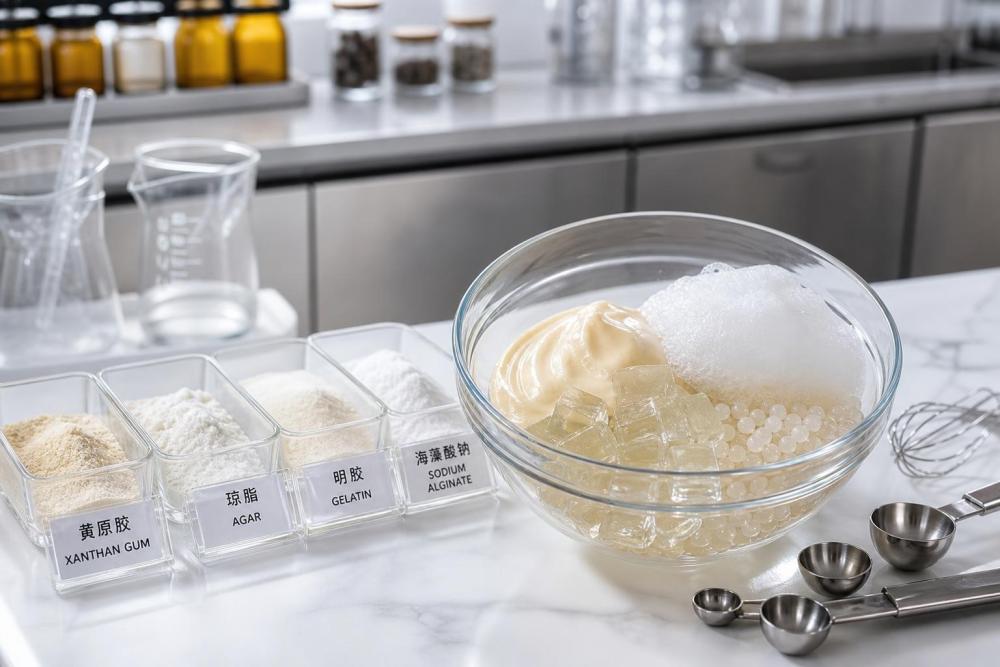
At the simplest level, hydrocolloids are water-loving polymers.
Once dispersed, they bind water, slow movement, and create internal structure inside a liquid system.
That structural change is what turns a thin base into a sauce, gel, foam, or suspension.
Some ingredients mainly increase viscosity.
Others build a network that traps water and creates a true gel.
A few are especially useful for holding air bubbles or keeping particles evenly distributed.
This is why xanthan gum behaves differently from agar, and why gellan does not feel like gelatin.
The molecular behavior also explains why dosage is usually small but highly sensitive.
A shift from 0.2% to 0.4% can move a texture from elegant to heavy.
FFAI often frames these materials as rheological thickeners, but that label only covers part of the story.
In molecular gastronomy, they influence the entire sensory arc, from first spoon contact to afterfeel.
Why do some hydrocolloids create silky sauces while others form brittle or elastic gels?
Texture depends on network shape, not just thickness.
Different hydrocolloid molecular gastronomy ingredients organize water in different ways.
That changes whether a system feels smooth, short, springy, sticky, or clean on the palate.
Xanthan gum usually gives high viscosity with good pourability.
It works well for glossy sauces and stable dressings.
Agar creates a firmer gel with a cleaner break.
That makes it useful when a defined shape matters more than creamy flow.
Gelatin feels softer and more elastic.
It melts near body temperature, which creates a richer and more rounded mouthfeel.
Sodium alginate is different again.
When paired with calcium, it forms membranes and beads used in spherification.
More advanced work often combines ingredients instead of relying on one alone.
A xanthan-locust bean gum system, for example, can improve body without making a sauce feel pasty.
That blending logic mirrors what FFAI tracks across food systems, fragrance carriers, and other sensory formulations.
A quick comparison helps clarify the choices
Where do these ingredients make the biggest difference in real applications?
The obvious answer is plated molecular cuisine, but that is only one part of the picture.
Hydrocolloid molecular gastronomy ingredients matter anywhere texture must stay stable under pressure.
That includes ready sauces, dairy systems, bakery fillings, frozen desserts, and beverage suspensions.
They also support clean-label reformulation when fat reduction or sugar reduction would otherwise damage mouthfeel.
In a foam, the hydrocolloid slows liquid drainage.
In an emulsion, it helps control phase separation.
In a frozen system, it can limit ice crystal growth and improve scoopability.
In a fruit preparation, it can reduce syneresis and keep the surface glossy.
This wider role fits the FFAI view of ingredients as functional bridges between chemistry and commercial usability.
The same discipline used to understand flavor release or preservative performance also helps decode texture control.
How should you choose between hydrocolloid options instead of guessing by trend?
A useful starting point is to define the texture target in sensory terms.
Do you want a slow-flowing sauce, a clean-cut gel, a creamy spoon feel, or a burstable sphere?
That answer narrows the field faster than ingredient popularity does.
Then check the processing conditions.
Heat, acidity, calcium level, shear, freeze-thaw exposure, and holding time all affect performance.
A hydrocolloid that looks ideal in water may fail in a salty or acidic recipe.
It also helps to judge by four practical filters:
- Hydration behavior: Does it disperse easily or clump during mixing?
- Texture style: Does it feel natural for the intended eating experience?
- Process fit: Can it survive heating, pumping, filling, or storage?
- Label and compliance fit: Does it align with market and regulatory expectations?
That last point matters more than many teams expect.
FFAI’s compliance perspective is useful here because texture decisions often become export or claims decisions later.
What mistakes cause disappointing texture, even with the right ingredient on paper?
The most common problem is poor dispersion.
Many hydrocolloids hydrate fast on the outside and trap dry powder inside a lump.
Once that happens, smooth texture is hard to recover.
Another mistake is chasing viscosity when the real need is structure.
A thicker liquid is not always a better texture.
It may feel heavy, sticky, or muted in flavor release.
Ignoring interaction effects is another risk.
Sugar, acid, salts, proteins, and fat can all reshape hydrocolloid performance.
That is why small-batch tests should reflect the actual formulation, not a simplified model.
A short checklist usually prevents most failures:
- Preblend powders when needed to improve dispersion.
- Measure dosage carefully, especially below 1% usage.
- Validate pH and mineral content before scaling up.
- Check texture after holding time, not only right after mixing.
- Evaluate mouthfeel and flavor release together, not separately.
Do cost, timing, and formulation strategy change how hydrocolloids should be used?
Yes, and often more than the technical specification sheet suggests.
A low-dose ingredient can still become expensive if it increases trial cycles or process complexity.
On the other hand, a slightly higher raw material cost may reduce waste and improve consistency.
Timing matters too.
Some systems hydrate quickly and support rapid kitchen execution.
Others need controlled heating, resting, or ion management before they reach the intended texture.
In broader FMCG work, this becomes a scale-up issue rather than a simple recipe choice.
FFAI’s market view is relevant because ingredient value is rarely only about price per kilogram.
It includes sensory payoff, process reliability, clean-label compatibility, and shelf-life support.
A practical evaluation model should ask:
- How many trials are needed to lock the texture?
- Will the ingredient behave consistently across batches?
- Does it support the intended sensory positioning?
- Can it fit compliance, export, and labeling needs later?
Those questions lead to better decisions than chasing novelty alone.
So what is the smartest next step when working with hydrocolloid molecular gastronomy ingredients?
Start by describing the target texture as precisely as possible.
Words like silky, elastic, fluid, glossy, spoonable, or clean-cut are more useful than simply saying thick.
Then match that goal to process conditions, storage reality, and ingredient interactions.
The best hydrocolloid molecular gastronomy ingredients are the ones that perform well in the full system, not just in theory.
That is why texture work benefits from the same disciplined thinking used in preservation, flavor design, and active ingredient evaluation.
Hydrocolloids shape more than body.
They shape perception, repeatability, and the final quality signal a product sends.
A sound next move is to build a small comparison matrix, test under real conditions, and document the texture trade-offs clearly.
That approach turns hydrocolloid selection from trial-and-error into a controlled formulation decision.
Related News
- How to assess a bio-based thickener manufacturer's batch consistencyOct 16, 2026Food Rheology Expert
- Verifying halal status of hydrocolloid ingredients in the Middle EastOct 15, 2026Food Rheology Expert
- Why Can Xanthan Gum Lose Viscosity After Adding Electrolytes?Oct 18, 2026Food Rheology Expert
- How Do You Test Hydrocolloid Viscosity After Changing a Thickener?Oct 17, 2026Food Rheology Expert
Related News
- 00
0000-00
Bairun Nine-Month Profit Up 20.4% to RMB 662m; Flavors and Fragrances Also Grow - 00
0000-00
How biomimetic peptides work in anti-aging skincare formulations - 00
0000-00
2026 Osong Cosmetics and Beauty Expo Concludes in South Korea - 00
0000-00
How to compare cosmetic active compounds by their cost in use - 00
0000-00
HKBU Showcases DR2 Following NMPA Registration as a New Cosmetic Ingredient
Food Rheology Expert
Weekly Insights
Stay ahead with our curated technology reports delivered every Monday.