





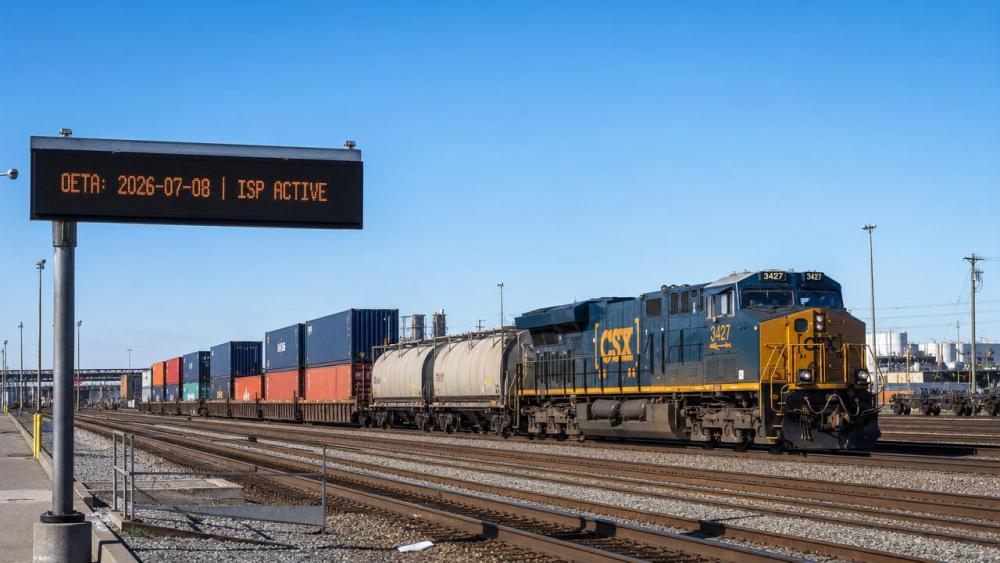
Beginning July 8, 2026, the U.S. Surface Transportation Board (STB) will require Class I railroads to publicly report two key operational metrics: Original Estimated Time of Arrival (OETA) and Industry Switching and Processing (ISP) data—on a weekly basis. This rule directly affects importers and supply chain stakeholders handling time-sensitive goods, particularly in the chemical raw materials, food additives, and cosmetic active ingredients sectors, where predictability of rail-delivered cargo is critical for inventory planning and just-in-time operations.
Event Overview
The U.S. Surface Transportation Board issued its final rule mandating that all Class I railroads submit weekly reports on Original Estimated Time of Arrival (OETA) and Industry Switching and Processing (ISP) data. The requirement takes effect on July 8, 2026. The STB confirmed this as the culmination of a four-year stakeholder process responding to shipper demands for greater transparency in rail performance metrics.
Industries Affected by the Rule
Direct Importers and International Traders
These entities rely on U.S. rail networks to move containerized or bulk raw materials from ports to inland destinations. With OETA and ISP data now standardized and disclosed, importers gain earlier visibility into potential delays at interchange points or classification yards—reducing uncertainty in customs clearance timing and warehouse intake scheduling.
Raw Material Procurement Teams (e.g., in Chemicals, Food & Cosmetics)
Procurement functions managing high-turnover, shelf-life-constrained inputs—such as preservatives, emulsifiers, or specialty solvents—face tighter margin for error when rail transit times shift unexpectedly. The new disclosure enables more accurate lead-time modeling and supports dual-sourcing or buffer-stock decisions based on actual rail performance—not historical averages alone.
Domestic Manufacturers Receiving Imported Inputs
Manufacturers dependent on imported intermediates for production lines may experience reduced unplanned downtime if inbound rail shipments arrive within predictable windows. More consistent arrival data helps align receiving dock labor, quality inspection capacity, and production line sequencing—especially where batch-based processing requires synchronized material flow.
Logistics Service Providers and 3PLs
Third-party logistics providers offering end-to-end visibility and managed rail coordination must now integrate STB-mandated OETA/ISP feeds into their TMS or control tower platforms. Failure to reflect real-time rail performance updates risks service-level agreement (SLA) exposure and undermines differentiated value propositions tied to predictive ETA accuracy.
What Stakeholders Should Monitor and Act On Now
Track STB’s official implementation guidance and reporting templates
The STB has not yet published detailed specifications for data format, submission deadlines, or public access mechanisms. Stakeholders should monitor STB’s website and Federal Register notices for technical instructions—particularly regarding how ‘original’ OETA is defined (e.g., whether it reflects initial carrier assignment or first yard release).
Identify high-impact origin–destination lanes and commodity codes
Not all rail corridors or commodities will see equal improvement in predictability. Early attention should focus on routes linking major gateways (e.g., Los Angeles/Long Beach, Savannah, Chicago) to industrial hubs serving chemical parks or FMCG manufacturing zones—and on tariff items classified under HTS chapters 29 (organic chemicals), 38 (miscellaneous chemical products), and 33 (cosmetic preparations).
Distinguish between regulatory signal and operational readiness
While the rule mandates reporting, actual data quality, frequency of updates, and integration with existing carrier APIs remain unconfirmed. Observably, early adoption may be uneven across railroads; stakeholders should treat initial disclosures as baseline indicators—not immediate benchmarks—for internal forecasting models.
Update procurement and inventory protocols ahead of July 2026
Import teams should revise internal SOPs to incorporate OETA/ISP data into weekly demand review cycles. This includes calibrating safety stock formulas, adjusting order triggers for rail-dependent SKUs, and aligning with carriers on exception-handling workflows when OETA deviations exceed predefined thresholds (e.g., ±12 hours).
Editorial Perspective / Industry Observation
This rule is better understood as a structural transparency milestone—not an immediate operational fix. Analysis shows it formalizes long-standing shipper advocacy but does not compel railroads to improve performance; rather, it increases accountability through disclosure. From an industry perspective, its primary near-term value lies in enabling comparative analysis across carriers and lanes, which could gradually influence commercial negotiations and routing decisions. However, meaningful impact on delivery reliability depends on consistent, auditable data publication—and sustained stakeholder engagement to interpret and act on it.
In summary, the STB’s OETA/ISP disclosure rule marks a step toward greater data parity in U.S. rail freight—but its practical utility for importers hinges less on the policy itself and more on how effectively downstream users integrate, validate, and operationalize the disclosed metrics. Current conditions suggest treating this as an evolving data infrastructure initiative, not a standalone solution to rail delay risk.
Source: U.S. Surface Transportation Board (STB) Final Rule Notice, published in the Federal Register; no additional sources cited. Ongoing observation is warranted for STB’s implementation timeline, data accessibility format, and railroad-specific compliance timelines—none of which have been finalized as of the rule’s publication date.
Related News
- 2026 Osong Cosmetics and Beauty Expo Concludes in South KoreaOct 26, 2026Prof. Elian Thorne
- How to compare cosmetic active compounds by their cost in useOct 26, 2026Prof. Elian Thorne
- HKBU Showcases DR2 Following NMPA Registration as a New Cosmetic IngredientOct 25, 2026Cosmeceutical Formulator
- How to use ingredient market insights to forecast sourcing costsOct 25, 2026Prof. Elian Thorne
Related News
- 00
0000-00
2026 Osong Cosmetics and Beauty Expo Concludes in South Korea - 00
0000-00
How to compare cosmetic active compounds by their cost in use - 00
0000-00
HKBU Showcases DR2 Following NMPA Registration as a New Cosmetic Ingredient - 00
0000-00
How to use ingredient market insights to forecast sourcing costs - 00
0000-00
Galderma Marks 30 Years of Hyaluronic Acid Injectable Innovation
Industry Global
Weekly Insights
Stay ahead with our curated technology reports delivered every Monday.