





On June 18, 2026, IFRA put its 2026 Q2 amendment into force, lowering the free formaldehyde release limit for microencapsulated fragrances to no more than 35 ppm from the previous 50 ppm. The change directly affects exporters, formulators, compliance teams, testing partners, and buyers involved in microencapsulated fragrance products for daily-use and food applications destined for the EU, the UK, Canada, Japan, and South Korea, because it links formulation review with immediate re-testing and CPNP/SCS compliance filing requirements.
What the amendment now requires
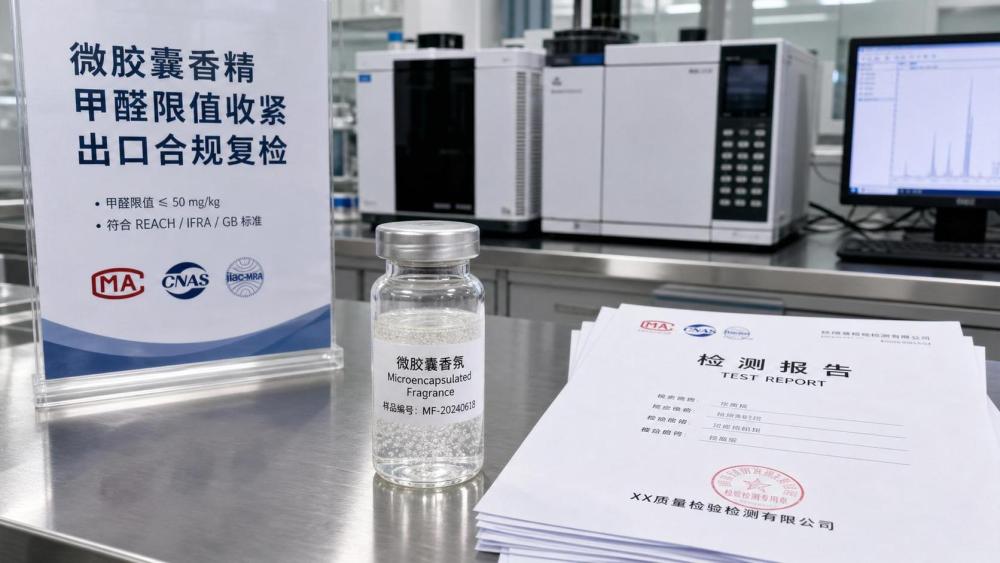
The confirmed change is that IFRA made its 2026 second-quarter revision mandatory on June 18, 2026. Under this revision, microencapsulated fragrances are subject to a new upper limit for free formaldehyde release of ≤35 ppm, compared with the previous 50 ppm threshold, representing a 30% tightening. The requirement applies to microencapsulated fragrance products in daily chemical and food-related applications exported to the EU, the UK, Canada, Japan, and South Korea. The summary provided also states that formula re-testing and CPNP/SCS compliance declarations must be completed with immediate effect.
Where the pressure is likely to appear first
Export-oriented formulation and manufacturing operations
These businesses are the most directly exposed because the revised limit applies to products already intended for external markets named in the event summary. The impact is likely to show up first in formulation verification, release testing, technical file review, and shipment readiness. From an industry perspective, what deserves closer attention is whether existing microencapsulated fragrance formulas can still support export plans without delay once re-testing is required.
Procurement and supplier management for fragrance inputs
Procurement teams and supplier managers may be affected because the rule change can alter what supporting compliance evidence is needed before purchase approval or replenishment. Analysis shows that companies handling microencapsulated fragrance products should pay close attention to updated test reports, supplier declarations, and the consistency of technical documents used for cross-border supply and internal compliance review.
Compliance filing and testing service workflows
Testing providers and teams responsible for declarations may see immediate workload changes because the event summary explicitly links the new threshold to re-testing and CPNP/SCS filing. The practical effect is less about general market sentiment and more about whether documentation, testing outputs, and filing materials remain aligned with the revised limit at the point of export or product notification.
Buyers, distributors, and delivery coordination
Buyers and downstream channel participants may also need to review product acceptance conditions where microencapsulated fragrance content is involved. Observably, the main concern is not only product specification compliance but also whether shipment documents, declaration materials, and product release timing still match the updated requirement in destination markets covered by the amendment.
What companies should review now
Re-testing should be treated as an immediate task
Because the summary states that formula re-testing is required with immediate effect, companies dealing in affected products should first identify which formulas, stock-keeping units, or export batches include microencapsulated fragrances and whether supporting test evidence still reflects the older 50 ppm benchmark rather than the new 35 ppm limit.
Compliance files need consistency across documents
For teams handling CPNP/SCS declarations, the current priority is document consistency. Analysis shows that attention should focus on whether test records, formulation descriptions, product compliance files, and submission materials use the same limit basis and the same product scope, especially where one formula is supplied to more than one export market named in the event summary.
Delivery schedules may need a compliance check
Where shipments are already scheduled, companies should closely review whether product release, customs-facing paperwork, customer submission packages, or internal approval gates depend on documents that may need updating after re-testing. It is more appropriate to understand this as a near-term execution issue rather than only a technical standard update.
Supplier communication should center on verifiable evidence
For businesses purchasing fragrance systems or outsourcing part of formulation and manufacturing, the practical focus should be on requesting verifiable test data and updated compliance support materials rather than relying on earlier approvals. The event summary does not provide detailed enforcement practice, so companies should avoid assuming that prior documentation will automatically remain sufficient.
Why this reads as an execution signal
Analysis shows that this development is best understood as a rule already in force rather than a distant policy direction. The combination of a tighter limit, defined market scope, and an immediate re-testing and filing requirement signals that affected companies should treat this as an operational compliance matter. At the same time, observably, there is still room for continued attention around how filing practice, customer acceptance criteria, and market-side documentation checks may develop in response to the new limit.
How the market may interpret the change
From an industry perspective, this update is less about broad policy messaging and more about the practical threshold for market access and shipment readiness in specified destinations. A neutral reading is that the amendment creates a clearer compliance line for microencapsulated fragrance exports, while leaving companies to manage the immediate work of re-testing, declaration alignment, and document control. It is more appropriate to understand this as an implemented compliance change with ongoing execution implications that still merit monitoring.
Basis of this article and what still needs verification
This article is generated from the user-provided news title, event date, and event summary. For developments of this kind, commonly relevant source types may include official notices, regulatory releases, customs or trade authority updates, industry association communications, standards organization documents, and reporting by authoritative trade media. No specific official source link was provided in the input, so the exact official publication path still requires follow-up verification. Continued attention should also be paid to any later clarification on detailed implementation language, certification or filing interpretation, procurement document updates, bid or specification changes, market feedback, and how companies are carrying out the required re-testing and compliance submissions.
Related News
- How to Choose Fragrance Ingredients for Diffusers That Stay Stable in Oil BasesAug 04, 2026Aromatics & Perfumery Fellow
- How to Choose Aroma Ingredients for Candles Based on Scent Throw and Wax CompatibilityAug 03, 2026Aromatics & Perfumery Fellow
- Home Diffuser Series Technical Guide for Fragrance BuyersJul 21, 2026Aromatics & Perfumery Fellow
- EU Bans More Microencapsulated Fragrance AllergensJul 16, 2026Aromatics & Perfumery Fellow
Related News
- 00
0000-00
How to verify compliance documents for cosmetic active compounds - 00
0000-00
How to verify food grade flavor formulation ingredients for safety - 00
0000-00
How to assess an anti-aging ingredients manufacturer’s batch consistency - 00
0000-00
How formulation tips prevent flavor separation in beverage applications - 00
0000-00
How biodegradable surfactants for laundry affect cold-water cleaning
Aromatics & Perfumery Fellow
Weekly Insights
Stay ahead with our curated technology reports delivered every Monday.