





Microencapsulated fragrances promise stronger shelf appeal, cleaner handling, and longer scent performance across modern consumer goods.
Yet many flavors & fragrances programs fail in-market because laboratory success does not always survive packaging, transport, humidity, friction, or time.
For product teams evaluating sensory ingredients, the real question is not whether encapsulation works.
The question is where performance gaps appear, how they affect visual appeal, and which checks prevent commercial disappointment.
This guide reviews the hidden weaknesses behind microencapsulated fragrances and explains how to judge stability, release, compatibility, and consistency more accurately.
What are microencapsulated fragrances, and why do they matter for shelf appeal?
Microencapsulated fragrances are aroma compounds enclosed inside small protective shells.
These shells can delay evaporation, reduce oxidation, and release scent through pressure, rubbing, moisture, or temperature change.
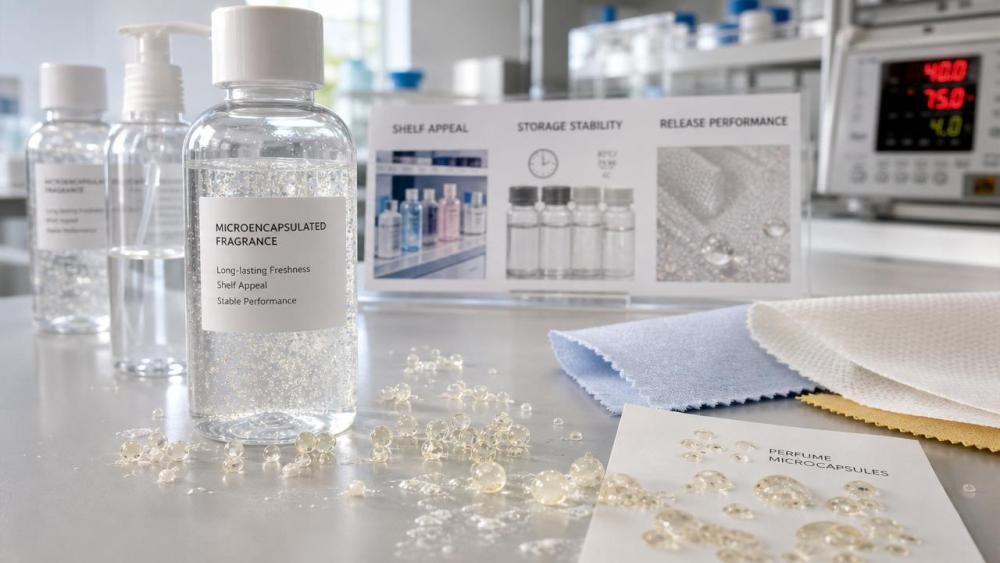
In flavors & fragrances applications, this technology supports detergents, fabric care, personal care, paper products, air care, and coated packaging.
Shelf appeal improves when the product looks stable and delivers a recognizable scent at first contact.
However, shelf appeal is not only about intensity.
It also depends on color retention, surface cleanliness, sediment control, and whether the fragrance remains true to the intended profile.
A product may smell strong in a sealed sample, yet disappoint on shelf because capsules break too early or fail to release when used.
That gap damages trust and weakens repeat purchase.
Why do some microencapsulated fragrances lose performance before consumers use the product?
Premature failure often begins with capsule integrity.
If wall materials are too brittle, mixing, pumping, or filling can rupture them during production.
If walls are too soft, volatile notes may slowly diffuse out during storage.
Temperature swings also matter.
Repeated heating and cooling can stress shell structures and accelerate fragrance migration into the base formula.
Humidity creates another problem, especially for hygroscopic substrates or water-sensitive encapsulation systems.
Over time, moisture may swell capsules, change release behavior, or trigger agglomeration.
In flavors & fragrances development, oxidation remains a hidden driver of shelf loss.
Even encapsulated oils can degrade when shell permeability is poorly matched to oxygen exposure.
Common early warning signs include:
- unexpected top-note fading
- oily rings or sweating near closures
- sediment, clumping, or floating particles
- off-notes after transit or warehouse storage
- strong package headspace but weak use-stage release
When these symptoms appear, the issue usually involves both formulation design and handling conditions.
How does substrate compatibility influence scent release and appearance?
Substrate compatibility is one of the most underestimated factors in microencapsulated fragrances.
A capsule that performs well in liquid detergent may behave poorly in dry wipes, powders, or coated paper.
Surface roughness, porosity, charge, moisture level, and binder chemistry can all alter adhesion and rupture behavior.
For example, highly absorbent substrates may trap fragrance molecules after capsule breakage.
This reduces bloom and weakens the sensory lift expected during opening or use.
Smooth surfaces create a different challenge.
Capsules may detach too easily, causing dusting, uneven distribution, or visible residue that harms shelf appeal.
In flavors & fragrances systems, pH and surfactant load are especially critical.
Aggressive surfactants can destabilize shell materials or strip fragrance from partially damaged capsules.
Compatibility checks should answer four practical questions:
- Does the capsule stay evenly dispersed during the product’s expected shelf life?
- Does the substrate keep capsules attached until the intended release moment?
- Does the shell survive contact with water, alcohol, surfactants, or salts?
- After release, does the substrate amplify or suppress the fragrance profile?
Without these checks, apparent fragrance strength may hide poor real-world transfer and weak consumer perception.
What testing methods reveal real performance gaps in flavors & fragrances programs?
Basic sniff testing is not enough.
Effective evaluation combines analytical data, stress simulation, and controlled sensory review.
First, check particle size distribution and shell morphology.
Large variation often predicts inconsistent deposition, release, and appearance.
Next, run accelerated stability studies under heat, cold, humidity, and light exposure.
A stable result at room temperature alone can be misleading.
Mechanical stress testing is equally important.
Mixing energy, pumping pressure, and filling shear should be replicated before scale-up.
For flavors & fragrances, release testing should also mirror the use event.
That may involve rubbing textiles, wetting tissues, heating surfaces, or compressing powder matrices.
Useful test framework:
The strongest programs compare fresh samples with aged samples under identical release conditions.
That comparison often exposes the biggest hidden performance gap.
Which selection mistakes create the biggest risk when comparing encapsulated fragrance options?
One common mistake is choosing based on fragrance load alone.
A higher oil content sounds attractive, but weak shells may erase that advantage before the product reaches market.
Another mistake is ignoring visual impact.
Capsule haze, sediment, whitening, or residue can reduce shelf appeal even when scent metrics look acceptable.
In flavors & fragrances, release trigger mismatch is also costly.
If the fragrance is designed for friction release, it may underperform in low-contact applications.
Another error involves overreliance on supplier data generated in simplified model systems.
Actual formulas may contain preservatives, salts, thickeners, or surfactants that change capsule behavior completely.
A practical comparison checklist includes:
- release trigger type and reliability
- stability in final formula pH range
- appearance in clear and opaque systems
- survival under process shear
- retention of top, heart, and base notes
- regulatory and labeling fit for target markets
Strong selection decisions balance sensory performance with formulation reality, packaging demands, and storage exposure.
How should teams judge cost, timeline, and implementation trade-offs?
Microencapsulated fragrances often carry a premium, but cost should be measured against outcome, not unit price alone.
A cheaper system may require higher dosage, extra stabilizers, or reformulation work that raises total cost.
Implementation time also varies.
Some systems integrate smoothly into existing mixing lines, while others demand process changes to reduce shear damage.
Packaging compatibility should not be postponed.
Closures, liners, and wall materials may absorb fragrance or create headspace distortion during storage.
For flavors & fragrances portfolios, the best implementation plan usually follows three stages:
- screen capsule candidates in the real base formula
- test under process, package, and climate stress
- validate sensory effect at launch-age, not only fresh fill
This approach shortens correction cycles and reduces expensive surprises after commercial release.
What quick FAQ points help identify likely failure modes earlier?
Microencapsulated fragrances can add meaningful shelf appeal, but only when technical promises survive commercial reality.
The most important gaps usually involve capsule integrity, substrate compatibility, trigger design, and storage stability.
In flavors & fragrances work, reliable decisions come from testing the full system, not the capsule alone.
Review shell behavior, formula interactions, package effects, and launch-age sensory output together.
That disciplined approach protects visual appeal, preserves fragrance value, and improves market consistency.
For the next evaluation cycle, build a screening plan around real storage conditions and real release moments.
That single step will reveal more than a dozen promising lab samples ever could.
Related News
- How to Choose Fragrance Ingredients for Diffusers That Stay Stable in Oil BasesAug 04, 2026Aromatics & Perfumery Fellow
- How to Choose Aroma Ingredients for Candles Based on Scent Throw and Wax CompatibilityAug 03, 2026Aromatics & Perfumery Fellow
- Home Diffuser Series Technical Guide for Fragrance BuyersJul 21, 2026Aromatics & Perfumery Fellow
- EU Bans More Microencapsulated Fragrance AllergensJul 16, 2026Aromatics & Perfumery Fellow
Related News
- 00
0000-00
2026 Osong Cosmetics and Beauty Expo Concludes in South Korea - 00
0000-00
How to compare cosmetic active compounds by their cost in use - 00
0000-00
HKBU Showcases DR2 Following NMPA Registration as a New Cosmetic Ingredient - 00
0000-00
How to use ingredient market insights to forecast sourcing costs - 00
0000-00
Galderma Marks 30 Years of Hyaluronic Acid Injectable Innovation
Aromatics & Perfumery Fellow
Weekly Insights
Stay ahead with our curated technology reports delivered every Monday.