





On 1 October 2026, global enforcement begins for IFRA’s updated restriction limits covering microencapsulated orange, lemon, and bergamot fragrances used in detergents and personal care. The change is drawing attention across fragrance supply, formulation, procurement, and quality control because it links market access more directly to encapsulation performance, analytical verification, and supplier audit readiness ahead of Q4 buying cycles.
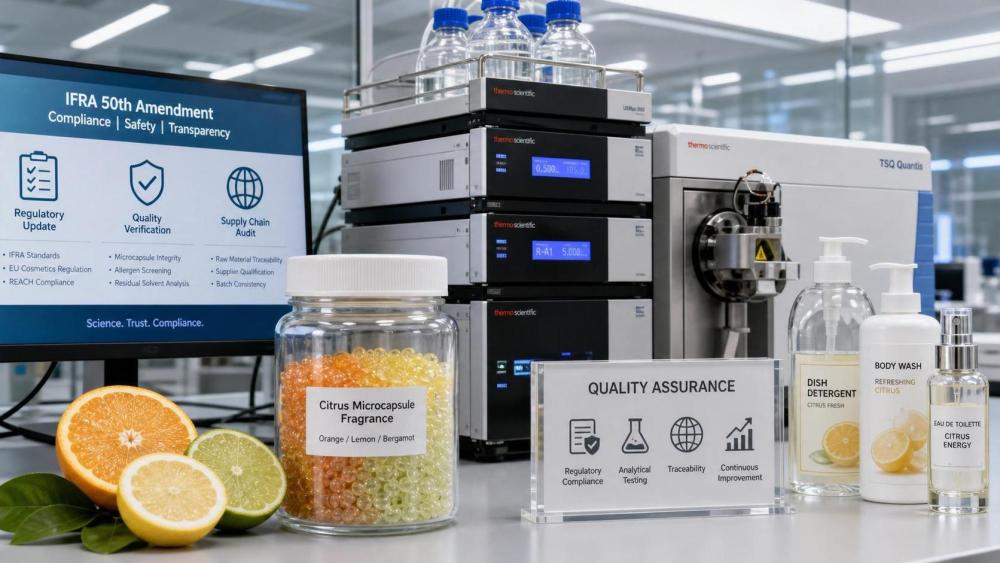
What the amendment now requires
According to the information provided, IFRA’s Standard Amendment 52, issued in July 2026, sets stricter release thresholds for limonene and D-limonene in microencapsulated citrus fragrances. The requirement applies to microencapsulated orange, lemon, and bergamot fragrances used in detergents and personal care products.
The stated technical benchmark is that capsules must demonstrate no more than 0.1% free limonene after encapsulation. Verification of that benchmark requires HPLC-MS. The same information also indicates that global buyers are expected to audit supplier encapsulation quality control protocols before Q4 procurement.
Where the pressure is likely to appear first
Fragrance and encapsulation suppliers face immediate proof demands
From an industry perspective, suppliers working with microencapsulated citrus fragrance systems may be affected first because the update focuses on post-encapsulation free limonene performance rather than only on fragrance selection. The main pressure point is likely to be quality documentation, analytical verification, and the ability to show that encapsulation controls can meet the new threshold.
Detergent and personal care manufacturers may need tighter supplier screening
Manufacturers using these fragrance capsules in finished products may be affected through raw material qualification and formulation sourcing decisions. What deserves closer attention is whether existing supplier files, technical documents, and release test evidence are sufficient for continued purchasing under the new enforcement timeline.
Procurement teams are pulled into technical compliance checks
For buyers, the update is not only a regulatory reading issue but also a purchasing workflow issue. The provided information explicitly points to supplier QC protocol audits before Q4 procurement, suggesting that commercial teams may need to align more closely with technical and quality functions during supplier review and order planning.
Testing and service functions become more central
Analysis shows that any role supporting HPLC-MS verification may become more important in the immediate implementation phase, because the threshold is tied to a specific analytical confirmation route. For service providers and internal labs, the operational focus is likely to be test readiness, method execution, and report credibility.
What companies should watch in practice
Check whether current citrus capsule lines fall within the named scope
Companies should first confirm whether their orange, lemon, or bergamot microencapsulated fragrances are used in detergents or personal care, since those are the categories explicitly mentioned in the provided information. This matters because the practical response depends on product scope, not on general fragrance exposure alone.
Review post-encapsulation evidence rather than relying on legacy specs
What deserves closer attention is the distinction between a general material specification and proof that free limonene remains at or below 0.1% after encapsulation. Businesses involved in sourcing or manufacturing should look closely at whether current technical files actually address the stated benchmark and whether HPLC-MS verification is available in usable documentation.
Audit supplier QC protocols before procurement windows tighten
The information provided highlights supplier encapsulation QC audits before Q4 procurement. In practice, that means companies should pay attention to audit timing, document completeness, and whether supplier controls can be explained clearly during customer or internal review. Delays here could affect purchasing decisions more quickly than broader strategic discussions.
Separate confirmed rule content from later interpretation
Observably, the confirmed facts are already specific on threshold direction, product scope, verification method, and buyer audit expectations. Companies should therefore distinguish between what is already stated and any later market interpretation, especially when communicating with customers, suppliers, or internal commercial teams.
Why this looks like more than a routine specification update
Analysis shows that this development is best understood as a technical compliance signal with immediate commercial consequences, rather than as a distant policy note. The key reason is that enforcement starts on a defined date and the requirement is tied to measurable post-encapsulation performance verified by HPLC-MS.
At the same time, it is more appropriate to understand this as an implementation-phase industry development rather than a fully settled long-term outcome. The provided information does not establish how broadly companies have already adapted, so continued attention is warranted around procurement execution, supplier readiness, and any further clarifications tied to the amendment’s application.
How the market may read the change for now
Based on the confirmed information, the immediate significance lies in the combination of stricter limonene control, a defined analytical benchmark, and buyer-side audit pressure before Q4 procurement. For the industry, this is less a general market narrative than a near-term operational checkpoint for fragrance capsules used in detergents and personal care.
A neutral reading is that the update should currently be treated as an actionable compliance and sourcing issue with wider strategic meaning still emerging. The strongest near-term focus remains documentation, verification, and supplier control, while longer-term market effects still need continued observation.
Basis of this article and follow-up verification
This article is based on the user-provided news title, event date, and event summary related to IFRA’s updated restriction limits for microencapsulated citrus fragrances. For this type of industry development, commonly relevant source categories may include official notices, industry association releases, company statements, standards organization documents, and reporting by authoritative trade media.
No specific official source link was provided in the input, so the exact original publication path still requires ongoing verification. Follow-up attention should remain on any official wording updates, implementation clarifications, and procurement-side audit expectations related to the stated 1 October 2026 enforcement start.
Related News
- How to Choose Fragrance Ingredients for Diffusers That Stay Stable in Oil BasesAug 04, 2026Aromatics & Perfumery Fellow
- How to Choose Aroma Ingredients for Candles Based on Scent Throw and Wax CompatibilityAug 03, 2026Aromatics & Perfumery Fellow
- Home Diffuser Series Technical Guide for Fragrance BuyersJul 21, 2026Aromatics & Perfumery Fellow
- EU Bans More Microencapsulated Fragrance AllergensJul 16, 2026Aromatics & Perfumery Fellow
Related News
- 00
0000-00
2026 Osong Cosmetics and Beauty Expo Concludes in South Korea - 00
0000-00
How to compare cosmetic active compounds by their cost in use - 00
0000-00
HKBU Showcases DR2 Following NMPA Registration as a New Cosmetic Ingredient - 00
0000-00
How to use ingredient market insights to forecast sourcing costs - 00
0000-00
Galderma Marks 30 Years of Hyaluronic Acid Injectable Innovation
Aromatics & Perfumery Fellow
Weekly Insights
Stay ahead with our curated technology reports delivered every Monday.