





On July 7, 2026, the US FDA finalized guidance with immediate effect on the GRAS reconsideration path for certain amino acid surfactants, bringing a clearer compliance threshold into focus for oral care and rinse-off cosmetics. For formulators, importers, Chinese suppliers, procurement teams, and documentation-driven compliance functions, the immediate issue is not only the rule text itself but how product use levels, supplier files, and supporting toxicology materials now align with the updated FDA position.
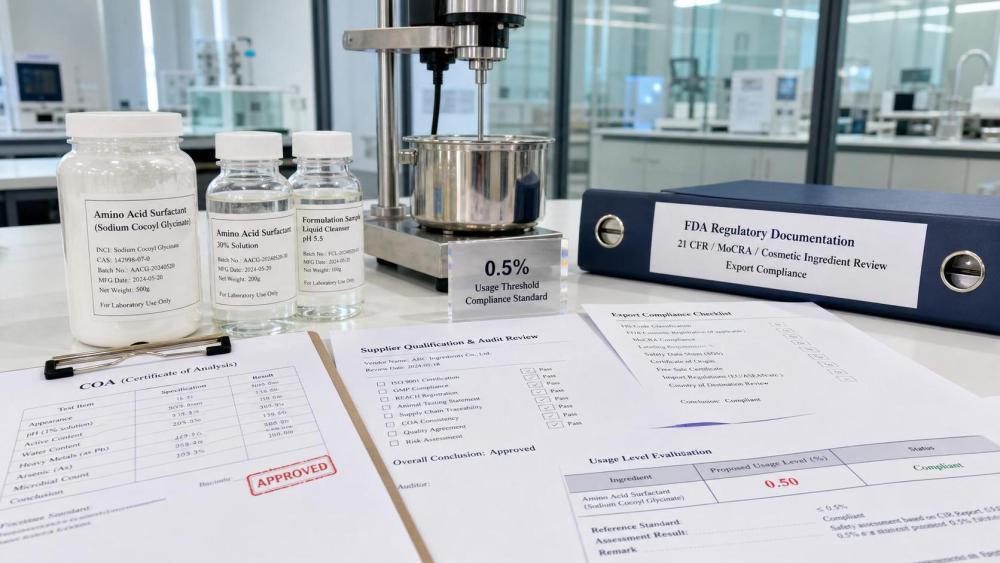
What the final FDA guidance now clarifies
FDA’s Center for Food Safety and Applied Nutrition (CFSAN) released final guidance stating that sodium lauroyl sarcosinate and sodium cocoyl glutamate require updated GRAS notifications when they are used above 0.5% in oral care or rinse-off cosmetics. The guidance takes immediate effect. The event summary also makes clear that overseas formulators importing from China must validate supplier GRAS dossiers against newly referenced exposure-assessment thresholds and toxicological endpoints.
Where the pressure will likely appear first in the supply chain
Imported formulation programs face a documentation check first
From an industry perspective, overseas formulators importing from China are likely to feel the change first because the guidance directly points to validation of supplier GRAS dossiers. The practical impact is concentrated in formula review, supplier onboarding, technical file verification, and import-related compliance preparation. What deserves closer attention is whether existing supplier materials still match the updated exposure-assessment thresholds and toxicological endpoints referenced by the new guidance.
Chinese suppliers may see tougher buyer-side technical screening
Analysis shows that suppliers providing these two surfactants into export-oriented formulation chains may face more detailed requests from customers for dossier support, use-level context, and toxicology-related substantiation. The immediate commercial effect is less about a new trade ban and more about whether supplier documentation is sufficient for customer review under the finalized FDA position. This can affect quotation review, specification confirmation, and pre-shipment document readiness.
Procurement and compliance teams may need to revisit product scope
For procurement functions and internal compliance teams, the change is relevant because the 0.5% use threshold is now an explicit trigger point in the guidance summary provided here. That means raw material selection, formula approval, and supplier qualification may need to be checked together rather than treated as separate steps. In practice, the key concern is whether current purchasing plans involve applications that move above that level and therefore require updated GRAS notification support.
What companies should review now
Check whether use levels cross the clarified threshold
Analysis shows that companies using sodium lauroyl sarcosinate or sodium cocoyl glutamate in oral care or rinse-off cosmetics should first identify where product formulations exceed 0.5%. This is a threshold-based issue, so the initial compliance review should be tied to actual formulation use rather than broad category assumptions.
Re-verify supplier GRAS files against the updated FDA framing
What deserves closer attention is whether existing GRAS dossiers already address the exposure-assessment thresholds and toxicological endpoints referenced in the guidance summary. If the current file set was built to an earlier interpretation, companies may need to reassess document completeness before relying on it for imports, customer submissions, or internal release decisions.
Prepare for tighter requests in technical and trade documents
Observably, the finalized guidance may lead to more detailed document requests across specification review, technical questionnaires, and supplier qualification files. The input does not provide a full execution mechanism, so it would be premature to describe a settled market practice. Still, companies should pay attention to whether customers, import-side reviewers, or compliance teams begin asking for updated wording, revised toxicology support, or clearer GRAS status confirmation.
Watch delivery planning where compliance review can delay release
From an industry perspective, the immediate-effect language matters for planning even where no shipment disruption has yet been confirmed in the input. Where formulas, supporting files, and import compliance checks need to be revalidated, procurement timing and delivery schedules may come under pressure. This is best treated as a review risk that companies should monitor closely rather than a confirmed outcome.
Why this reads as an execution signal, not just a policy note
Analysis shows that this development is better understood as a live compliance signal because the FDA guidance is final and described as taking immediate effect. At the same time, the available facts do not establish how consistently market participants, customers, or downstream reviewers will apply the new thresholds in day-to-day transactions. For that reason, it is more appropriate to understand this as a rule clarification with immediate practical relevance, while still leaving room to observe how documentation expectations and review standards settle in execution.
How the market should read this development for now
The industry meaning of this update lies in its effect on the interface between formulation decisions and dossier-based compliance. It does not merely restate a general regulatory principle; it identifies specific substances, a specific use threshold, and a concrete need to revalidate GRAS support where imports from China are involved. At this stage, the most balanced reading is that the change has already landed as an actionable compliance requirement, while the full pace of implementation across procurement, trade review, and customer acceptance still warrants close observation.
Basis of this article and points that still need verification
This article is generated from the user-provided news title, event date, and event summary. For developments of this type, relevant source categories typically include official regulatory releases, notices issued by supervisory authorities, trade or customs-related updates, industry association communications, standard-setting documents, and reporting by established professional media. A specific official source link was not provided in the input, so that point still requires follow-up verification. Observably, further attention should remain on any later policy detail, enforcement interpretation, certification or documentation practice, tender-file wording, industry feedback, and company-level execution responses.
Related News
- When does amino acid surfactant powder improve cleanser mildness?Oct 05, 2026Surfactant Chemistry Architect
- When to Seek Shampoo Formulation Support for Foam, Mildness, or Stability IssuesAug 07, 2026Surfactant Chemistry Architect
- FDA Tightens GRAS Data Requirements for Amino Acid SurfactantsJul 20, 2026Surfactant Chemistry Architect
- Amino Acid Surfactant Prices Rise on Coconut Oil TightnessJul 15, 2026Surfactant Chemistry Architect
Related News
- 00
0000-00
2026 Osong Cosmetics and Beauty Expo Concludes in South Korea - 00
0000-00
How to compare cosmetic active compounds by their cost in use - 00
0000-00
HKBU Showcases DR2 Following NMPA Registration as a New Cosmetic Ingredient - 00
0000-00
How to use ingredient market insights to forecast sourcing costs - 00
0000-00
Galderma Marks 30 Years of Hyaluronic Acid Injectable Innovation
Surfactant Chemistry Architect
Weekly Insights
Stay ahead with our curated technology reports delivered every Monday.